

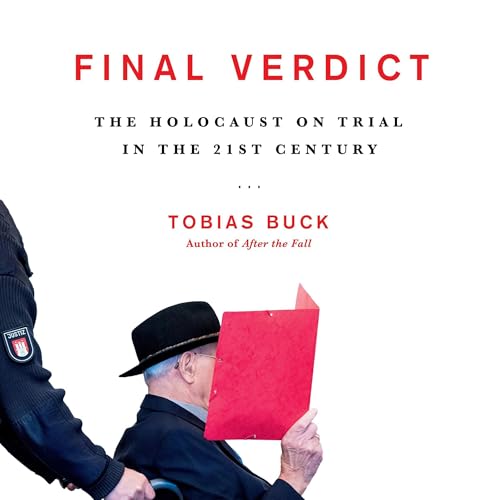
Final Verdict
The Holocaust on Trial in the 21st Century
Failed to add items
Sorry, we are unable to add the item because your shopping cart is already at capacity.
Add to Cart failed.
Please try again later
Add to Wish List failed.
Please try again later
Remove from wish list failed.
Please try again later
Follow podcast failed
Unfollow podcast failed
Audible Standard 30-day free trial
Select 1 audiobook a month from our entire collection of 900K+ titles.
Listen to your selected audiobooks as long as you're a member.
Get unlimited access to bingeable podcasts.
Standard auto-renews for $8.99/mo + applicable taxes after 30 days. Cancel anytime.

Final Verdict
Narrated by:
Leighton Pugh
Buy Now for $34.39
-
Narrated by:
-
Leighton Pugh
-
Written by:
-
Tobias Buck
About this listen
Bruno Dey's trial formed part of an extraordinary series of Holocaust cases brought by German prosecutors in recent years in a belated attempt to deliver justice to the victims and reverse decades of judicial neglect. It also surfaced at a pivotal moment for Germany and its thinking about the Holocaust. The Nazi genocide continues to occupy a crucial space in German public life, but many of the country's long-held certainties and convictions around the Holocaust are starting to fray. This reflects in part the passage of time, and the fact that the last surviving witnesses—victims and perpetrators alike—are rapidly fading away.
But it’s also the result of profound changes in German politics and society. The far-right has made electoral gains and is openly challenging the country’s historic commitment to Holocaust remembrance. At the same time, there is a small but vociferous group of intellectuals on the left who question Germany’s memory culture from a different angle, asking what political lessons the country should draw from the Holocaust today. What does it mean for the country’s new Muslim citizens from Syria and Afghanistan, many of whom arrived with their own traumas, to be expected to assume the nation’s guilt?
Final Verdict investigates questions that touch on German history, politics, and memory culture, and on the author’s own family history. Buck revisits the silence that surrounds his own family’s experiences and conduct during the Nazi period. In the face of rising anti-Semitism in Germany, the United States, and globally, Final Verdict examines the case for Holocaust justice in the twenty-first century—and the lessons that Germany's struggle with its Nazi past holds for the world today.
What the critics say
"Final Verdict is a thrilling read. It is a book that raises a myriad of fascinating questions and human dramas, beautifully constructed and enticingly written."
—Philippe Sands, author of East West Street and The Ratline
—Philippe Sands, author of East West Street and The Ratline
"Through a riveting account of the trial of ninety-three-year-old Bruno Dey, a guard at Stutthof concentration camp...'the smallest of small cogs' in the SS hierarchy, Buck compellingly shows how history is always present, never past."—Catrine Clay, author of The Good Germans
No reviews yet