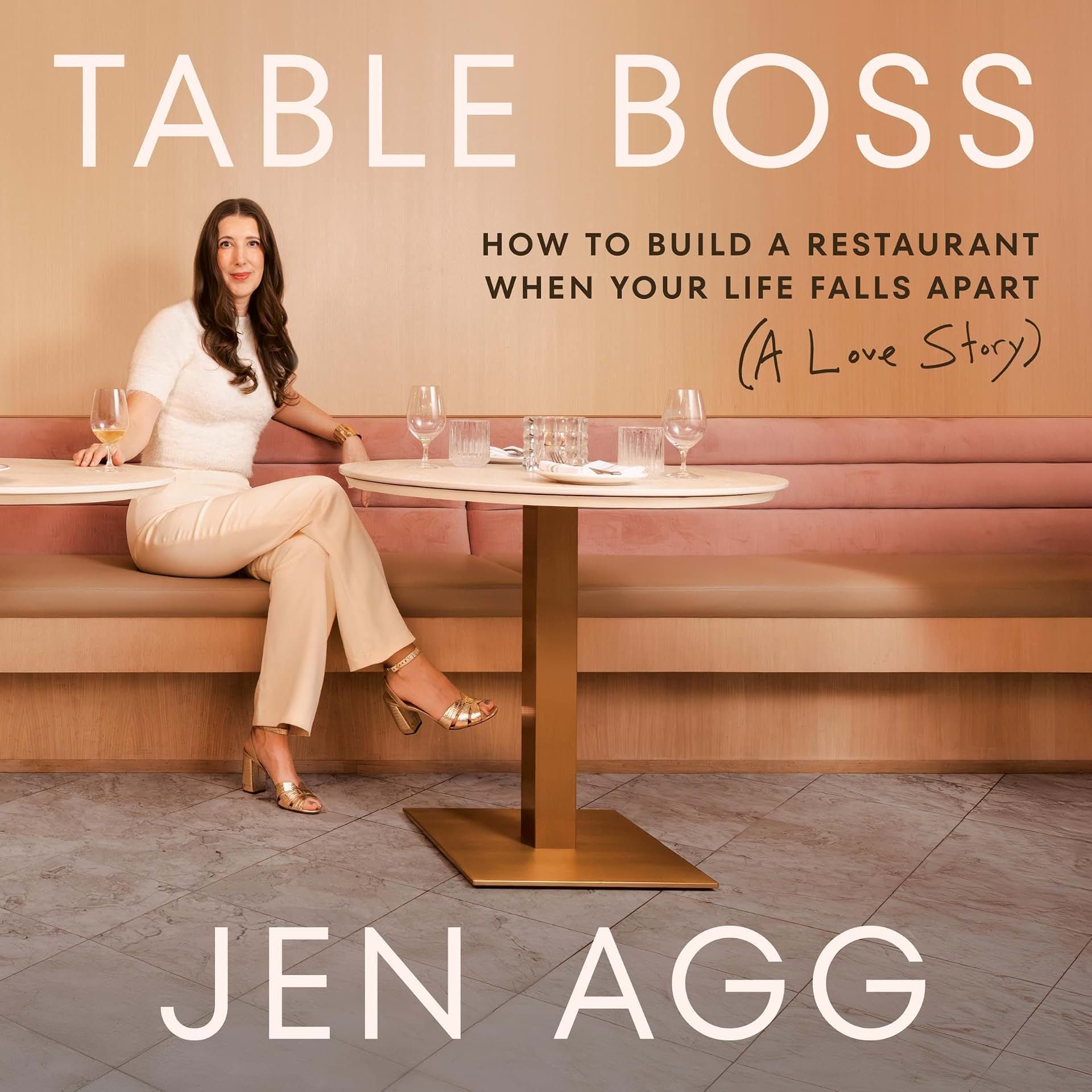



In the time since Toronto restaurateur Jen Agg narrated her bitingly funny first memoir, I Hear She's a Real Bitch, life's been a bit of one, too. Between her husband's catastrophic stroke and a global pandemic that decimated the industry she obsessively built her life around, Agg's been going through it. Fortunately for us, she's returned to voice her new memoir, Table Boss, an intimate window into what it's like to be a 40-something woman navigating a world that laughs while you make plans, written with equal parts hilarity, honesty, and impeccable taste.
Jerry Portwood: You’ve described Table Boss as a "love story." Is it a love story for your husband, your career, or the city of Toronto? All of the above?
Jen Agg: I meant it in the romantic sense, but I see how it's actually all of the above. I'd probably put it a little differently: my love of making restaurants, making books, and, of course, my husband. The city is fine, it's home, but love feels like too strong a word at the moment.
You are known for your honesty when speaking out. Why is that important to you?
Why is being honest important to me? I just don't know a different way to be! I mean, obviously I don't ever want to be unnecessarily cruel to people, but telling the truth feels essential to a well-lived life of comfort in one's own skin. And that means telling yourself the truth, too; that is the most important part.
A running, witty motif in this memoir is your obsession with the details—specifically, "good lighting" and creating a flawless, controlled room even when life is a complete mess. Did bringing the public into your very personal crisis feel like a risk?
I'm not sure I think about risk in that way. The catharsis of digging through my mess of feelings around a crisis is always tantamount. And ignoring that, what could possibly be a risk after including a line drawing of my naked body in I Hear She's a Real Bitch? Which I probably described in hilarious detail in the audiobook, not that I can bring myself to listen, but I'm told it's good!
Anthony Bourdain was a major champion of your first book. In Table Boss, you write about rebuilding when the old magic of the industry has shifted. What did you learn from Anthony Bourdain?
As much as I respected Tony, I didn't see myself as a disciple and appreciated that he always spoke to me as an equal, so I don't know that I can say I learned anything specific, especially about restaurants. I deeply admired his openness about all people, his curiosity, and his ability to really listen. He was a wonderful and articulate storyteller, which is, in my opinion, deeply linked with listening well.
How does your vision of restaurant leadership challenge the kitchen-centric perspective that Bourdain and others popularized?
As important as delicious food is, has always been and will always be, restaurants are about feelings! A large part of what makes people feel good and want to actively return to the same places, repeatedly, is warm hospitality. The vibes of a room also play a huge role—are you being flatteringly lit while you're trying to Shazam the great song that's playing? Are you surrounded by interesting things to look at? Are you comfortable? So, I for one am thrilled to hear so many people in the restaurant business (even chefs) talk about this, after decades of “kitchen gods” bullshit. I think Tony respected my opinion around this even if he didn't dogmatically believe it. I wish we could ask him.
People (and the media) are often obsessed with "shiny new things." Can you explain the "middle-aged restaurant," and why are you adamant that Torontonians need to save them?
Restaurants tend to only get better with a few operational years under their belts. Things are dialed in, small staffing changes don't cause major upheaval because systems and a strong team are in place, the food is more consistent, and put quite simply, restaurants that survive that long are likely doing a lot of things right. So, I am a big fan of middle-aged restaurants and want to see them get the protection and love they deserve.
What is next for you?
A little break, I hope! It has been (and continues to be) a very intense year of too many spinning plates!