

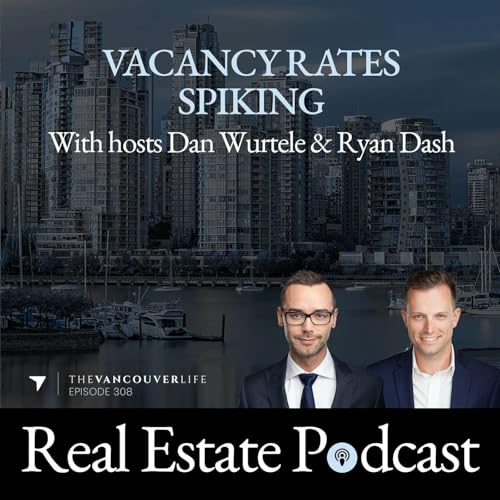
Vacancy Rate Hits 37 Year High As Record Number Of Rentals Are Coming To Market
Échec de l'ajout au panier.
Échec de l'ajout à la liste d'envies.
Échec de la suppression de la liste d’envies.
Échec du suivi du balado
Ne plus suivre le balado a échoué

Vacancy Rate Hits 37 Year High As Record Number Of Rentals Are Coming To Market
-
Narrateur(s):
-
Auteur(s):
À propos de cet audio
As we close out 2025, the data coming across the wire is some of the most consequential Canada has seen in decades—and it is quietly rewriting the playbook for real estate in 2026. For the first time in modern history, Canada’s population is shrinking, not growing. At the same time, rental vacancy rates are climbing to multi-decade highs, rents are falling, developers are pulling back, and interest rates are no longer clearly on a path down. And yet, in what feels like a contradiction, headline employment, GDP, and inflation continue to beat expectations. In this episode, we unpack how these cross-currents collide—and what they mean for housing prices, investors, homeowners, and anyone facing a buy, sell, or mortgage renewal decision in the year ahead.
The most important shift begins with population. Canada’s population fell by roughly 76,000 people in Q3, a 0.2% quarterly decline and the largest contraction on record outside of pandemic border closures. Annual population growth has slowed to just 0.2%, the lowest level ever recorded. This reversal is almost entirely driven by non-permanent residents—foreign students and temporary workers—who accounted for nearly all population growth between 2022 and 2024. That trend has now flipped.
Canada lost 176,000 non-permanent residents in a single quarter, bringing their share of the population down to 6.8%, with federal policy targeting closer to 5% by 2027. For housing, this is seismic. The demand tailwind that drove rents, prices, and pre-sales for years has disappeared just as housing completions and rental construction approach record levels. The result is straightforward: softer rents, rising developer inventory, and growing caution among investors—a dynamic that may not fully bottom out until 2027.
Rental data confirms the shift. Vancouver one-bedroom rents are down 8% year-over-year, national rents have fallen to their lowest level since mid-2023, and vacancy rates have surged. Vancouver’s purpose-built vacancy rate reached 3.7%, the highest since 1988, while Toronto hit 3% for the first time since the pandemic. Importantly, the largest wave of rental completions is still ahead. While falling rents offer short-term relief, they also widen the monthly gap between renting and owning—pushing some Canadians toward renting longer. Yet the long-term wealth divide remains stark when comparing long term outcomes between homeowners’ median net worth (on average 10 to 19 times higher than renters’) - depending on age group. Short-term affordability and long-term wealth creation are moving in opposite directions.
Housing supply tells a similar story of imbalance. National housing starts are uneven, single-family construction is shrinking, and major B.C. markets—including Vancouver—continue to slow. National home prices have fallen 21% from their 2022 peak, returning to 2017 levels in real terms. In Greater Vancouver, benchmark prices are set to fall for a tenth straight month, ending the year near three-year lows.
Taken together, this is not a crisis—but it is a reset. 2026 is shaping up to be a year defined less by momentum and more by discipline, selectivity, and long-term strategy. And for those paying attention, the data isn’t just noise—it’s a market signal.
Join the webinar: www.laidlercapital.com/emptynesters?ref=thevancouverlife
_________________________________
Contact Us To Book Your Private Consultation:
📆 https://calendly.com/thevancouverlife
Dan Wurtele, PREC, REIA
604.809.0834
dan@thevancouverlife.com
Ryan Dash PREC
778.898.0089
ryan@thevancouverlife.com
www.thevancouverlife.com