

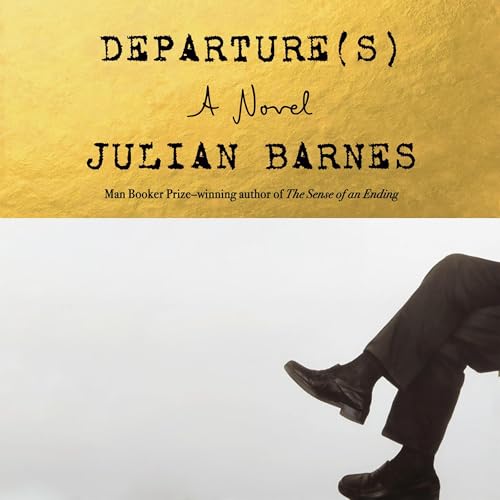
Departure(s)
A Novel
Échec de l'ajout au panier.
Veuillez réessayer plus tard
Échec de l'ajout à la liste d'envies.
Veuillez réessayer plus tard
Échec de la suppression de la liste d’envies.
Veuillez réessayer plus tard
Échec du suivi du balado
Ne plus suivre le balado a échoué
1 mois d'essai gratuit à Audible Standard
8,99 $/mois à la fin de l’essai. Annulation à tout moment.

Departure(s)
Narrateur(s):
Julian Barnes
Acheter pour 23,84 $
-
Narrateur(s):
-
Julian Barnes
-
Auteur(s):
-
Julian Barnes
À propos de cet audio
“A culmination . . . shimmering with [Barnes’s] silky, erudite prose; beneath the suave surface is an earnest investigation into the mysterious ways of the human heart.” —The Atlantic
Shortly after our narrator, a writer named Julian, begins this compact book by discussing the workings of involuntary memory, he interrupts himself with a bulletin to the reader: "There will be a story—or a story within the story—but not just yet.”
Of course, whether Departure(s) is mostly fiction or not, there is a lot of its author in it, including Barnes's reckoning with the blood disorder he has been living with since he was diagnosed in 2020, his long preoccupation with dying and grief, and his mordant sense of the indignities and lost opportunities we're prey to in love. The story he promises to deliver is a love story, that of two friends he met at university in the 1960s, that time of touted but rarely experienced sexual freedom. Julian played matchmaker to Stephen (tall, gangling, uncertain) and Jean (tart and attractive); as the third wheel he was deeply invested in the success of their love and insulted when they broke up. Time is swift, and forty years later, he tries again, watching as their rekindled affair produces joys, betrayals, and disappointments of a different order.
"Life and memory can be so . . . quixotic, don't you find?" Barnes uses both his novelistic memory and his (real?) personal diary entries to examine not just the quixotic relationship of Jean and Stephen but his writer's eye upon it, and how his efforts in their behalf add up in the end. Having promised them he'd never write about them, he breaks the promise to fulfill one, amply, to his readers, in this delightful and poignant novelist’s game that only Julian Barnes knows how to play.
Great material for Woody Allen
Un problème est survenu. Veuillez réessayer dans quelques minutes.
Like spending a long weekend with a friend.
Un problème est survenu. Veuillez réessayer dans quelques minutes.