

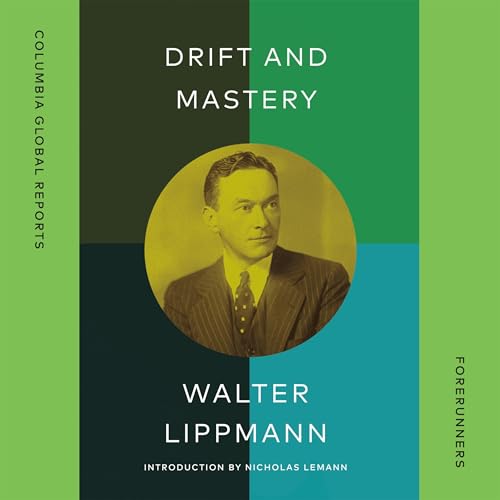
Drift and Mastery
Échec de l'ajout au panier.
Veuillez réessayer plus tard
Échec de l'ajout à la liste d'envies.
Veuillez réessayer plus tard
Échec de la suppression de la liste d’envies.
Veuillez réessayer plus tard
Échec du suivi du balado
Ne plus suivre le balado a échoué
30 jours d'essai gratuit à Audible Standard
Choisissez 1 livre audio par mois dans notre collection contenant plus de 900 000 titres.
Écoutez les livres audio que vous avez sélectionnés tant que vous êtes membre.
Profitez d’un accès illimité à des balados incontournables.
L'abonnement Standard se renouvelle automatiquement au tarif de 8,99 $/mois + taxes applicables après 30 jours. Annulation possible à tout moment.

Drift and Mastery
Narrateur(s):
Lee Osorio
Acheter pour 23,84 $
-
Narrateur(s):
-
Lee Osorio
-
Auteur(s):
-
Walter Lippman
-
Nicholas Lemann - introduction
À propos de cet audio
In Drift and Mastery, a twenty-five-year-old Walter Lippmann surveyed what he saw as the chaos of newly industrial America and dreamed of a bold new future. Published in 1914, at the height of the Progressive Era, this audacious manifesto diagnosed the spiritual and political confusion of a nation grappling with unbridled capitalism, mass immigration, and the collapse of old certainties. Rejecting the sentimental populism of William Jennings Bryan and the moralizing of Woodrow Wilson, Lippmann embraced Theodore Roosevelt’s “New Nationalism,” envisioning a society led not by profiteers but by trained experts—scientists, managers, and professionals working for the common good.
More than a period piece, Drift and Mastery is striking in its embrace of centralized knowledge, its optimism about reform, and its blind spots about power. Nicholas Lemann’s incisive introduction places the book alongside the contemporary work of thinkers like John Dewey and W. E. B. Du Bois while highlighting its relevance in an age of populist backlash and elite mistrust. Lippmann’s flawed but fearless vision challenges us to rethink democratic leadership today.
Pas encore de commentaire