

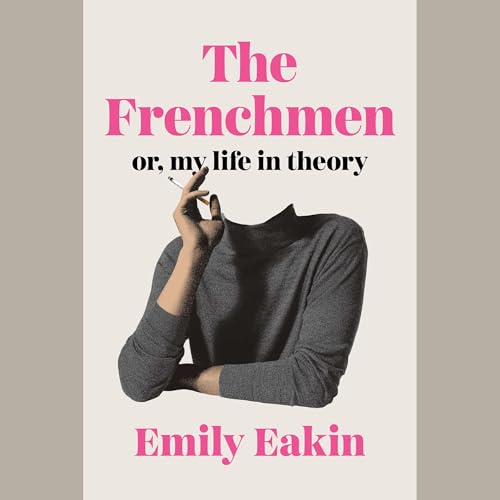
The Frenchmen
Or, My Life in Theory
Échec de l'ajout au panier.
Veuillez réessayer plus tard
Échec de l'ajout à la liste d'envies.
Veuillez réessayer plus tard
Échec de la suppression de la liste d’envies.
Veuillez réessayer plus tard
Échec du suivi du balado
Ne plus suivre le balado a échoué
Choisissez 1 livre audio par mois dans notre incomparable catalogue.
Accès illimité à notre catalogue d'écoute à volonté de plus de 15 000 livres audio et balados
L'abonnement Premium Plus se renouvelle automatiquement au tarif de 14,95 $/mois + taxes applicables après 30 jours. Annulation possible à tout moment.

The Frenchmen
Précommander pour 30,86 $
-
Narrateur(s):
-
Auteur(s):
-
Emily Eakin
À propos de cet audio
When Emily Eakin arrived at Harvard in the late 1980s, she fell under the spell of an eclectic body of philosophical texts by a handful of French authors. This was French theory, a set of recondite ideas that had taken American campuses by a storm during the preceding decades. In retrospect, the influence of these men and their writings seems both extraordinary and improbable. The Frenchmen argued that language is all-powerful, meaning unstable, and the self is an illusion. Their prose was brilliant, dazzling even, but often mystifyingly elaborate and highly abstract. Yet American students and scholars flocked to their books and lectures, intoxicated by a powerful new means of understanding—and perhaps even changing—the world. For Eakin, an unsophisticated graduate of a small-town Midwestern high school, theory was no mere intellectual exercise but a way of being—a heady shortcut to worldly glamour and wisdom.
The Frenchmen is the story of Eakin’s youthful love affair with French theory, alongside a wider examination of its rise and fall. Looking closely at Jacques Derrida, Louis Althusser, Roland Barthes, Gilles Deleuze, Michel Foucault, Félix Guattari, Jacques Lacan, and the French-speaking Belgian Paul de Man, Eakin untangles their famously difficult works with peerless, delightful clarity. What’s more, she brings to light the eccentric, scandalous—at times criminal!—lives of thinkers who themselves were often highly averse to biography, in a daringly original weave of storytelling and exegesis.
As she explores the magnetism of their work, Eakin illuminates not just the Frenchmen’s enduring legacy but some of today’s deepest political, social, and intellectual arguments. She neither rejects nor flatters the Frenchmen’s ideas but instead reveals how they indelibly changed our understanding of power, truth, and identity. Eakin shows how, for better or worse, the Frenchmen continue to shape and unsettle our lives today.
Pas encore de commentaire