

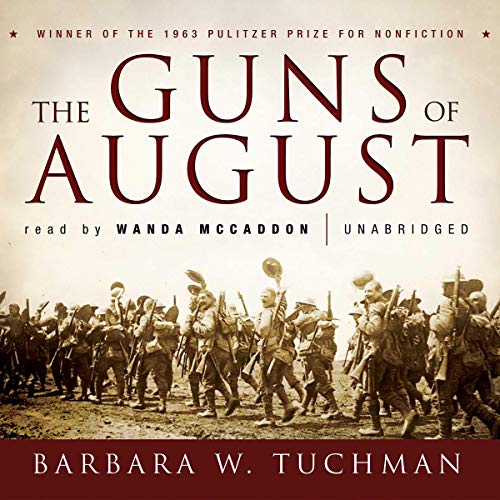
The Guns of August
Échec de l'ajout au panier.
Échec de l'ajout à la liste d'envies.
Échec de la suppression de la liste d’envies.
Échec du suivi du balado
Ne plus suivre le balado a échoué
30 jours d'essai gratuit à Audible Standard

The Guns of August
Acheter pour 29,96 $
-
Narrateur(s):
-
Wanda McCaddon
-
Auteur(s):
-
Barbara W. Tuchman
À propos de cet audio
Tuchman masterfully portrays this transition from 19th to 20th Century, focusing on the turning point in the year 1914: the month leading up to the war and the first month of the war. With fine attention to detail, she reveals how and why the war started, and why it could have been stopped but wasn't, managing to make the story utterly suspenseful even when we already know the outcome.
©1990 Dr. Lester Tuchman (P)2005 Blackstone Audio, Inc.Ce que les critiques en disent
"More dramatic than fiction...a magnificent narrative - beautifully organized, elegantly phrased, skillfully paced...The product of painstaking and sophisticated research." (Chicago Tribune)
Great book, might be better in physical version
Un problème est survenu. Veuillez réessayer dans quelques minutes.
I read (for the second time, after many years) Guns of August in preparation for reading Maragaret MacMillan’s Paris 1919 (The Peacemakers), the account of the peace process at the end of World War I, which created the conditions for the Second World War, and helped to shape the world of today.
Tuchman tracks the decisions (and equivocations and indecisions, the surrender to inevitability or military necessity) made by politicians and generals, and examines their characters, and failures of character, in brilliant, brief portraits. The story is a litany of failures: failures of vision, failures of decision making, of politics and diplomacy, failures of will, failures of conscience.
She does not examine what happened to Austria Hungary and Serbia after the first few hours that started the war, but this is on purpose. Tuchman’s project is to understand why a local dispute between these two countries led Germany to invade Belgium and France, and what happened immediately after, focusing mostly on the conflict in western Europe.
Tuchman describes Germany’s explicit acts of terror against civilians in Belgium and France as a conscious policy of control. France’s suicidal offensive military philosophy of elan. Britain’s indecisivenss on entering (and staying in) the war (which continues to today - see Ferguson’s The Pity of War). Russian leadership’s vast corruption and ineptitude (which also continues to today). Many of the main characters do not come off well. The German Kaiser, his capricious arrogance and selfishness. Joffre’s implacable certainty. John French’s collapse of will in the fog of war.
I have read some of the criticisms of this book by modern historians, but the overall arc is still valid and certainly well told.
For all of their willingness, even eagerness, to go to war, the generals and politicians were woefully unprepared for the consequences, and did not understand how war had fundamentally changed in a world of industrial scale technologies.
Modern military historians argue that by the Somme (1916) the military combatants had (finally) learned what heavy artillery and machine guns could do, and had developed improved (but still horrifically wasteful) tactics, but Tuchman looks at the first months of the war when generals in their chateaux continued to order reckless mass charges (the French, in their bright coloured uniforms) against entrenched defensive positions leading to hundreds of thousands of unnecessary casualties in a few weeks.
Such a terrible waste of life, of value, of potential, for the sake of imperial honour and ambition.
I plan to read Christopher Clark’s The Sleepwalkers to get an updated perspective on the same material, but I would still recommend Guns of August.
A master class in narrative history
Un problème est survenu. Veuillez réessayer dans quelques minutes.
Can't believe this happens only 100 years ago!
Un problème est survenu. Veuillez réessayer dans quelques minutes.
Guns of August
Un problème est survenu. Veuillez réessayer dans quelques minutes.
Accurate window into past events
Un problème est survenu. Veuillez réessayer dans quelques minutes.