

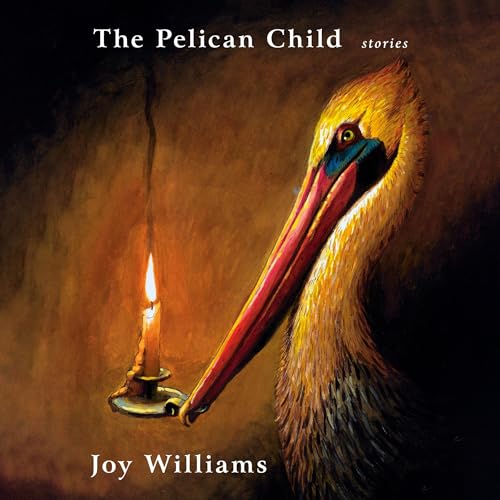
The Pelican Child
Stories
Échec de l'ajout au panier.
Veuillez réessayer plus tard
Échec de l'ajout à la liste d'envies.
Veuillez réessayer plus tard
Échec de la suppression de la liste d’envies.
Veuillez réessayer plus tard
Échec du suivi du balado
Ne plus suivre le balado a échoué
0,00 $ pour vos 30 premiers jours
OFFRE D'UNE DURÉE LIMITÉE
0,99 $/mois pendant vos 3 premiers mois
L'offre prend fin de 29 janvier 2026 à 23 h 59, HP.
Vos 3 premiers mois d'Audible à seulement 0,99 $/mois
1 nouveauté ou titre populaire à choisir chaque mois – ce titre vous appartiendra.
L'écoute illimitée des milliers de livres audio, de balados et de titres originaux inclus.
L'abonnement se renouvelle automatiquement au tarif de 0,99 $/mois pendant 3 mois, et au tarif de 14,95 $/mois ensuite. Annulation possible à tout moment.
Choisissez 1 livre audio par mois dans notre incomparable catalogue.
Écoutez à volonté des milliers de livres audio, de livres originaux et de balados.
L'abonnement Premium Plus se renouvelle automatiquement au tarif de 14,95 $/mois + taxes applicables après 30 jours. Annulation possible à tout moment.

The Pelican Child
Narrateur(s):
Xe Sands, Roger Wayne, Cynthia Farrell, John Pirhalla
Acheter pour 25,70 $
-
Narrateur(s):
-
Xe Sands
-
Roger Wayne
-
Cynthia Farrell
-
John Pirhalla
-
Auteur(s):
-
Joy Williams
À propos de cet audio
“An American master is back with crystalline stories that map the personal and political minefields of her unmoored characters. Williams blends everyday dramas with surreal imagery, her voice and range inspiring awe.” —Boston Globe
“Night was best, for, as everyone knows, but does not tell, the sobbing of the earth is most audible at night.” “Men are but unconscious machines and they perform their cruelties so effortlessly.” “Caring was a power she’d once possessed but had given up freely.” The sentences of Joy Williams are like no other—the coiled wit, the sense of a confused and ruined landscape, even the slight chortle of hope that lurks between the words—for the scrupulous effort of telling, in these eleven stories, has a ravishing beauty that belies their substance. We meet lost souls like the twin-sister heiresses of a dirty industrial fortune in “After the Haiku Period,” who must commit a violent act in recompense for their family's deeds; in “Nettle,” a newly grown man who still revolves in a dreamscape of his childhood boarding-school innocence; the ghost of George Gurdieff, on an obsessive visit to the Arizona birthplace of the shining Susan Sontag; the “pelican child” who lives with the bony, ill-tempered Baba Yaga in a little hut on chicken legs.
All of these characters insist on exploring, often at their peril, an indifferent and caustic world: they struggle against our degradation of the climate, of each other, and of honest human experience (“I try to relate only to what is immediately verifiable,” says one narrator ruefully), possibly in vain. But each brief, haunted triumph of understanding is celebrated by Williams, a writer for our time and all time.
Pas encore de commentaire