

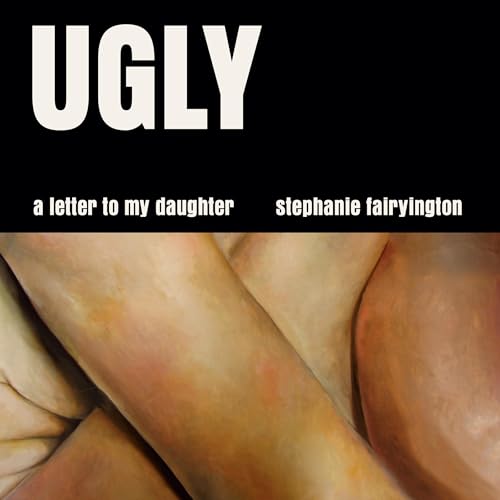
Ugly
A Letter to My Daughter
Échec de l'ajout au panier.
Veuillez réessayer plus tard
Échec de l'ajout à la liste d'envies.
Veuillez réessayer plus tard
Échec de la suppression de la liste d’envies.
Veuillez réessayer plus tard
Échec du suivi du balado
Ne plus suivre le balado a échoué
Choisissez 1 livre audio par mois dans notre incomparable catalogue.
Accès illimité à notre catalogue d'écoute à volonté de plus de 15 000 livres audio et balados
L'abonnement Premium Plus se renouvelle automatiquement au tarif de 14,95 $/mois + taxes applicables après 30 jours. Annulation possible à tout moment.

Ugly
Narrateur(s):
Stephanie Fairyington
Précommander pour 28,65 $
-
Narrateur(s):
-
Stephanie Fairyington
-
Auteur(s):
-
Stephanie Fairyington
À propos de cet audio
“A rigorous ladyballs-out polemic that also tells the most raw, tender, against-all-odds story of parenthood that I've ever read.” —Mary Gaitskill, author of Veronica
Ugly is a word with fangs that can kill a woman’s self-esteem in one bite. Edicts about how women should look, behave, and think are the brutal forge through which they are made — not born — as Simone de Beauvoir famously argued in The Second Sex. And to defy the pretty imperative is to experience a kind of invisibility. It can be a hard thing to admit to yourself, let alone to your child, to say the words “I am ugly” or “I am seen as ugly.” But early on in her motherhood journey, watching her young daughter begin to wrestle with beauty standards, Stephanie Fairyington felt compelled to face her own demons and to unpack her own ugly self-perception, one that she could trace to her own childhood, in order to conquer this seemingly immoveable frontier, far too taboo even among women to broach: the ways in which women’s lives are unfairly contoured by the nature of their looks.
The multiple iterations of ugliness that Fairyington saw in her young self—her physical appearance, her formative gender dissonance, and obvious lesbianism—are not present in her beautiful and traditionally feminine daughter. But Fairyington’s old feelings of inadequacy take on new meaning as she confronts fresh insecurities around her role as the nonbiological mother in her relationship, exacerbating wounds from a lifetime of being treated differently, from the poverty of her genetic inheritance to questions about her parentage to doubts about the legitimacy of her family.
Interlacing cultural history and analysis with memoir, Ugly is a probing investigation into cultural norms and the formation of our aesthetic sense of self. Fairyington contrasts her so-called ugliness with her daughter’s attractiveness and adherence to beauty ideals, a tender and tenuous condition that her daughter was already walking a tightrope to maintain at age six. By sharing the history of her troubled self-image, Fairyington invites us to go rogue, to invent a new language and logic to overthrow all the ways that women have been cultivated to hate themselves.
Ce que les critiques en disent
“As a bittersweet ode to hope and a consideration of ugliness as a tool of resistance, Ugly has a powerful grace.” —Andi Zeisler, Salon
“[A] bold debut.”—The Millions
“Ugly is beautiful, a rigorous ladyballs-out polemic that also tells the most raw, tender, against-all-odds story of parenthood that I've ever read. Steph Fairyington and her family are quietly heroic in their will to have what most people are able to take for granted, a warm and loving family unmolested by the blithe incomprehension and cruelty of social norms—particularly the often random norms regarding beauty. Reading it made me sad and outraged anew at the damage that can be done to women, starting in childhood, when they don't conform to what we decree is beauty, no matter how beautiful they actually are.”—Mary Gaitskill, author of Veronica
“A penetrating, courageous, loving, and deeply moving exploration of girlhood, womanhood, motherhood, and selfhood.”—Stephanie Coontz, author of For Better and Worse: The Complicated Past and Challenging Future of Marriage
“A polemic, a memoir, and an important addition to the feminist canon, Ugly is a beautiful book and I am so incredibly glad it exists.”— Molly Jong-Fast, author of How to Lose Your Mother
“Stephanie Fairyington displays a keen intellect and a warm inclusive heart as she takes on the looks-based oppression of women and girls in this endearing letter to her young daughter. Although we are all still plagued by the idea of female imperfection, Ugly brings some hope that there are ways to resist lookism—and is a story and analysis sorely needed.”—Joan Jacobs Brumberg, author of Fasting Girls: The History of Anorexia Nervosa
“What I love about the way Stephanie Fairyington takes ownership of ugliness is the freedom it opens up for uncertainty, unlearning, and reinventing—everything from the family and mother-child knots, to cruelty, femininity, anxiety, and normality. She has a talent for vulnerability and a stunning, startling voice.”—Laura Kipnis, author of Against Love: A Polemic
“Ugly is a beautiful book—read it!” —E. Jean Carroll, author of Not My Type: One Woman vs. a President
“Valiant and audacious. . . . Through reflections on parenthood, LGBTQ+ historical context, and biting reprovals of American culture, Fairyington’s concerns for her impressionable offspring are valid, sharp, and urgent, yet eloquently conveyed in this hybrid of maternal love letter and cautionary counsel.”—Kirkus, starred review
“This maternal manifesto makes a major impression.”—Publishers Weekly
“[A] bold debut.”—The Millions
“Ugly is beautiful, a rigorous ladyballs-out polemic that also tells the most raw, tender, against-all-odds story of parenthood that I've ever read. Steph Fairyington and her family are quietly heroic in their will to have what most people are able to take for granted, a warm and loving family unmolested by the blithe incomprehension and cruelty of social norms—particularly the often random norms regarding beauty. Reading it made me sad and outraged anew at the damage that can be done to women, starting in childhood, when they don't conform to what we decree is beauty, no matter how beautiful they actually are.”—Mary Gaitskill, author of Veronica
“A penetrating, courageous, loving, and deeply moving exploration of girlhood, womanhood, motherhood, and selfhood.”—Stephanie Coontz, author of For Better and Worse: The Complicated Past and Challenging Future of Marriage
“A polemic, a memoir, and an important addition to the feminist canon, Ugly is a beautiful book and I am so incredibly glad it exists.”— Molly Jong-Fast, author of How to Lose Your Mother
“Stephanie Fairyington displays a keen intellect and a warm inclusive heart as she takes on the looks-based oppression of women and girls in this endearing letter to her young daughter. Although we are all still plagued by the idea of female imperfection, Ugly brings some hope that there are ways to resist lookism—and is a story and analysis sorely needed.”—Joan Jacobs Brumberg, author of Fasting Girls: The History of Anorexia Nervosa
“What I love about the way Stephanie Fairyington takes ownership of ugliness is the freedom it opens up for uncertainty, unlearning, and reinventing—everything from the family and mother-child knots, to cruelty, femininity, anxiety, and normality. She has a talent for vulnerability and a stunning, startling voice.”—Laura Kipnis, author of Against Love: A Polemic
“Ugly is a beautiful book—read it!” —E. Jean Carroll, author of Not My Type: One Woman vs. a President
“Valiant and audacious. . . . Through reflections on parenthood, LGBTQ+ historical context, and biting reprovals of American culture, Fairyington’s concerns for her impressionable offspring are valid, sharp, and urgent, yet eloquently conveyed in this hybrid of maternal love letter and cautionary counsel.”—Kirkus, starred review
“This maternal manifesto makes a major impression.”—Publishers Weekly
Pas encore de commentaire