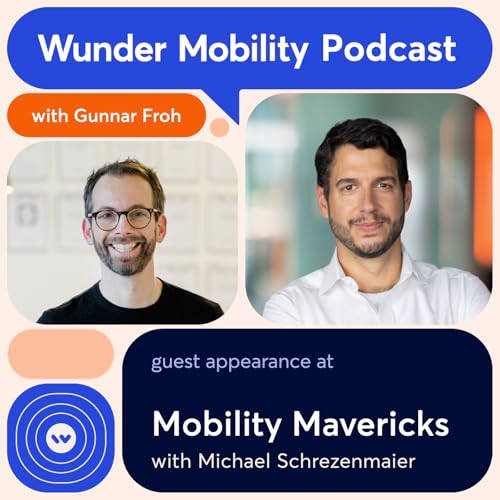
Page de couverture de #67 Michael Schrezenmaier, Host @Mobility Mavericks Podcast, Partner at Incharge Capital

#67 Michael Schrezenmaier, Host @Mobility Mavericks Podcast, Partner at Incharge Capital

#67 Michael Schrezenmaier, Host @Mobility Mavericks Podcast, Partner at Incharge Capital

Écouter gratuitement

Voir les détails du balado

À propos de cet audio

In this special German-language episode, Gunnar Froh (Founder & CEO, Wunder Mobility) joins Michael Schredlmeir for an in-depth conversation on where shared mobility is heading as the market matures and autonomous vehicles begin to reshape the value chain. They unpack what most end users never see: the operational and technical complexity required to make vehicle sharing feel simple and reliable. Beyond the app interface, the heavy lifting happens in backend systems and integrations with many different vehicle types—covering access control, billing, payments, user management, fleet operations (maintenance, repositioning, in-/out-fleeting), and pricing logic. A central theme is that shared mobility still lives and dies by “availability”—matching supply and demand at street level—while operators increasingly move toward more sophisticated levers such as subscriptions, loyalty, and revenue management. A major thread is how autonomy changes the economics. If vehicles can reposition themselves, service levels can improve while fleet sizes (and therefore costs) potentially decrease—shifting the industry toward higher utilization and better unit economics. Gunnar also outlines why the market has remained fragmented: mobility is operationally local and highly regulated, with local advantages often outweighing global network effects. As autonomous fleets scale, Gunnar expects further convergence between carsharing and ride-hailing, with specialized operators acting as fulfillment partners while customer-facing platforms focus on loyalty, bundling, and distribution. Finally, the discussion zooms out: while AVs are a major development, many European cities will continue prioritizing public transport and two-wheelers for efficient urban movement. The episode touches on how modern operators are improving bike-sharing economics through better operations, refurbishment, and smarter commercialization models—showing that profitability is increasingly achievable when execution and data capabilities are strong.
Pas encore de commentaire