

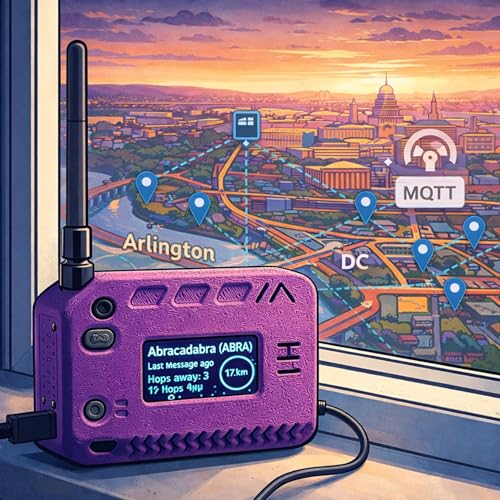
Becoming an Always-On Meshtastic Router by Accident
Échec de l'ajout au panier.
Échec de l'ajout à la liste d'envies.
Échec de la suppression de la liste d’envies.
Échec du suivi du balado
Ne plus suivre le balado a échoué

Becoming an Always-On Meshtastic Router by Accident
-
Narrateur(s):
-
Auteur(s):
À propos de cet audio
I didn’t come to Meshtastic with a plan.
I bought a cheap purple device off Etsy for about fifty-five dollars because I’d heard the word a few times and vaguely understood it meant LoRa mesh messaging. I wasn’t a prepper. I’m not a ham. I didn’t have a scenario in mind. The buy-in was low enough that curiosity won.
I live on the 8th floor in Arlington Heights, with windows facing southeast. From that height, there’s a clear line of sight over a golf course and across low-rise terrain toward the Gaylord MGM. That’s not a metaphor or a thought experiment. It’s just geography. If you’re going to put a radio somewhere, elevation and openness matter.
So I plugged it in and turned it on.
At first, it behaved like a gadget. I paired it with my phone. Sent a few test messages. Watched nodes appear and disappear. It worked, which was reassuring, but nothing about it felt consequential. Traffic was sparse. Most activity looked like people checking in, not routing through.
I left it on.
That turned out to matter more than anything I did deliberately.
Over time, it became clear that Meshtastic doesn’t reward interaction. It rewards presence. Nodes that come and go don’t contribute much beyond their own visibility. Nodes that stay up quietly start to matter in ways that aren’t obvious from the app.
Eventually, I changed the device role from node to router. Not out of altruism, but because the device was stationary, wall-powered, and well-placed. Letting it sleep made no sense. A sleeping radio with good placement is just wasted capacity.
That’s where the friction started.
Router mode changes how the device behaves. Power management becomes aggressive. Bluetooth access becomes opportunistic instead of persistent. From the phone’s perspective, it feels unreliable. From the network’s perspective, it’s doing exactly what it should.
There was a stretch where Bluetooth access felt broken. It wasn’t. The control plane was sleeping while the radio stayed active. Once I connected over USB and adjusted the settings with that in mind, the behavior made sense. Deep sleep off. Bluetooth given more patience. The display left on, because power wasn’t scarce.
Once that was done, the device became boring.
And boring is the goal.
Around the same time, the local Arlington / MeshDC area started showing more consistent LongFast traffic. More ACKs. More multi-hop messages. Nodes sticking around instead of flickering in and out. Not because of anything I personally changed, but because more devices were staying online, placed well, and allowed to just exist.
I chose the handle ABRA. Originally short for Abraham. That felt too personal. Now it’s Abracadabra, which fits better. I connected the node to MQTT so it appears on the global map, which is still quietly astonishing. A little purple radio in a window, visible via the modern web, routing messages it doesn’t need to read.
Most of the coordination, discussion, and culture happens elsewhere anyway. Discord. Reddit. The meta layer. The mesh itself just moves packets.
What I learned wasn’t radio theory or emergency planning. It was simpler.
Meshtastic works best when you stop treating nodes like personal devices and start treating them like infrastructure. Infrastructure doesn’t demand attention. It needs uptime, placement, and restraint.
I didn’t set out to build anything. I just left something on in a good place.
Everything else followed.