OFFRE D'UNE DURÉE LIMITÉE | Obtenez 3 mois à 0.99 $ par mois

14.95 $/mois par la suite. Des conditions s'appliquent.
Page de couverture de Consultants Saying Things

Consultants Saying Things

Consultants Saying Things

Auteur(s): Chris Lockhart
Écouter gratuitement

À propos de cet audio

We saw the need for some direct talk about some of the topics we’re encountering in daily work as business and technology practitioners. This is everything you wanted to know... the REAL deal... about consulting. We talk about the stuff that our clients care about and that consultants everywhere deal with every day. This podcast is about business, people, technology and the intersection of the three. Check out the website or Youtube channel for more stuff.Chris Lockhart Économie
Épisodes
  • Episode 83: The 2025 Christmas Special
    Jan 2 2026

    Happy Christmas! The Consulting model is totally collapsing! Well, perhaps it is just the traditional consulting pyramid business model that is being disrupted. Check out this episode for 5 things you need to know about it...


    We Discuss:

    • Can AI do all the consulting work, making consultants obsolete?
    • What happens to the consulting pyramid structure when AI eliminates junior analyst roles?
    • How can consulting firms maintain revenue when they need fewer billable bodies?
    • Where will future consultants get their experience if there are no entry-level positions?
    • Is this disruption happening now or is it still years away?


    5 Takeaways:

    1. AI is fundamentally disrupting the traditional consulting pyramid model where one person can now output what previously required five people, forcing firms to reconsider their staffing structures and revenue models that have relied on billable bodies for over a century (00:02:03 - 00:08:15).
    2. The consulting industry is shifting from task specialization to end-to-end problem-solving, where consultants must now handle everything from analytics to implementation and training, rather than just creating plans and recommendations then walking away (00:12:16 - 00:12:59).
    3. Firms will need to pivot from time-and-materials billing to outcomes-based pricing models because clients won't accept invoices for AI agents processing data for hours, forcing a fundamental change in how consulting services are valued and sold (00:14:40 - 00:15:21).
    4. The traditional entry-level analyst role is disappearing, creating a career pipeline problem where firms can't sustain the pyramid structure if they have no junior intake, potentially making industry experience the new entry point rather than coming straight from college (00:23:41 - 00:25:18).
    5. AI may actually save consulting by eliminating the burnout-inducing grind work, allowing the industry to focus on what consultants should truly do—provide human judgment, industry expertise, and strategic thinking—while AI handles data processing and analytical tasks (00:25:18 - 00:29:27).


    Article referenced in this episode: https://www.linkedin.com/pulse/not-so-quiet-collapse-consulting-pyramid-dave-clark-icg5e

    Voir plus Voir moins
    37 min
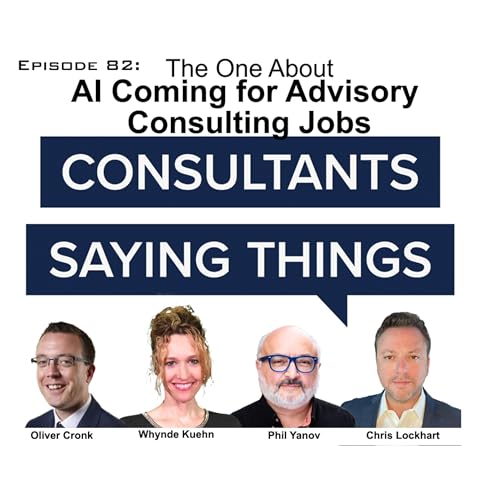
  • The One About AI Coming for Advisory Consulting Jobs
    Dec 30 2025

    With AI, the consulting industry faces an existential crisis beyond technical roles. Traditional strategy and advisory work is now threatened. Check out this episode for 5 takeaways to help you navigate this change... We Discuss:

    • What are consulting firms actually selling in the age of AI?
    • Is "strategy through execution" enough going forward, or do consultants need to provide something more?
    • Will consulting shift from human meetings to AI-integrated platforms?
    • How can consultants avoid becoming commoditized like bank tellers or gas station attendants?
    • What role does the human element play as AI capabilities expand?

    5 Takeaways:

    1. AI is creating a bifurcation in consulting where top performers must shift from selling frameworks and thinking to delivering concrete outcomes and accountability that clients can't get from AI tools alone.
    2. The human element of consulting—building trust, providing emotional support through change, and making clients feel valued—remains critical because people remember how you made them feel more than what you told them.
    3. Consultants who survive the AI disruption will be those who know which strategic questions to ask and where to apply their expertise, rather than those who can be replaced by increasingly sophisticated automation.
    4. The consulting industry risks commoditization as AI handles lower-value work like slide creation and report generation, forcing professionals to move up the value chain to strategic advisory roles.
    5. Future consulting may fundamentally shift from human-to-human meetings to AI-integrated collaborative platforms where advisory insights are embedded directly into the documents and tools clients use daily.


    Stories mentioned in the discussion:

    • https://www.linkedin.com/posts/james-o-dowd_a-month-ago-i-highlighted-that-accentures-activity-7341911790261297153-Txpo?utm_source=share&utm_medium=member_desktop&rcm=ACoAAABb6A4B6Bfgr3O3JnrFYNVBjrqyKshAVKc
    • https://www.ft.com/content/a1a5c903-0a24-4c42-aae0-f86e04c06910
    • https://furtheradvisory.com/insights/what-a-successful-advisory-firm-looks-like-in-2026/


    Voir plus Voir moins
    33 min
  • The One About Selling Architecture Consulting
    Sep 9 2025

    It's hard to sell 'architecture' consulting gigs since people frequently don't know what it means or what they're gonna get for their money. Check out this episode for 5 takeaways to help you get better at selling architecture...

    This is our first ever LIVE podcast recording at the BCS Enterprise Architecture Annual Conference in 2024.

    We Discuss:

    • How do you build trust early in EA engagements when you don't have established relationships?
    • What's the most important thing to leave behind when a consulting engagement ends - artifacts or wisdom?
    • Should architecture be primarily an internal function or can it be effectively outsourced?
    • How do you sell abstract EA work through procurement processes that expect concrete deliverables?
    • What engagement models work best for EA consulting?

    5 Takeaways:

    1. Enterprise architecture consulting faces unique sales challenges because it delivers intangible, strategic value rather than concrete deliverables, making it difficult to quantify benefits and navigate procurement processes that expect specific technical roles.
    2. Building trust is fundamental to EA consulting success since you're essentially "selling insurance" for long-term organizational health, requiring consultants to meet clients where they are rather than imposing predetermined frameworks.
    3. The most effective approach combines a strong internal architecture core team with external consultants who act as "adaptable architects" or "Swiss Army knives," supporting the organization's journey rather than replacing internal capability.
    4. Successful EA engagements should leave clients empowered with both tangible assets (playbooks, knowledge bases) and intangible wisdom, positioning consultants as trusted advisors who build client capability rather than creating dependency.
    5. The key to overcoming EA's abstract nature is connecting all work directly to business outcomes and strategy, using assessment and questioning to understand the real problems before proposing solutions.

    Voir plus Voir moins
    42 min
Pas encore de commentaire