Épisodes

  • Arad's Revolution: The End of State Socialism
    Oct 31 2025

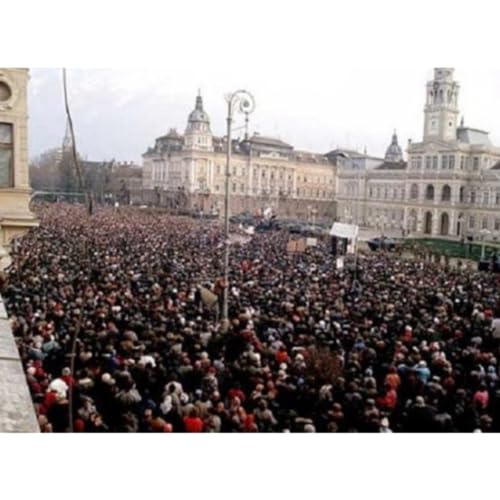
    This chapter written by Lehoczky Attila, from the book "In the Labyrinth of Hope" translated into English by Gabriel Roman, offers an overview of the 1989 Romanian Revolution in the city of Arad, focusing on the period from December 20 to December 25. The author highlights that the revolutionary environment was influenced by the strict state regime and external factors, specifically mentioning broadcasts from Hungarian media featuring figures like former King Mihai I and pastor László Tőkés. The account divides the events in Arad into a period of peaceful protests followed by military clashes, detailing the initial worker demonstrations led by figures like Valentin Voicilă and the subsequent formation of the Romanian Democratic Front. The source further documents the violent period following the escape of Nicolae Ceaușescu, which involved confrontations between revolutionaries and elements of the former regime, resulting in fatalities, and also examines the concurrent spontaneous self-organization of the Hungarian community and the establishment of the local branch of the Hungarian Democratic Union of Romania (UDMR). Free download books in Romanian and English about the history of Arad from the digital library here: https://www.arad.zone/biblioteca-digitala/biblioteca-digitala-copy

    Voir plus Voir moins
    15 min
  • Post-War Hungarian Press in Arad: Jövő and Vörös Lobogó
    Oct 31 2025

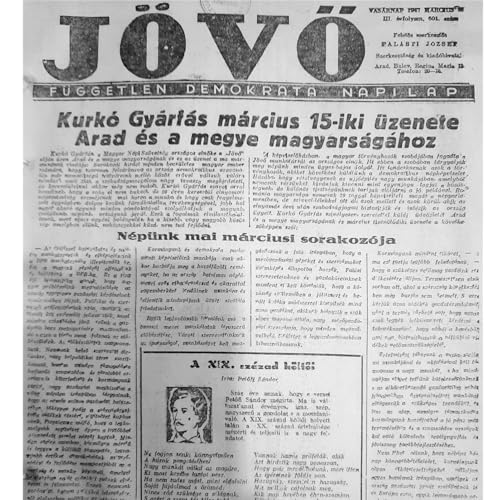
    This chapter from the book „In the Labyrinth of Hope” written by Puskel Péter, translated into English by Gabriel Roman details the tumultuous development of the press in Arad, Romania, following the end of World War II. It focuses heavily on the establishment and evolution of Hungarian-language newspapers, particularly the daily Patriotul and its eventual replacement, Jövő (The Future), which later became Vörös Lobogó (Red Flame). The source carefully documents how the press was quickly seized upon by the emerging Communist Party to promote its anti-fascist and later Bolshevik agenda, noting the rapid shift toward political and editorial control marked by intense censorship and "purges" of staff. It also outlines the technical difficulties faced by journalists and printers, who operated with salvaged, antiquated equipment, all while attempting to satisfy a post-war hunger for news despite increasing governmental restrictions. Free download books in Romanian and English about the history of Arad from the digital library here: https://www.arad.zone/biblioteca-digitala/biblioteca-digitala-copy

    Voir plus Voir moins
    13 min
  • Communist Consolidation and Arad Administration (1944-1958)
    Oct 31 2025

    The provided chapter in the book „In the labyrinth of hope” written by Király András and translated into English by Gabriel Roman, offers a detailed historical account of the city of Arad, Romania, focusing on the period of transition following World War II and the subsequent establishment of the communist regime. It documents the sweeping political, administrative, and economic changes that occurred, including the rise of the Romanian Workers' Party and the nationalization of industries and institutions. A significant portion of the material analyzes the daily struggles of the city's inhabitants, such as chronic shortages, rampant inflation, inadequate public services (like heating and sanitation), and efforts to restore order. Furthermore, the source provides an extensive overview of the Hungarian minority's organizational efforts through the Hungarian People's Union (MNSZ/UPM), detailing its political maneuvering and eventual subjugation to communist directives. This source thus chronicles Arad's painful shift from post-war disorder toward solidified communist control, highlighting both national policies and their local impact. Free download books in Romanian and English about the history of Arad from the digital library here: https://www.arad.zone/biblioteca-digitala/biblioteca-digitala-copy

    Voir plus Voir moins
    15 min
  • Arad: Social Life and Sports Under Communism
    Oct 31 2025

    The provided chapters written by Puskel Péter and Matekovits Mihály in the book „In the Labyrinth of Hope”, translated into English by Gabriel Roman, offer an extensive overview of social life and sports in Arad, Romania, from the post-World War II era through the end of the communist regime in 1989. The first section details the difficulties of post-war recovery, including social suspicion, economic hardship, natural disasters, and the political impacts of the communist government, while also describing the resilience of the community through activities like outdoor recreation, popular entertainment, and community solidarity. The subsequent sections focus on the reorganization and success of sports in Arad, particularly the historic achievements of the UTA football team and the rise of table tennis, highlighting the influential figures, training clubs, and numerous national and international titles won by local athletes. These sources collectively paint a picture of a city navigating profound political and social transformation while maintaining a vibrant, though often challenging, public life centered on both communal tradition and organized athletic excellence. Free download books in Romanian and English about the history of Arad from the digital library here: https://www.arad.zone/biblioteca-digitala/biblioteca-digitala-copy

    Voir plus Voir moins
    11 min
  • Churches in Communist Romania After 1948
    Oct 30 2025

    This text written by Ujj János and translated into English by Gabriel Roman, offers an extensive overview of the severe persecution and marginalization of religious denominations in Romania following the communist takeover after 1948. It details how the new regime abolished previous religious laws and imposed total state control over churches, requiring mandatory oaths of loyalty and commemoration of national holidays. The sources specifically chronicle the suppression of various faiths, including the Roman Catholic, Reformed, Evangelical Lutheran, Baptist, and Jewish communities, through methods like property nationalization, the closure of schools and seminaries, propaganda, and the imprisonment and execution of clergy. While the Romanian Orthodox Church largely cooperated and was favored as a de facto state religion, the text emphasizes the intense pressure and systemic repression faced by minority churches, with many priests suffering severe sentences and torture for resisting state policies. Free download books in Romanian and English about the history of Arad from the digital library here: https://www.arad.zone/biblioteca-digitala/biblioteca-digitala-copy

    Voir plus Voir moins
    17 min
  • Socialist Realism as an Artistic Style
    Oct 30 2025

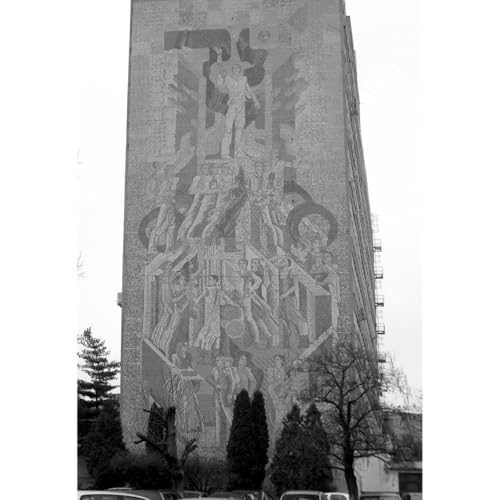
    This text written by Ujj János and translated into English by Gabriel Roman offers an extensive overview of Socialist Realism as an artistic style, characterizing it as the dominant cultural force in Central and Eastern Europe during the communist era. The sources explain that this movement was an ideologically-driven variant of realism used to serve communist party propaganda, aiming to portray reality in a "historically accurate and concrete manner" while promoting the ideological transformation and education of workers in the socialist spirit. The discussion notes that while this art form is now largely rejected by later generations, it once demanded optimistic, heroic depictions of the proletariat and socialist achievements in various fields, including visual arts, literature, and architecture, with examples provided from the Soviet Union, Hungary, and Romania, such as the famous statue "The Worker and the Kolkhoz Woman." Finally, the text traces the style’s origins, its mandatory nature during the peak of the movement, and the subsequent easing of restrictions after Stalin's death, though its influence periodically resurfaced in countries like Romania. Free download books in Romanian and English about the history of Arad from the digital library here: https://www.arad.zone/biblioteca-digitala/biblioteca-digitala-copy

    Voir plus Voir moins
    13 min
  • Culture Under Communism in Arad After 1948
    Oct 30 2025

    The source, "Culture after 1948" compiled by Ujj János and translated into English by Gabriel Roman, details the systematic imposition of Bolshevik doctrine on Romanian society following World War II, focusing heavily on the suppression and control of cultural life in the western region of Arad. It explains how the Communist Party employed widespread censorship and established cultural committees to eliminate "bourgeois culture" and promote Soviet and "indigenous socialism" ideologies, particularly affecting minority groups like the Hungarians. The text further outlines the initial strict Stalinist period followed by a brief cultural relaxation after 1964, which ended with Nicolae Ceaușescu’s ideological theses and the subsequent rise of the personality cult. Finally, the source documents the impact of these policies on local institutions, including the dissolution of the Hungarian section of the Arad People's Theater and the constrained activities of Hungarian writers, historians, and visual artists under the regime, while also noting efforts to preserve traditions through amateur cultural groups. Free download books in Romanian and English about the history of Arad from the digital library here: https://www.arad.zone/biblioteca-digitala/biblioteca-digitala-copy

    Voir plus Voir moins
    18 min
  • Everyday Life and Prices Under Socialism in Arad
    Oct 30 2025

    The provided text written by Muntean Tibor and translated into English by Gabriel Roman offers an extensive overview of everyday life and economic conditions in Romania under socialism, particularly focusing on the city and county of Arad. It contrasts the idealized family life and craftsmanship of one family with detailed macroeconomic and social data, examining aspects such as salaries, inflation, housing construction, and consumer spending on goods like food, clothing, and utilities. The analysis also explores cultural life and media consumption, especially the use of television for mass manipulation, and concludes with a discussion of Romania's lagging economic development compared to other Central European states and the deterioration of the Hungarian minority community in Arad during the communist era. Free download books in Romanian and English about the history of Arad from the digital library here: https://www.arad.zone/biblioteca-digitala/biblioteca-digitala-copy

    Voir plus Voir moins
    15 min