Page de couverture de Forging The Future with Chris Howard

Forging The Future with Chris Howard

Forging The Future with Chris Howard

Auteur(s): Chris Howard
Écouter gratuitement

À propos de cet audio

Join Chris Howard, Founder and CEO of Softeq, as he interviews knowledgeable leaders in the innovation spectrum, including CEOs, CTOs, R&D professionals, and start-up founders. Real conversations, technology, and processes of bringing new ideas to market.© 2022 All rights reserved. "Forging the Future" podcast, content, title, and logo owned by Softeq. Unauthorized use prohibited. Contact: ftf@speakerboxmedia.com. Respect our creativity. Économie
Épisodes
  • The Race to Ultra-Efficient, Low-Power AI with Edge Impulse and Nordic Semiconductor
    Mar 6 2026
    At CES 2026 in Las Vegas, Brandon Shibley of Edge Impulse and Thomas Soderholm of Nordic Semiconductor join Chris to explore the exciting shift of AI from the cloud to the edge. Brandon shares how streamlined, low power machine learning models are unlocking new possibilities in health wearables, industrial inspection, and agriculture by bringing fast, responsive intelligence directly onto devices. Thomas highlights how Nordic’s latest ultra low power chips with built-in neural processing are making this next wave of innovation possible. Together, they paint an optimistic picture of AI that is faster, smarter, and more accessible, running right where data is created. 🎧 Episode Highlights ●[01:02]: Why AI is moving from cloud to edge ●[08:08]: Wearables and health monitoring on-device ●[11:08]: Industrial and agricultural vision at the edge ●[22:25]: Bluetooth Low Energy and ultra low power design ●[28:02]: New Nordic chips with built-in neural processing 🔑 Key Takeaways: ●Edge AI is about efficiency, not scale for the sake of it. Smaller, purpose-built models running directly on devices can reduce latency, preserve privacy, and dramatically lower power consumption while still delivering high impact outcomes in health, agriculture, and industrial settings. ●Hardware innovation is unlocking the next wave of on-device intelligence. Ultra low power chips with integrated neural processing units and advanced Bluetooth Low Energy connectivity make it possible to run meaningful machine learning workloads on wearables and battery-driven products. ●The future of AI is distributed by design. Instead of relying entirely on massive cloud models, intelligence will live closer to where data is created, balancing performance, cost, and connectivity to create scalable and practical real world solutions. 👤 Guest Spotlight: Brandon Shibley Brandon Shibley is a Founder at Edge Delivery and Senior Staff Engineer at Edge Impulse, a Qualcomm company, where he helps developers and enterprises build and deploy machine learning models on edge devices. With a background spanning CTO, founder, and innovation leadership roles, he has led full-stack IoT and edge computing strategies across industrial, robotics, and embedded systems markets. Brandon specializes in bringing intelligent software closer to the physical world, enabling scalable, low power AI solutions that run directly on devices. Thomas Soderholm Thomas Soderholm is the Vice President of Business Development at Nordic Semiconductor, where he helps drive the company’s strategy in ultra low power wireless connectivity and edge AI. With deep roots in Bluetooth Low Energy innovation, he works at the intersection of hardware, software, and connectivity to enable smarter battery-driven devices. Thomas focuses on advancing integrated solutions that bring efficient machine learning and secure connectivity to wearables and connected products worldwide. Stay Connected: ●https://www.softeq.com/ ●https://www.linkedin.com/in/techris/ ●https://www.linkedin.com/in/shibley ●https://www.linkedin.com/company/nordic-semiconductor/ Stay inspired and ahead of the curve by subscribing to Forging the Future. Share your thoughts on this episode with the hashtag #ForgingTheFuture or tag us online!
    Voir plus Voir moins
    43 min
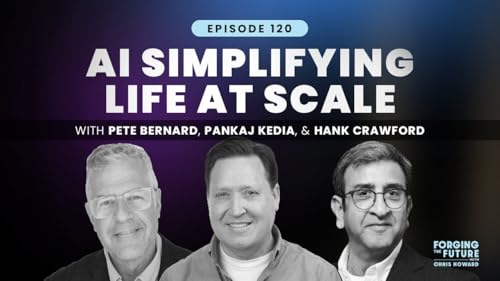
  • AI Beyond Chatbots: 3 Experts on Edge, Robotics, and Real Impact
    Feb 19 2026
    This special CES 2026 episode brings together Pete Bernard (EDGE AI FOUNDATION), Pankaj Kedia (2468 Ventures), and Hank Crawford (Blue Collar Robotics) to explore how AI is moving from theory into everyday use. From cameraless sensing to edge-powered devices that listen, measure, and respond in real time, it’s clear that AI is becoming embedded in our everyday lives. Pete, Pankaj, and Hank all share one common goal: to have AI to solve real problems and simplify life at scale. For Pete, that means building collaborative edge AI ecosystems that work reliably outside the cloud. For Pankaj, it’s unlocking applied AI that delivers real ROI in the healthcare, education, and automotive industries. And for Hank, it’s rethinking grocery shopping by using virtually controlled robotics to tackle labor shortages without replacing people. The future of AI isn’t abstract or far off, it’s already at work in the real world. 🎧 Episode Highlights ● [01:15] Why Edge AI is bigger than TinyML and how physical, generative, and agentic AI are converging ● [04:36] Cameraless AI: using signals and radio waves to sense environments without cameras ● [16:52] Why AI shouldn’t just match human performance but exceed it in safety-critical systems like self-driving and robotics ● [27:47] Applied AI as the real ROI driver across healthcare, education, and mobility ●[39:38] How human-in-the-loop robotics for grocery fulfillment provides global labor opportunities 🔑 Key Takeaways: ● The most impactful AI isn’t happening in massive data centers, it’s happening where systems can sense, interpret, and act in real time. From cameraless perception to signal-based sensing, edge AI enables intelligence in environments where latency, privacy, and connectivity matter most. ● AI must outperform humans in safety-critical systems to matter. Matching human performance isn’t enough when lives, health, or infrastructure are at stake. Whether in autonomous driving, healthcare triage, or robotics, the bar for AI is being meaningfully safer, more consistent, and more reliable than human decision-making. ● The most scalable AI systems don’t replace people, they amplify them. Human-in-the-loop robotics and applied AI models solve labor shortages, unlock global talent, and improve productivity while preserving human judgment, accountability, and trust. 👤 Guest Spotlight: Pete Bernard Pete Bernard is Executive Director of the EDGE AI FOUNDATION, advancing the development and adoption of edge AI across industries. With a background in embedded systems and machine learning, he focuses on building collaborative ecosystems that bring physical, generative, and agentic AI out of the cloud and into real-world deployment. He is known for translating complex technical shifts into practical frameworks that enable reliable, scalable AI at the edge. Pankaj Kedia Pankaj Kedia is Managing Partner at 2468 Ventures, investing in AI, robotics, autonomy, and applied technology. He backs companies delivering measurable ROI across healthcare, education, mobility, and industrial sectors, with a focus on systems that outperform humans in safety-critical and high-impact environments. Hank Crawford Hank Crawford is Founder of Blue Collar Robotics, developing human-in-the-loop robotic systems to address labor shortages. His work centers on remotely operated, task-specific robots that augment workers, beginning with grocery fulfillment and expanding into broader physical industries. Connect with Pete: Pete Bernard Connect with Pankaj: Pankaj Kedia Connect with Hank: Hank Crawford Connect with Chris: Chris Howard Explore past episodes: ftf.show Learn about Softeq: softeq.com Stay inspired and ahead of the curve by subscribing to Forging the Future. Share your thoughts on this episode with the hashtag #ForgingTheFuture or tag us online!
    Voir plus Voir moins
    1 h et 3 min
  • Is The Smart Home Getting an Upgrade? Inside Amazon’s Push Toward Agentic AI
    Feb 16 2026
    At CES 2026 in Las Vegas, Olivier Bernard of Amazon sits down with Chris to talk about how IoT has evolved from simple device connectivity into intelligent tools, essentially becoming our “second brains.” He breaks down why many companies walked away from the IoT space, pointing to thin margins and limited standalone value, while Amazon found success by embedding IoT into a broader cloud ecosystem that includes data storage, machine learning, and agentic AI. Olivier shares his vision of the “invisible home,” where AI-powered devices configure, automate, and optimize how we live. In the end, he explains how the convergence of IoT and agentic AI turns dormant device data into actionable insights, delivering real ROI for both consumers and enterprises. 🎧 Episode Highlights ● [01:25]: Olivier Bernard introduces AWS IoT and smart home ecosystem ● [04:00]: Why many companies exited the IoT market and how Amazon survived ● [9:59]: The plateau of smart devices becoming a plug-and-play feature for homes ● [13:55]: The future of the “invisible home” and automated routines ● [32:36]: AWS re:Invent: Announcing new smart and generative AI devices 🔑 Key Takeaways: ● IoT only matters when it’s connected to outcomes. On its own, device connectivity produces cost and complexity, not value. When paired with AI and cloud infrastructure, IoT data becomes usable intelligence, driving better product decisions, operational efficiency, and customer experience. ● Agentic AI is the turning point for smart homes. Moving away from manual setup and rigid commands toward systems that understand context and adjust on their own removes the friction that held smart homes back. This kind of “invisible” automation is what finally makes smart homes accessible to everyone, not just early adopters. ● The real opportunity is distributed intelligence with measurable ROI. Placing AI across devices, edge, and cloud, while respecting latency, privacy, and trust, turns AI from experimentation into a durable business capability that scales across consumer and enterprise use cases. 👤 Guest Spotlight: Olivier Bernard Olivier Bernard is the Worldwide Go-To-Market Lead for AWS IoT Services at Amazon, where he connects customer needs, technology opportunity, and business strategy across the global IoT and edge ecosystem. He brings deep experience executing at scale across IoT, M2M, automotive, and connected-device platforms. Bernard blends engineering discipline with business leadership to turn emerging technologies into practical applications that open new markets and deliver measurable impact. Connect with Oliver: ⁠www.linkedin.com/in/ojbernard⁠ Connect with Chris: ⁠www.linkedin.com/in/techris⁠ Explore past episodes: ⁠Forging the Future Episodes⁠ Learn about Softeq: ⁠softeq.com Stay inspired and ahead of the curve by subscribing to Forging the Future. Share your thoughts on this episode with the hashtag #ForgingTheFuture or tag us online!
    Voir plus Voir moins
    32 min
Pas encore de commentaire