

Global Debt Crisis 2025: Who Pays the Price? Deep Dive into US Debt, India Debt, China Debt & Global Financial Risks Impacting Everyday Lives Amid Rising Public & Private Debt | ZAYD HAJI | IFR
Échec de l'ajout au panier.
Échec de l'ajout à la liste d'envies.
Échec de la suppression de la liste d’envies.
Échec du suivi du balado
Ne plus suivre le balado a échoué

Global Debt Crisis 2025: Who Pays the Price? Deep Dive into US Debt, India Debt, China Debt & Global Financial Risks Impacting Everyday Lives Amid Rising Public & Private Debt | ZAYD HAJI | IFR
-
Narrateur(s):
-
Auteur(s):
À propos de cet audio
Global Debt Crisis 2025: Who Pays the Price? Deep Dive into US Debt, India Debt, China Debt & Global Financial Risks Impacting Everyday Lives Amid Rising Public & Private Debt
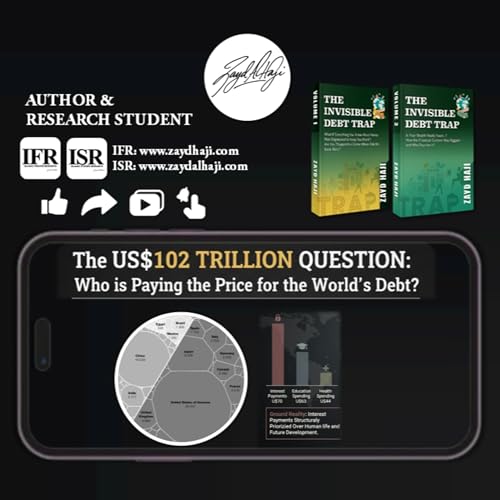
Explore the critical global debt landscape of 2025, where total public debt has soared to over one hundred trillion US dollars. This comprehensive analysis reveals the staggering figures behind the United States debt, India debt, China debt, and other major economies, showing how debt dynamics are reshaping our world’s financial future. Despite advanced economies like the United States and Japan accounting for nearly seventy percent of global public debt, their low-cost borrowing contrasts sharply with the harsh reality facing developing countries, whose debt is rising twice as fast. These nations, including India, Latin American countries, and African economies, grapple with crushing interest payments that siphon away vital resources needed for healthcare, education, and infrastructure.
Understanding key metrics such as the US national debt, America public debt, and India debt to GDP ratio uncovers the uneven burden of repayments and their human consequences. For example, developing countries paid over nine hundred billion dollars in interest alone in 2024, often spending more on debt servicing than on critical social services. This hidden cost translates into real suffering — children missing out on schooling, clinics without medicines, and families trapped in cycles of poverty. The US debt clock and China debt to GDP highlight the scale and complexity of the problem, while emerging markets and developing economies face unique vulnerabilities tied to currency volatility, rising interest rates, and nonbank financial institution exposures.
This deep dive covers how the US debt to GDP ratio and India’s external debt influence global credit risk and liquidity, stressing the interconnectedness of economies. The volatile US dollar and its depreciation in 2025 add another layer of risk, impacting import costs and corporate borrowing worldwide. Moreover, private creditors now hold a majority share of developing countries’ external debt, often demanding commercial rates that exacerbate financial strain and slow debt resolution efforts.
Key themes include the urgent call for debt reform through inclusive global governance, crisis liquidity measures, effective debt workout mechanisms, and concessional financing to build resilience. Recognizing these forces equips individuals, investors, and policymakers with critical insights to navigate a fragile global financial system under pressure from soaring debt levels.
This content is essential for anyone seeking to understand the real-world impact of the world’s biggest debts — from the US government debt to India’s national debt challenges — and how these silent economic forces affect our daily lives. From higher mortgage rates and credit card interest to strained public services and slowed economic growth, the consequences of this financial burden extend far beyond balance sheets.
Stay informed with detailed, clear, and actionable insights derived from credible sources including the International Monetary Fund, World Bank, and United Nations, ensuring you comprehend the depth of the crisis behind the headlines. Learn why knowing about debt to GDP ratios by country, America’s debt to GDP, China’s country debt, and the debt-to-GDP ratio in India is crucial not just for economists, but for every one of us living in an interconnected world.
The story of the world’s USD 102 trillion debt is not just about numbers — it’s about who pays the price and how we can push for a fairer, more sustainable future for all.
Resources
https://drive.google.com/file/d/11Z8DqOixzJpMH-hqTuyPkxHSbzNU5OxZ/view?usp=sharing
https://drive.google.com/file/d/1omd9Hg-07_Pa1Wl4PrbnOpxsGegozxNI/view?usp=sharing