Obtenez 3 mois à 0,99 $/mois

OFFRE D'UNE DURÉE LIMITÉE
Page de couverture de Hometown History

Hometown History

Hometown History

Auteur(s): Shane Waters
Écouter gratuitement

À propos de cet audio

Discover forgotten stories from small-town America that never made it into history books. Hometown History is the podcast uncovering hidden American history—overlooked events, local mysteries, and untold tragedies from communities across the nation. Every week, meticulous research brings pre-2000 small-town stories to life in 20-minute episodes. From forgotten disasters to local legends, hidden chapters to pivotal moments, each episode explores a different town's overlooked history. Perfect for history enthusiasts seeking forgotten American stories, small-town history, and local history that shaped our nation. Respectful storytelling meets educational depth—history podcast content for curious minds who want to learn about America's hidden past without hour-long episodes.

© Copyright Hometown History Podcast
Monde Sciences sociales True Crime
Épisodes
  • Gauley Bridge, West Virginia: America's Deadliest Industrial Cover-Up
    Dec 9 2025
    Episode SummaryIn 1931, seventeen-year-old Dewey Flack stepped off a train in Gauley Bridge, West Virginia, carrying a one-way ticket and a promise to send money home to his family. Two weeks later, he was dead—his lungs filled with crystalline silica dust so pure it turned them to stone. His death certificate said pneumonia. It was a lie.Dewey was one of approximately 764 workers who died during construction of the Hawks Nest Tunnel, a three-mile hydroelectric project that has been called America's worst industrial disaster. The project, managed by Union Carbide subsidiary New Kanawha Power Company and contracted to Rinehart & Dennis, attracted roughly 3,000 workers during the depths of the Great Depression. Three-quarters of them were Black migrants fleeing unemployment in the segregated South, drawn by the promise of paying work when jobs had vanished across America.What they found instead was a death sentence. The tunnel cut through rock that was 99 percent pure silica, and the contractors used dry drilling methods to save time and extract the valuable mineral. Workers testified that the dust was so thick they couldn't see an electric light ten feet away—one survivor said you could "practically chew the dust." Medical science had documented silicosis since 1910. The companies knew exactly what they were doing.When workers began dying—sometimes dozens in a single week—the company fired them. Those too sick to leave were buried in mass graves under cover of darkness, their death certificates falsified to read "pneumonia" or "tuberculosis." Families back home waited for letters that never came, believing their sons and fathers had abandoned them. Dewey Flack's family spent eighty-eight years thinking he had run away—until NPR finally located his niece in 2019 and told her the truth.Timeline of EventsThe Hawks Nest Tunnel disaster unfolded over eighteen months that changed American labor history. What began as a Depression-era promise of employment became a systematic cover-up that would take nearly a century to fully expose.January 7, 1927 — Union Carbide creates New Kanawha Power Company to build hydroelectric project at Gauley Bridge, West Virginia.March 31, 1930 — Construction begins on three-mile Hawks Nest Tunnel through Gauley Mountain. Rinehart & Dennis employs approximately 3,000 workers, most of them Black migrants from the South.February 1931 — Local newspaper reports 37 deaths among tunnel workers in just two weeks. A local judge issues a gag order. The story disappears.May 1931 — Dr. Leonidas H. Harless examines dozens of workers at Gauley Bridge hospital and identifies silicosis. He writes to Union Carbide warning of catastrophic death rates. The company ignores him.September 1931 — Tunnel construction is completed. Workers continue dying for years afterward as silicosis claims its victims.January 1936 — House Committee on Labor begins Congressional investigation, led in part by New York Congressman Vito Marcantonio. The subcommittee documents 476 official silicosis deaths and condemns conditions as "hardly conceivable in a democratic government."September 7, 2012 — Historical marker finally dedicated at Hawks Nest, acknowledging the disaster.Historical SignificanceThe Hawks Nest Tunnel disaster stands as a devastating example of how corporate profit was placed above human life during America's industrial age. The Congressional investigation of 1936 exposed not just the immediate tragedy, but a system designed to exploit the most vulnerable workers while evading any accountability.What makes Hawks Nest particularly significant is how thoroughly the disaster was buried. Unlike other industrial tragedies that sparked immediate reform, Hawks Nest was actively covered up. The companies falsified death certificates, buried workers in unmarked mass graves, and fired anyone who got sick before they could seek treatment. Families were never notified. Records were destroyed. For decades, the full scope of what happened remained hidden.The racial dimension cannot be ignored. Three-quarters of the workforce was Black, and these workers were assigned the dirtiest, most dangerous tasks. They were paid in company scrip while white workers received cash. They were housed twelve to a room in boxcars while white workers got better accommodations. When they died, they were buried in segregated trenches because they weren't allowed in "white" cemeteries. The Congressional report noted that conditions were "hardly conceivable in a democratic government in the present century."While Hawks Nest helped establish silicosis as a recognized occupational disease with compensation protections, the tunnel workers themselves were never protected by these laws. Union Carbide paid less than $1,000 per death on average in legal settlements. No executives ever went to prison. The disaster that killed more Americans than any other industrial incident in history resulted in no criminal charges...
    Voir plus Voir moins
    20 min
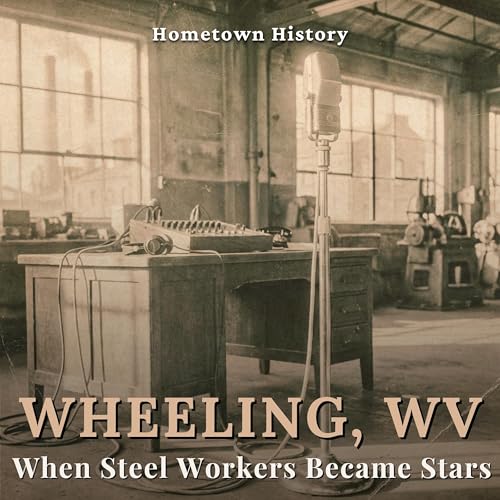
  • Wheeling, West Virginia: When Steel Workers Became Radio Stars
    Dec 2 2025
    The StoryIn the depths of the Great Depression, when unemployment in West Virginia topped 25% and families struggled to afford even basic necessities, something remarkable happened in Wheeling. Steel workers—machinists, crane operators, stenographers—became national radio celebrities. Their show, "It's Wheeling Steel," reached millions of Americans coast to coast and proved that working-class people weren't just audiences—they were artists.The man behind this unlikely experiment was John L. Grimes, advertising director for the Wheeling Steel Corporation. For six years, from 1930 to 1936, Grimes lobbied his bosses with a radical idea: create a radio variety show featuring only company employees and their families as performers. His executives were skeptical. Why would anyone want to listen to factory workers sing and play music? But Grimes saw something they didn't—untapped talent, community pride, and an advertising opportunity that could transform both the company's image and employee morale.On November 8, 1936, "It's Wheeling Steel" debuted on Wheeling's WWVA radio station. The half-hour program featured light classics, popular songs, and show tunes performed by an orchestra of local musicians and amateur headliner performers—all drawn from Wheeling Steel's extended family of employees. Grimes maintained strict requirements: every performer, every producer, every arranger had to work for Wheeling Steel Corporation or be an immediate family member. Even when professional talent like singer Regina Colbert joined the show, she was first hired as a secretary in the advertising department to meet the requirement.The program was an instant success with local audiences. The forty-two-piece orchestra, dubbed the Musical Steelmakers, featured employees who balanced grueling factory shifts with weekly rehearsals. Dorothy Ann Crowe, a company stenographer, performed solos that drew thousands of fan letters. The Steel Sisters harmonized for radio audiences between their office duties. These weren't professional entertainers—they were ordinary people with extraordinary talents, finally given a platform to shine.In January 1939, the Mutual Broadcasting System picked up "It's Wheeling Steel" for national distribution. The show's appeal proved nationwide. By 1939, the program had outgrown its studio space and moved to Wheeling's Capitol Theatre, where audiences of up to 2,400 people could watch the live broadcasts. On June 25, 1939, the Musical Steelmakers performed at the New York World's Fair before more than 26,000 attendees—one of the fair's largest outdoor performances.In 1941, "It's Wheeling Steel" jumped to NBC's Blue Network and rose to fifth place in national listener ratings. The show that skeptical executives had questioned was now competing with the biggest names in radio. For eight years, from 1936 to 1944, steel workers proved they belonged on America's biggest stages.When World War II began, the program shifted focus to support the war effort. "Buy a Bomber" broadcasts toured West Virginia cities, challenging communities to purchase enough defense bonds to buy a bomber plane. One broadcast from West Virginia University's field house generated more than $650,000 in bond sales—the largest such fundraiser in Monongalia County. Communities that met their goals had their city names painted on bomber aircraft heading into battle.The program remained at the height of its popularity when it broadcast its final episode on June 18, 1944. After 326 episodes spanning eight years, declining health forced John L. Grimes to end the show. He'd achieved what he set out to prove: that working-class Americans had talent worth celebrating, that industrial towns weren't cultural voids, and that employees could become their company's greatest ambassadors.The LegacyThe influence of "It's Wheeling Steel" extended far beyond its final broadcast. Lew Davies, the show's musical arranger, later assisted Lawrence Welk in developing a television variety show that reflected "It's Wheeling Steel's" format and character—family-oriented programming featuring a mix of light classics, popular songs, and wholesome entertainment where regular performers became audience favorites.The Capitol Theatre, where "It's Wheeling Steel" broadcast from 1939 onward, still stands at 1015 Main Street in Wheeling. After nearly two years of closure, the historic venue was purchased by the Wheeling Convention and Visitors Bureau in April 2009 and reopened that September following an $8 million restoration. Today it seats 2,400 people, hosts the Wheeling Symphony Orchestra, and welcomes over 50,000 annual attendees. You can visit it. You can sit in the seats where thousands once gathered to watch their neighbors perform on national radio.All 326 "It's Wheeling Steel" recordings are housed at the West Virginia and Regional History Center at West Virginia University, preserving the voices of steel workers who became radio stars.Timeline of ...
    Voir plus Voir moins
    25 min
  • Erie, Pennsylvania: The Wall of Water That Killed 36
    Nov 25 2025
    On August 3, 1915, a wall of water tore through downtown Erie, Pennsylvania, at twenty-five miles per hour, destroying three hundred buildings and killing thirty-six to forty people in the city's deadliest disaster. The Mill Creek Flood wasn't an act of God—it was the predictable result of a choice made by a growing American city that buried a powerful creek beneath culverts and ignored repeated warnings.For decades, Erie built over Mill Creek to maximize developable land, covering the nineteen-mile waterway with approximately twenty culverts through downtown. When 5.77 inches of rain fell in just hours, debris clogged a critical culvert at 26th and State Streets, creating a four-block reservoir. At 8:45 PM, the culvert gave way, unleashing a twenty-five-foot wall of water that destroyed everything in its three-mile path.Tonight's episode explores how Erie learned from catastrophe, building the Mill Creek Tube—an engineering marvel that has protected the city for over a century. It's a story of tragedy, resilience, and the price of ignoring nature's power.Show Notes:On the night of August 3, 1915, downtown Erie, Pennsylvania, experienced its worst natural disaster when a twenty-five-foot wall of water tore through the city at twenty-five miles per hour. The Mill Creek Flood killed thirty-six to forty people, destroyed three hundred buildings, and left hundreds of families homeless. But this wasn't a random act of nature—it was the predictable result of decades of urban development that ignored the power of a nineteen-mile creek flowing through the heart of a growing industrial city.The City That Buried Its CreekBy 1915, Erie had become known as the "Boiler and Engine Capital of the World," with factories lining Lake Erie's southern shore and a dense population of German, Irish, Polish, and Italian immigrant workers. As the city grew, officials made a choice common to American cities of that era: they buried Mill Creek beneath approximately twenty culverts and ten bridges, maximizing developable land downtown. The philosophy was simple—if you have a creek running through valuable real estate, you don't preserve it. You bury it.Mill Creek itself had considerable power. With a steep gradient dropping two hundred feet over its nineteen-mile length and a compact thirteen-square-mile watershed, heavy rainfall funneled downstream fast. The creek had flooded before—in 1878 and 1893—but city officials assumed the culverts would be sufficient. They were wrong.The Storm and the Breaking PointOn August 3, 1915, between 3 PM and 9 PM, a succession of storms unleashed 5.77 inches of rain over the Mill Creek watershed. As saturated soil collapsed along creek banks, debris swept downstream—trees, barns, chicken coops, outhouses—all funneling toward the narrow culvert at 26th and State Streets in downtown Erie.For five hours, Fire Chief John McMahon and police officers tried to clear the debris blockage. They used dynamite. It didn't work. Behind the clogged culvert, an artificial lake formed—four city blocks flooded, water thirty feet deep in places.At 8:45 PM, the culvert gave way.What followed was catastrophic. A twenty-five-foot wall of water raced through downtown Erie at twenty-five miles per hour, destroying everything in a three-mile path. Houses were lifted from foundations and carried blocks away. Railcars and streetcars were knocked off their tracks. State Street businesses from 19th to 7th Streets suffered extensive damage. The floodwaters carried a horrifying mix—mud, building debris, twisted automobiles, tree trunks, cattle carcasses, and human remains.Heroes and VictimsFire Chief John McMahon became one of the flood's most tragic victims. While directing rescue efforts at East 23rd and French Streets, McMahon had just handed a blind woman through a window to safety when the house was swept away with him and three firefighters still on board. The men rode the roof for four blocks before it disintegrated. Firefighter John Donovan, 25, drowned trying to save McMahon. McMahon survived the night, trapped under twenty feet of debris until a woman heard his cries and alerted rescuers. But his injuries were severe, and seventeen days later, on August 20, 1915, he died from typhoid pneumonia contracted during his ordeal.Erie historian Caroline Reichel remembers stories her father told her. He was twenty years old during the flood and witnessed the grim aftermath—bodies in the water, survivors trapped in trees, the complete destruction of entire neighborhoods. The flood's casualty reports varied between thirty-six and more than forty deaths, with property damage estimated between three and five million dollars in 1915 currency.Engineering a SolutionErie learned its lesson. Within a year, the city commissioned one of the most ambitious flood control projects of its era. Between 1917 and 1923, workers constructed the Mill Creek Tube—a reinforced concrete conduit twenty-two feet wide, nineteen...
    Voir plus Voir moins
    22 min
Pas encore de commentaire