

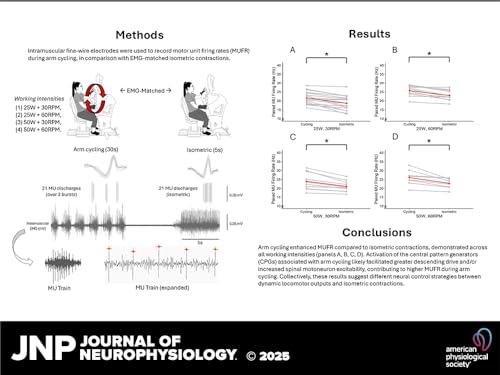
Motor Unit Firing Rates During Arm Cycling vs. Isometric Contractions
Échec de l'ajout au panier.
Échec de l'ajout à la liste d'envies.
Échec de la suppression de la liste d’envies.
Échec du suivi du balado
Ne plus suivre le balado a échoué

Motor Unit Firing Rates During Arm Cycling vs. Isometric Contractions
-
Narrateur(s):
-
Auteur(s):
À propos de cet audio
In this episode, coauthor Daniel C. Basile discusses the team’s newly published research, "Investigating motor unit firing rates during arm cycling compared with intensity-matched isometric contractions in humans." Until now, motor unit firing rates (MUFRs) during upper-limb locomotor tasks had not been recorded in humans, leaving gaps in our understanding of how motor units behave during dynamic, CPG-mediated activity. Using indwelling fine-wire electrodes, the study reveals that MUFRs are significantly higher during arm cycling compared to isometric contractions, pointing to distinct neural control strategies between these movement types. Tune in to explore the implications for motor control and rehabilitation science.
Investigating motor unit firing rates during arm cycling compared with intensity-matched isometric contractions in humans Daniel C. Basile, Alysha D. Wira, Charles L. Rice, and Kevin E. Power
Journal of Neurophysiology 2025 134:1, 162-170