Épisodes

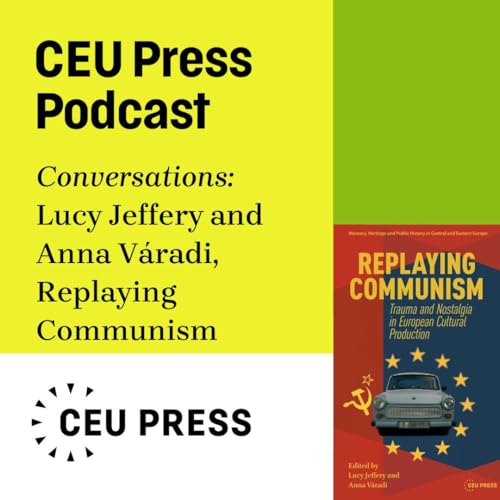
  • Lucy Jeffery and Anna Váradi, "Replaying Communism: Trauma and Nostalgia in European Cultural Production" (CEU Press, 2025)
    Dec 17 2025
    In this episode, host Andrea Talabér (CEU Press) sat down with Lucy Jeffery and Anna Váradi to talk about their edited volume, Replaying Communism: Trauma and Nostalgia in European Cultural Production. The volume explores the lasting impact of the communist era across Central and Eastern Europe, with chapters thematically threaded through by concepts including curation, immersion, interaction, humor, and authenticity. In the podcast we talked about what it means to “replay” communism, about the trauma/nostalgia paradigm in relation to cultural production, and about inter-generational experiences of media depicting the communist period. You can purchase a copy here. You can find out more about the Replaying Communism project here. If you would like to cooperate with Anna and Lucy, or you have a similar project, please contact them via the replayingcommunism@gmail.com email address. The CEU Press Podcast delves into various aspects of the publishing process: from crafting a book proposal, finding a publisher, responding to peer review feedback on the manuscript, to the subsequent distribution, promotion and marketing of academic books. We also talk to series editors and authors, who will share their experiences of getting published and discuss their series or books. Interested in CEU Press’s publications? Click here to find out more: https://ceupress.com/ Stay tuned for future episodes and subscribe to our podcast to be the first to be notified. Learn more about your ad choices. Visit megaphone.fm/adchoices Support our show by becoming a premium member! https://newbooksnetwork.supportingcast.fm/eastern-european-studies
    Voir plus Voir moins
    59 min
  • Maja Davidović, "Governing the Past: 'Never Again' and the Transitional Justice Project" (Cambridge UP, 2025)
    Dec 5 2025
    The way we govern the past to ensure peaceful futures keeps conflict anxieties alive. In pursuit of its own survival, permanence and legitimacy, the project of transitional justice, designed to put the 'Never Again' promise into practice, makes communities that ought to benefit from it anxious about potential repetition of conflict. Governing the Past: 'Never Again' and the Transitional Justice Project (Cambridge UP, 2025)challenges the benevolence of this human rights-led global project. It invites readers to reflect on the incompatibility between transitional justice and the grand goal of ensuring peace, and to imagine alternative and ungovernable futures. Rich in stories from the field, the author draws on personal experiences of conflict and transition in the former Yugoslavia to explore how different elements of transitional justice have changed the structure of this Bosnia and Herzegovina and neighbouring societies over the years. This powerful study is essential reading for students, scholars and practitioners interested in human rights and durable international peace. Learn more about your ad choices. Visit megaphone.fm/adchoices Support our show by becoming a premium member! https://newbooksnetwork.supportingcast.fm/eastern-european-studies
    Voir plus Voir moins
    55 min
  • Jacob Daniels, "The Jews of Edirne: The End of Ottoman Europe and the Arrival of Borders" (Stanford UP, 2025)
    Dec 3 2025
    At the turn of the twentieth century, the city of Edirne was a bustling center linking Istanbul to Ottoman Europe. It was also the capital of Edirne Province—among the most religiously diverse regions of the Ottoman Empire. But by 1923, the city had become a Turkish border town, and the province had lost much of its non-Muslim population. In The Jews of Edirne: The End of Ottoman Europe and the Arrival of Borders (Stanford UP, 2025), Jacob Daniels explores how one of the world's largest Sephardi communities dealt with the encroachment of modern borders. Using Ladino, French, English, and Turkish sources, Daniels offers a new take on the ways in which ethno-religious minorities experienced the transition "from empire to nation-state." Rather than tracing a linear path, Edirne Jews zigzagged between the Ottoman Empire and three nation-states—without moving a mile. And by maintaining interstate Sephardi networks, they resisted pressure to treat the shifting border as a limit to their zone of belonging. Ultimately, proximity to the border would undo Edirne's Jewish community, but the way this ending came about—local Jews were rarely killed or deported—challenges common assumptions about state borders and Jewish history. By studying Jewish encounters with the nation-state alongside the emergence of modern borders, Daniels sheds light on both phenomena. Learn more about your ad choices. Visit megaphone.fm/adchoices Support our show by becoming a premium member! https://newbooksnetwork.supportingcast.fm/eastern-european-studies
    Voir plus Voir moins
    1 h et 21 min
  • Dennis Deletant, "In Search of Romania" (Hurst, 2022)
    Dec 1 2025
    The imposition of Communist ideology was a misfortune for millions in Eastern Europe, but never for Dennis Deletant. Instead, it drew him to Romania. The renowned historian’s association with the country and its people dates back to 1965, when he first visited. Since then, Romania has made Dennis appreciate the value of shrewd dissimulation, in the face of the state’s gross intrusion in the life of the individual. This vivid memoir charts his first-hand experience of the Communist era, coloured by the early 1970s surveillance of his future wife Andrea; his contacts with dissidents; and his articles and BBC World Service broadcasts, which led to his being declared persona non grata in 1988. In Search of Romania (Hurst, 2022) also considers how life went on under dictatorship, even if it was largely mapped out by the regime. How did individual citizens negotiate the challenges placed in their path? How important was the political police, the Securitate, in maintaining compliance? How did dissent towards the regime manifest? How did all this affect the moral compass of the individual? Why did utopia descend into dystopia under Ceaușescu? And how has his legacy influenced the difficult transition to democracy since the collapse of Communism? Roland Clark is a Senior Lecturer in Modern European History at the University of Liverpool, a Senior Fellow with the Centre for Analysis of the Radical Right, and the Principal Investigator of an AHRC-funded project on European Fascist Movements. Learn more about your ad choices. Visit megaphone.fm/adchoices Support our show by becoming a premium member! https://newbooksnetwork.supportingcast.fm/eastern-european-studies
    Voir plus Voir moins
    53 min
  • Jochen Hellbeck, "World Enemy No. 1: Nazi Germany, Soviet Russia, and the Fate of the Jews" (Penguin Group, 2025)
    Nov 24 2025
    In the West, World War II is commonly understood as the Allies’ struggle against Nazism. Often elided, if not simply forgotten, is the Soviet Union’s crucial role in that fight. With this book, acclaimed historian Jochen Hellbeck rectifies this omission by relocating the ideological core of the conflict. It was not the Western powers but Communist Russia that Nazi Germany viewed as an existential threat—in fact, “World Enemy No. 1.” Jewish revolutionaries, the Nazis believed, had seized power in 1917 and were preparing the Soviet state to destroy Germany and the world. And so, on June 22, 1941, a German army of three million attacked the Soviet Union to exterminate “Judeo-Bolshevism,” Hitler’s cardinal obsession. While Europe’s Jews were expelled, exiled, and persecuted by the Nazis, Soviet Jews were immediately slated for elimination. The Soviet lands thus became ground zero for systematic extermination, which was only later extended to all Jews, igniting the Holocaust.Hellbeck plumbs newly declassified archives and previously undiscovered sources—testimonies, diaries, and dispatches from soldiers and civilians, Soviet and German—to offer a unique history that takes account of both sides. He reconstructs the years leading up to the war when “Europe against Bolshevism” was the Nazis’ most fervid rallying cry, and documents their annihilatory ambitions on the battlegrounds in the East. Widely disseminated accounts of German atrocities mobilized millions of Soviet citizens to join a people’s war against the hated invaders. Hellbeck tracks the desire for revenge that drove the Red Army on its path of reconquest, an advance that further inflamed the belief in a murderous “Bolshevik Jew,” stirring the Germans to fight to the bitter end. Recounted here in vivid detail are the events at Babi Yar, the Battle of Stalingrad, the liberation of the concentration camps, and the arrival of the Red Army in the Nazi capital. Finally, Hellbeck reckons with the West’s persistent disregard of the Soviet Union’s incalculable contribution to winning the war—and its sacrifice of twenty-six million citizens—as anti-communism and the Cold War turned erstwhile allies into mortal enemies.Hellbeck’s eye-opening work is an astonishing new reading of both the Second World War and how its history has been told. Learn more about your ad choices. Visit megaphone.fm/adchoices Support our show by becoming a premium member! https://newbooksnetwork.supportingcast.fm/eastern-european-studies
    Voir plus Voir moins
    1 h et 28 min
  • Marek Kohn, "The Stories Old Towns Tell: A Journey Through Cities at the Heart of Europe" (Yale UP, 2023)
    Nov 24 2025
    Historic quarters in cities and towns across the middle of Europe were devastated during the Second World War—some, like those of Warsaw and Frankfurt, had to be rebuilt almost completely. They are now centers of peace and civility that attract millions of tourists, but the stories they tell about places, peoples, and nations are selective. They are never the whole story. These old towns and their turbulent histories have been key sites in Europe’s ongoing theater of politics and war. Exploring seven old towns, from Frankfurt and Prague to Vilnius in Lithuania, the acclaimed writer Marek Kohn examines how they have been used since the Second World War to conceal political tensions and reinforce certain versions of history. Uncovering hidden stories behind these old and old-seeming façades in The Stories Old Towns Tell: A Journey through Cities at the Heart of Europe (Yale University Press, 2023), Dr. Kohn offers us a new understanding of the politics of European history-making—showing how our visits to old towns could promote belonging over exclusion, and empathy over indifference. This interview was conducted by Dr. Miranda Melcher whose new book focuses on post-conflict military integration, understanding treaty negotiation and implementation in civil war contexts, with qualitative analysis of the Angolan and Mozambican civil wars. Learn more about your ad choices. Visit megaphone.fm/adchoices Support our show by becoming a premium member! https://newbooksnetwork.supportingcast.fm/eastern-european-studies
    Voir plus Voir moins
    1 h
  • Oana Godeanu-Kenworthy, "Videotape" (Bloomsbury, 2025)
    Nov 22 2025
    Over the span of a single decade, VHS technology changed the relationship between privacy and entertainment, pried open the closed societies behind the Iron Curtain, and then sank back into oblivion. Its meteoric rise and fall encapsulated the dynamics of the '80s and foreshadowed the seismic cultural shifts to come after the Cold War.In the West, its advent deepened the trends of the age: individualism, consumerism, the fragmentation of society, and the consolidation of corporate power in the entertainment industry and its victory over the regulatory powers of the state. In the East, it encouraged new forms of socialization and economic exchanges, while announcing the gradual crumbling of government control over the imagination of the people.By the mid-1990s, the VHS format was displaced by the DVD. The DVD would eventually give way to streaming. As explored in Videotape (Bloomsbury, 2025), by Dr. Oana Godeanu-Kenworthy in the Object Lessons series, the cultural legacy of the videotape continues to inform our relationship to technology, privacy, and to entertainment. This interview was conducted by Dr. Miranda Melcher whose book focuses on post-conflict military integration, understanding treaty negotiation and implementation in civil war contexts, with qualitative analysis of the Angolan and Mozambican civil wars. You can find Miranda’s interviews on New Books with Miranda Melcher, wherever you get your podcasts. Learn more about your ad choices. Visit megaphone.fm/adchoices Support our show by becoming a premium member! https://newbooksnetwork.supportingcast.fm/eastern-european-studies
    Voir plus Voir moins
    45 min
  • Carol Lilly, "Death and Burial in Socialist Yugoslavia: The Politicization of Cemeteries and Ethnic Conflict in the Balkans" (Bloomsbury, 2024).
    Nov 21 2025
    Across the globe, memorial and grave sites are being increasingly weaponized in conflicts and politicized by parties to advance agendas. Here, Carol S. Lilly examines ideas of death, politics, memory, ideology and nationalism in the former Yugoslav republics of Bosnia & Hercegovina, Croatia, and Serbia to shine fresh light on cemetery culture in 20th-century Europe.More specifically, Death and Burial in Socialist Yugoslavia: The Politicization of Cemeteries and Ethnic Conflict in the Balkans (Bloomsbury, 2024) argues that while the CPY created its own communities of the dead in postwar Partisan Cemeteries, it failed to do the same for civilian cemeteries in ways that might reinforce its ideals of secularism, pluralism, and brotherhood and unity. Moreover, the communist regime left the previous system of ethno-religious segregation in place, further isolating Catholics, Orthodox, Muslims and Jews who continued to be buried in separate locations. Finally, it explicitly politicized burial rites and grave markers, making cemeteries into legitimate spaces of political discourse.As a result, by the time Yugoslavia disintegrated in the early 1990s, dead bodies and cemeteries had become a concerted weapon of war in the ongoing ethnic conflict. Ultimately, then, this timely study reveals for the first time the extent to which the communist regime not only failed to created their own communities of the dead but also further divided and alienated living communities in Yugoslavia. Learn more about your ad choices. Visit megaphone.fm/adchoices Support our show by becoming a premium member! https://newbooksnetwork.supportingcast.fm/eastern-european-studies
    Voir plus Voir moins
    58 min