Page de couverture de Newsroom Robots

Newsroom Robots

Newsroom Robots

Auteur(s): Nikita Roy
Écouter gratuitement

À propos de cet audio

Looking to explore the intersection of AI and journalism? Influential thought leaders in the industry join data scientist and media entrepreneur, Nikita Roy, each week to explore what's next with AI and its implications for the media landscape. In each episode, industry experts discuss how automated newsrooms have the potential to change journalism and uncover opportunities to optimize workflows and increase efficiency without compromising journalistic integrity.

Hosted on Acast. See acast.com/privacy for more information.

Nikita Roy
Politique Économie
Épisodes
  • Tav Klitgaard: How Zetland turned a newsroom problem into a global AI business
    Dec 15 2025

    This week on Newsroom Robots, host Nikita Roy is joined by Tav Klitgaard, the CEO of the Danish newsroom Zetland, to unpack the origin story of GoodTape — an AI transcription tool that began as an internal newsroom solution and evolved into a profitable, global product used far beyond journalism.


    Zetland is an audio-first newsroom in Denmark. But GoodTape wasn’t born from an AI strategy or a product roadmap. It emerged from a familiar newsroom pain point of journalists spending hours transcribing interviews, with existing tools falling short, especially in non-English languages like Danish.


    In this conversation, Tav breaks down how GoodTape went from an internal experiment to a standalone, subscription-based product that quickly became profitable, generated millions in revenue and was eventually divested. He also shares what building GoodTape taught Zetland about AI adoption, organizational learning, and where newsrooms should, and shouldn’t, use generative AI.


    This episode covers:


    05:50 – How a prototype using OpenAI’s Whisper sparked GoodTape


    08:36 – The moment Zetland realized GoodTape could be a real product


    12:34 – How journalism’s trust and privacy standards became a product advantage


    13:59 – What actually improves transcription quality beyond the model itself


    15:27 – How GoodTape became profitable and contributed to Zetland’s revenue


    16:29 – Why Zetland eventually divested GoodTape instead of scaling it internally


    17:36 – What building an AI product taught Zetland about newsroom AI adoption


    19:08 – Why Zetland uses AI for productivity, not editorial output


    28:14 – A real-world example of AI use that forced Zetland to rethink its own guidelines


    30:34 – Why principles matter more than rigid AI rules in newsrooms


    🎧 Listen to the full conversation with Tav Klitgaard on Apple Podcasts, Spotify, or your favorite podcast platform.

    Hosted on Acast. See acast.com/privacy for more information.

    Voir plus Voir moins
    38 min
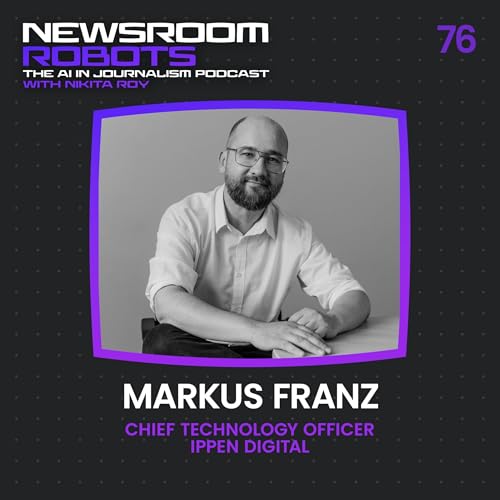
  • Markus Franz: How Germany's Ippen Digital Is Prototyping the AI-Powered Newsroom of the Future
    Nov 26 2025

    How do you redesign a newsroom’s entire workflow when AI is no longer a single tool, but a collection of agents, voice interfaces, and ambient intelligence changing how journalism gets produced?


    This week on Newsroom Robots, host Nikita Roy is joined by Markus Franz, Chief Technology Officer at Ippen Digital, one of Germany’s largest digital media networks with more than 80 online news and media portals. This episode was recorded live at the Digital Growth Summit in Stuttgart, where Markus shared how his team is building some of the most forward-looking AI experiments in European media.


    Markus leads Ippen Digital’s Incubator Lab, an innovation unit focused on reimagining how publishing and AI-driven experiences will evolve. With 16 years inside the company, Markus has been central to Ippen’s digital transformation and now leads efforts around multi-agent architectures and building adaptive workflows for the newsroom.


    In this conversation, Markus breaks down how his lab is experimenting with multi-agent “virtual teams,” voice-first newsroom interfaces, multimodal content production and an ambient AI-powered newsroom where intelligent systems support journalists in real time. He shares what his team has learned from early prototypes, why the biggest challenges are cultural rather than technical, and how news organizations should think about guardrails, platform dependency, and the rise of self-evolving models.


    This episode covers:


    02:22 – Why Ippen Digital built an Incubator Lab and how it’s structured as a future-focused R&D unit


    04:49 – What multi-agent systems look like inside a newsroom


    9:42 – The case for voice as the next major interface for both journalists and audiences


    14:41 – The shift from human-in-the-loop to human-on-the-loop workflows


    17:40 – Guardrails for agent systems: grounding, bounding, editorial policies


    19:33 – The vision for an ambient newsroom powered by AI companions and real-time intelligence


    27:31 – Why vendor lock-in and self-evolving LLMs pose new strategic risks


    30:08 – Multimodal personalization and rethinking how news is experienced


    34:27 – Why most AI pilots fail and what experimentation looks like in practice


    49:19 – Markus’s personal AI stack and how he uses these tools day-to-day


    Sign up for the Newsroom Robots newsletter for episode summaries and insights from host Nikita Roy.

    Hosted on Acast. See acast.com/privacy for more information.

    Voir plus Voir moins
    52 min
  • Olle Zacharison: How BBC News is Shaping its AI Strategy for the Next Era of Journalism
    Nov 15 2025

    How do you bring AI into a newsroom as big and globally distributed as the BBC, an editorial network that stretches across 42 languages and more than 5,000 journalists?


    This week on Newsroom Robots, host Nikita Roy talks to Olle Zachrison, Head of News AI at BBC News, where he leads the BBC’s efforts to advance AI use and strengthen its journalism and audience experiences. Previously, the Head of AI at Swedish Radio, Olle has spent the past few years implementing practical newsroom AI workflows while upholding public-service values.


    In this conversation, Olle breaks down BBC’s four-part AI strategy, covering large-scale translation and transcription, content reformatting, investigative tools, and early experiments with synthetic audio and conversational news. He shares what’s working inside one of the world’s largest news organizations, what routinely stalls AI projects, and why the most challenging part of AI transformation isn’t the technology but the collaboration required across editorial, product, and engineering. Olle also reflects on what it means to innovate as a public broadcaster in an AI-driven ecosystem, and why archives, credibility, and direct audience relationships will determine which journalism remains indispensable in the years ahead.


    This episode covers:


    03:39 – The BBC’s four-part AI strategy: Boosting productivity, reformatting content, augmenting journalism, and innovating user experience as the core themes


    05:10 – Using AI for large-scale transcription, tagging, live pages, alt text, newsletter production, and translation to save time and make content more searchable.


    08:17 – Reformatting content across platforms and formats


    20:59 – Innovating user experiences with synthetic audio and conversational formats


    31:59 – How the BBC uses strategic themes, clear metrics, and fast pilots to decide what’s worth building and scaling


    46:59 – Inside the BBC’s fine-tuned LLM and Style Assist


    52:01 – What it means to be a public broadcaster in an AI-driven ecosystem


    01:02:58 – Olle’s personal AI stack


    Sign up for the Newsroom Robots newsletter for episode summaries and insights from host Nikita Roy.

    Hosted on Acast. See acast.com/privacy for more information.

    Voir plus Voir moins
    1 h et 6 min
Pas encore de commentaire