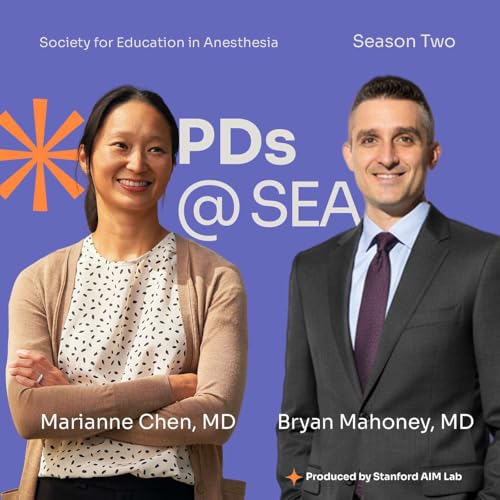
Page de couverture de PDs @ SEA

PDs @ SEA

PDs @ SEA

Auteur(s): Stanford Anesthesia Informatics and Media (AIM)Lab
Écouter gratuitement

À propos de cet audio

PDs @ SEA is a conversation series created for anesthesiology residency leaders, faculty, and trainees who want an honest look into the evolving world of anesthesia education. The show features Residency Program Directors from across the country discussing the decisions, challenges, and real-world considerations behind recruiting, training, and supporting residents.


Hosts Bryan and Marianne draw from their own experiences while inviting colleagues to reflect on practical issues such as changes to the interview and application process, transitions in leadership, and shifting expectations in graduate medical education. Each episode offers candid dialogue, shared lessons, and the sense of community that many program directors look for but often find difficult to access in day-to-day work.


The series includes in-depth conversations with current and former residency leaders, members of the American Society of Anesthesiologists Medical Student Component, and educators who are shaping how residents learn. Together, these discussions provide insight into how program directors think, how residency decisions are made, and how the field continues to adapt to the needs of students, residents, and institutions.


Produced by the Stanford AIM Lab on behalf of the Society for Education in Anesthesiology.


For questions, topic suggestions, or to join the conversation, email: pdsatsea@seahq.org

© 2026 PDs @ SEA
Épisodes
  • Early Exposure, Better Advice: Medical Student Education and the Future of Anesthesiology
    Feb 3 2026

    Medical student education in anesthesiology is often treated as peripheral to residency leadership. Less often is it examined as a strategic lever for recruitment, advising quality, and the long-term health of the specialty.

    In this episode of PDs@SEA, Dr. Marianne Chen is joined by Dr. Mike Hofkamp and Dr. Christine Vo to examine how early exposure to anesthesiology shapes student interest, preparedness, and competitiveness. Drawing from their experiences as long-standing medical student clerkship directors, they reflect on how externships, early electives, interest groups, and even research participation can meaningfully influence career trajectories.

    The conversation explores how medical school curriculum redesign, shortened preclinical phases, and elective flexibility have created new opportunities for anesthesia engagement. The group compares mandatory versus elective anesthesia rotations, highlighting the tradeoffs between intentional participation and broad exposure, and how each model influences student motivation and perception of the specialty.

    Attention then turns to the realities of advising in an increasingly competitive match environment. The episode offers candid guidance on away rotations, virtual interviews, and the evolving role of audition rotations as month-long assessments of both programs and applicants. The discussion moves deeply into signaling strategy, unpacking gold versus silver signals, common misconceptions, and how poor advising can inadvertently disadvantage otherwise strong candidates.

    These themes are grounded in the lived experience of clerkship leadership: variable institutional support, lack of protected time, and the absence of national standardization for medical student directors. The guests reflect on the inaugural medical student education session at the SAAAPM meeting, identifying an advising gap and the growing need for a national community of practice.

    The episode closes with a forward-looking discussion on advocacy, mentorship, and why investing in medical student education is not optional but foundational to sustaining anesthesiology as a specialty.

    Key Takeaways From This Episode

    • Early exposure to anesthesiology strongly influences student interest, preparedness, and application competitiveness.
    • Externships, early electives, and interest groups are powerful recruitment tools, often with unintended positive downstream effects.
    • Elective versus mandatory anesthesia rotations each carry benefits and tradeoffs in engagement and discovery.
    • Audition rotations now serve as critical bidirectional assessments in a virtual interview era.
    • Gold signals drive match outcomes far more than silver signals, and poor signaling strategy can undermine strong applications.
    • Advising gaps persist nationally, particularly around signaling, away rotations, and program competitiveness.
    • Medical student clerkship directors operate with highly variable support, limiting standardization and sustainability.
    • Building a national advising and education community is essential to the future of the specialty.

    Especially Useful For

    Medical student clerkship directors, residency advisors, program directors, associate program directors, vice chairs for education, and anesthesiologists involved in recruitment, mentoring, or undergraduate medical education.

    Related Episodes

    Everything You Wanted to Know About Being a Program Director

    A candid discussion of PD responsibilities, hidden labor, and the structural pressures shaping residency leadership.

    Recruitment in the Virtual Era: Signals, Interviews, and Applicant Experience

    Examines how virtual interviews, signaling, and visiting rotations are reshaping anesthesiology recruitment.

    Voir plus Voir moins
    38 min
  • Everything You Wanted to Know About Being a Program Director
    Dec 20 2025

    Program directorship is often framed as an administrative role or temporary leadership assignment. Less often is it examined as a structurally vulnerable position, balancing the needs of residents, faculty, institutions, and accreditation requirements.

    In this episode of PDs@SEA, Dr. Marianne Chen and Dr. Bryan Mahoney reflect on the candid “Everything You Wanted to Know” session from the SAAAPM annual meeting, surfacing experiences program directors across the country rarely articulate publicly. The conversation opens with a striking finding: only a small minority of program directors anticipate staying in the role beyond six years, prompting discussion about burnout, identity, and the hidden labor of residency leadership.

    The discussion explores how artificial intelligence is entering PD workflows, from letters of recommendation and promotion reviews to early scheduling experiments, alongside a clear-eyed assessment of where automation helps and where human judgment remains essential. Recruitment practices are also examined, including signaling, interview volume, second looks, and the tension between efficiency, equity, and applicant experience.

    These themes are grounded in the daily realities of program leadership: evaluations, duty hours, follow-ups, and persistent administrative load. Practical strategies emerge around organization, delegation, habit formation, and boundary-setting, as well as how perspective shifts with experience.

    The episode closes by asking whether the growing competitiveness of anesthesiology will translate into a sustainable pipeline of future leaders, and what institutions must do to support those entrusted with raising the next generation professionally.

    Key Takeaways From This Episode

    • Program director burnout is largely structural, driven by the role’s position between residents, faculty, institutions, and accreditation requirements.
    • Short PD tenures signal sustainability challenges that cannot be solved through individual resilience alone.
    • AI is beginning to reduce administrative burden for PDs, but only when paired with deliberate human oversight.
    • Recruitment mechanisms such as signaling and second looks improve efficiency while introducing new equity tradeoffs.
    • Administrative overload remains a central stressor and requires systems-level solutions, not incremental fixes.
    • Sustainable PD leadership depends on habits, delegation, and boundaries rather than constant availability.
    • Program directors shape the future of the specialty by “raising residents professionally,” extending their impact beyond individual programs.

    Especially Useful For

    Program directors, associate program directors, residency leadership teams, department chairs, and clinician-educators focused on the sustainability of graduate medical education leadership.

    Related Episodes

    • Why Residency Leadership Is Burning Out (And Why It Still Matters)
      A direct examination of PD burnout, structural pressures, and why sustaining leadership roles requires institutional support rather than individual endurance.
    • Passing the Torch: How a Residency Survives (and Grows) Through Leadership Change
      Explores leadership transitions, continuity, and what departments can do to protect programs during periods of PD turnover.
    Voir plus Voir moins
    40 min
  • A New Co-Host and a New Era in Residency Recruitment
    Nov 7 2025

    This episode marks a major milestone for PDs @ SEA. We celebrate our tenth episode and welcome our new co-host, Dr. Marianne Chen, Residency Program Director at Stanford. Marianne joins host Dr. Bryan Mahoney to talk about leadership transitions, the realities of running a residency, and how signaling and recent ERAS changes are reshaping recruitment across anesthesiology.

    Together, they compare early data, share how signaling is affecting the depth and fairness of application review, and reflect on the role of team-based recruitment. They also discuss the value and limits of the new applicant essay prompts and how programs interpret gold and silver tier signals differently.

    This conversation offers practical insight for program directors, faculty, clerkship directors, and educators navigating this year’s recruitment season. It also highlights the shared commitment across programs to support trainees and build strong, inclusive learning environments.

    This episode was recorded, produced, edited and published by Larry Chu, MD and the Stanford AIM lab.

    Voir plus Voir moins
    32 min
Pas encore de commentaire