Épisodes

  • 3-1-26: 2nd Sunday of Lent Readings + Homily
    Mar 1 2026
    A Reading from the Book of Gensis


    The LORD said to Abram: “Go forth from the land of your kinsfolk and from your father’s house to a land that I will show you.“I will make of you a great nation, and I will bless you; I will make your name great, so that you will be a blessing. I will bless those who bless you and curse those who curse you. All the communities of the earth shall find blessing in you.”Abram went as the LORD directed him.


    The Word of the Lord

    Responsorial Psalm

    Lord, let your mercy be on us, as we place our trust in you.

    Upright is the word of the LORD,
    and all his works are trustworthy.
    He loves justice and right;
    of the kindness of the LORD the earth is full.


    R. Lord, let your mercy be on us, as we place our trust in you.

    See, the eyes of the LORD are upon those who fear him,
    upon those who hope for his kindness,
    To deliver them from death
    and preserve them in spite of famine.

    R. Lord, let your mercy be on us, as we place our trust in you.

    Our soul waits for the LORD,
    who is our help and our shield.
    May your kindness, O LORD, be upon us
    who have put our hope in you.

    R. Lord, let your mercy be on us, as we place our trust in you.


    A reading from the 2nd letter off St. Paul to Timothy

    Beloved: Bear your share of hardship for the gospel with the strength that comes from God.He saved us and called us to a holy life, not according to our works but according to his own design
    and the grace bestowed on us in Christ Jesus before time began, but now made manifest
    through the appearance of our savior Christ Jesus, who destroyed death and brought life and immortality to light through the gospel.


    The Word of the Lord


    A reading from the Holy Gospel according to Matthew

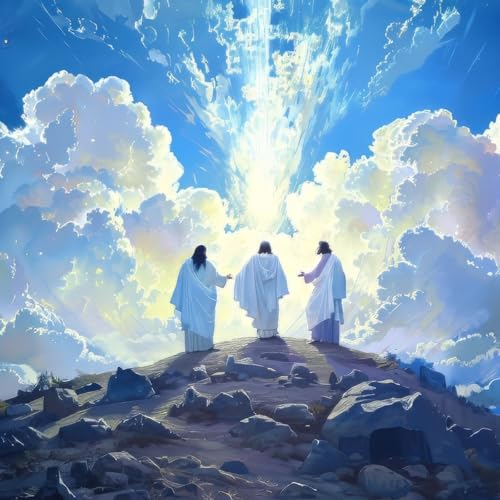
    Jesus took Peter, James, and John his brother, and led them up a high mountain by themselves.
    And he was transfigured before them; his face shone like the sun and his clothes became white as light. And behold, Moses and Elijah appeared to them, conversing with him. Then Peter said to Jesus in reply, “Lord, it is good that we are here. If you wish, I w ill make three tents here,
    one for you, one for Moses, and one for Elijah.” While he was still speaking, behold,
    a bright cloud cast a shadow over them, then from the cloud came a voice that said, “This is my beloved Son, with whom I am well pleased; listen to him.”

    When the disciples heard this, they fell prostrate and were very much afraid. But Jesus came and touched them, saying, “Rise, and do not be afraid.” And when the disciples raised their eyes,
    they saw no one else but Jesus alone.As they were coming down from the mountain,
    Jesus charged them, “Do not tell the vision to anyone until the Son of Man has been raised from the dead.”

    The Gospel of the Lord


    Voir plus Voir moins
    12 min
  • 3-1-26: 2nd Sunday of Lent Homily
    Mar 1 2026
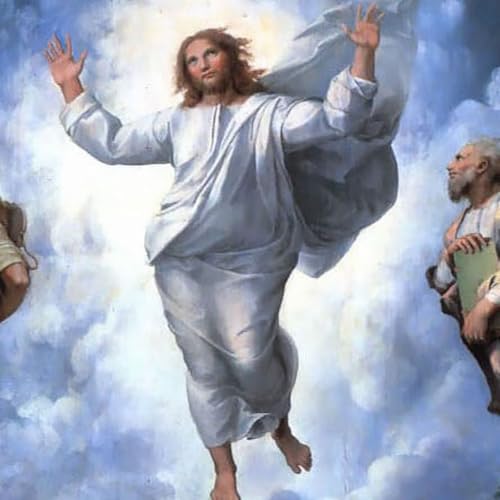
    Second Sunday of Lent – 3-1-2026 Year A – The Transfiguration The Cloud of Knowing The oldest surviving depiction of Christ’s crucifixion is in Rome. It dates from the 430s and is carved into the wooden doors of the church of Santa Sabina on Rome's Aventine Hill. The carving is not particularly expressive of Christ’s suffering. He is alive and rather dignified. He is between two thieves, and his arms are extended in the traditional pose of the crucifixion. It’s a bit surprising but showing Christ crucified was uncommon in the first few centuries of the Church. Crucifixes, and even paintings and icons of the crucifixion, did not proliferate until the 6th through the 9th centuries, and even then, very slowly. It wasn’t until the dawning of the high Middle Ages, around 1000 AD, that the suffering, bloodied, forlorn Christ on the cross became common in churches throughout the known world. Before he was shown pinned to the cross, Christ was more commonly shown as the Good Shepherd, young and sometimes beardless, or at the table of the Last Supper flanked by his apostles. He was very often shown in the orans, or praying, position. Sometimes he was shown in a Roman toga holding a book or a scroll, resembling a philosopher. Or he was shown as he appears in today’s gospel – Transfigured on a high mountain. It makes sense, culturally and sociologically, that early Christians were reluctant to depict their founder struggling, pained and dead. Crucifixion was an act of capital punishment. And in a world of barbaric cruelty towards prisoners and criminals, showing your leader on a common instrument of torture would probably have been counter-productive. Imagine displaying a painting in your home of a man dying in an electric chair, or wearing a gold medal showing a man with a noose around his neck, hanging from a branch. We have become habituated to the crucifix, but for early Christians it may have been too raw and too confusing to bend their knee or bow their head toward a bloody man stuck to a wooden beam. Not showing Christ on the cross also made sense theologically for early Christianity. A crucifix is easily understood by us today because we have a wealth of teaching and solid traditions to help us interpret it – the God-man dies for our sins and then opens for us the doors to paradise through his bodily resurrection. Christ’s immolation was a multi-layered theological event. It took many centuries for the Church’s best minds to cogently plumb the depths of Christ’s great act of redemptive suffering in its full biblical, historical, liturgical, and philosophical richness. Christ’s miracles, His resurrection, His preaching, and His transfiguration, as opposed to his crucifixion, require less theology to grasp. These events explain themselves. They don’t require knowledge of the Old Testament to make sense. And so the most common artistic motifs of the first millenium show Christ praying, performing miracles, being transfigured, teaching, or rising from his tomb. Centuries were to pass before Christ’s self-offering on the cross could be fully understood by the common mind and fully displayed in common art. Roughly speaking, very roughly, the second millennium church gathered around Christ’s death on Calvary in Jerusalem, while the first millennium church gathered around his crib in Bethlehem. Christ’s humble self-gift in the incarnation led, over centuries, to a deeper comprehension of his self-gift on the cross. The spiritual refreshment pulled from the well of the incarnation is based on humility, a humility witnessed by Peter, James, and John in today’s gospel Christ shows this select core of three apostles his radiant glory – and the apostles are dumbfounded. They have not met this man before. What happened to the carpenter’s son from little Nazareth? The Church fathers consistently commented that the real miracle of the transfiguration was not this one moment in which Christ revealed his divinity but that he consistently suppressed his divinity throughout his life. His ordinariness, the mundane, day in and day out humdrumness of his life was the real miracle to behold. Christ could have been surrounded by today’s super-halo as He planed a board in his workshop. But he wasn’t. He could have walked around in the midst of a cloud of witnesses such as Moses and Elijah. But he didn’t. The voice of His father could have thundered in appreciation at every holy act he performed. But it didn’t. Christ wore a common tunic. He slept on the ground. He ate fish baked over a campfire. He walked long miles on dusty trails. And few discerned his divine nature until his resurrection and ascension. Christ’s first and most significant transfiguration was becoming a baby. His sustained suppression of his divinity was what made him unique. Like superman ripping open his shirt to reveal ...
    Voir plus Voir moins
    9 min
  • 1st Sunday of Lent 2026 Readings & Homily
    Feb 22 2026
    First Sunday of Lent Readings 2-22-2026 Year C A reading from the Book of Genesis The LORD God formed man out of the clay of the ground and blew into his nostrils the breath of life, and so man became a living being. Then the LORD God planted a garden in Eden, in the east, and placed there the man whom he had formed. Out of the ground the LORD God made various trees grow that were delightful to look at and good for food, with the tree of life in the middle of the garden and the tree of the knowledge of good and evil. Now the serpent was the most cunning of all the animals that the LORD God had made. The serpent asked the woman, “Did God really tell you not to eat from any of the trees in the garden?” The woman answered the serpent: “We may eat of the fruit of the trees in the garden; it is only about the fruit of the tree in the middle of the garden that God said, ‘You shall not eat it or even touch it, lest you die.’” But the serpent said to the woman: “You certainly will not die! No, God knows well that the moment you eat of it your eyes will be opened and you will be like gods who know what is good and what is evil.” The woman saw that the tree was good for food, pleasing to the eyes, and desirable for gaining wisdom. So she took some of its fruit and ate it; and she also gave some to her husband, who was with her, and he ate it. Then the eyes of both of them were opened, and they realized that they were naked; so they sewed fig leaves together and made loincloths for themselves. The Word of the LordResponsorial Psalm R. Be merciful, O Lord, for we have sinnedHave mercy on me, O God, in your goodness; in the greatness of your compassion wipe out my offense. Thoroughly wash me from my guilt and of my sin cleanse me. R. Be merciful, O Lord, for we have sinnedFor I acknowledge my offense, and my sin is before me always: “Against you only have I sinned, and done what is evil in your sight.” R. Be merciful, O Lord, for we have sinned. A clean heart create for me, O God, and a steadfast spirit renew within me. Cast me not out from your presence, and your Holy Spirit take not from me. R. Be merciful, O Lord, for we have sinned. Give me back the joy of your salvation, and a willing spirit sustain in me. O Lord, open my lips, and my mouth shall proclaim your praise. R. Be merciful, O Lord, for we have sinned. A reading from the letter of St. Paul to the Romans Brothers and sisters: Through one man sin entered the world, and through sin, death, and thus death came to all men, inasmuch as all sinned— for up to the time of the law, sin was in the world, though sin is not accounted when there is no law. But death reigned from Adam to Moses, even over those who did not sin after the pattern of the trespass of Adam, who is the type of the one who was to come. But the gift is not like the transgression. For if by the transgression of the one, the many died, how much more did the grace of God and the gracious gift of the one man Jesus Christ overflow for the many. And the gift is not like the result of the one who sinned. For after one sin there was the judgment that brought condemnation; but the gift, after many transgressions, brought acquittal. For if, by the transgression of the one, death came to reign through that one, how much more will those who receive the abundance of grace and of the gift of justification come to reign in life through the one Jesus Christ. In conclusion, just as through one transgression condemnation came upon all, so, through one righteous act, acquittal and life came to all. For just as through the disobedience of the one man the many were made sinners, so, through the obedience of the one, the many will be made righteous.The Word of the LordA reading from the Hoiy Gospel according to MatthewAt that time Jesus was led by the Spirit into the desert to be tempted by the devil. He fasted for forty days and forty nights, and afterwards he was hungry. The tempter approached and said to him, “If you are the Son of God, command that these stones become loaves of bread.” He said in reply, “It is written: One does not live on bread alone, but on every word that comes forth from the mouth of God.” Then the devil took him to the holy city, and made him stand on the parapet of the temple, and said to him, “If you are the Son of God, throw yourself down. For it is written: He will command his angels concerning you and with their hands they will support you, lest you dash your foot against a stone.” Jesus answered him, “Again it is written, You shall not put the Lord, your God, to the test.”Then the devil took him up to a very high mountain, and showed him all the kingdoms of the world in their magnificence, and he said to him, ""All these I shall give to you, if you will prostrate yourself and worship me.” At this, Jesus said to him, “Get away, Satan! It is written: The Lord, your God, shall ...
    Voir plus Voir moins
    18 min
  • 1st Sunday of Lent 2026 Homily
    Feb 22 2026
    First Sunday of Lent 2-22-26 Homily We, the hearers of today’s mass readings, find ourselves in a primordial garden this First Sunday of Lent, ear witnesses to the first conversations of mankind. After blowing life into the nostrils of man, God quickly follows with a prohibition: “You shall not eat the fruit of the tree of knowledge of good and evil” ...and it’s all downhill from there. The mouth is a source of many and varied sins. The mouth, in fact, may be the cause of damnation more than any other part of the human body. The mouth of Eve opens wide in today’s reading from Genesis and closes again on a piece of fruit, changing the world forever. That “opening” act was preceded by Eve opening her mouth for a different purpose - to jaw with the serpent. That superfluous exchange of words formed the glide path to the original sin of eating. Mankind eats. We must eat. The necessity of eating is part of all animal life, down to bacterial life. Even amoebas eat, though not with mouths. The need to eat pulls man out of his home, compelling him to search for food, to gathering the material needed to nourish his body. This search for food is a fundamental reason why mankind engages with the broader world in the first place and becomes a social animal. While on the search for food, we cross paths with people we would otherwise never meet...at the market, the store, or the restaurant. Eve herself is in a garden looking for food when she runs into the devil himself. If she had stayed home, she may never have met her match. And what does man eat? Anything and everything. We are omnivores. Our jaws, our teeth, and our appetites consume bark, clams, liver, mushrooms, grasshoppers, snake eggs, monkey brains, frog legs, and sheep eyeballs - the list of strange foods and delicacies is endless. We are greedy for food and devour almost all that the earth offers us. Nearly all that our eyes behold is fit for consumption, especially when in dire need, except when our eyes fall on our fellow man. We see our cousin, our neighbor, even our enemy, and we know that him we cannot consume. Only the most primitive man, he most untrained in religious and human virtues, will consume his neighbor. When I conclude that I cannot eat my fellow man I am also concluding something else - that my fellow man should not eat me. My neighbor is not edible for the same reason that I am not edible. My dignity surpasses that of a carrot, a lobster, or a cow. Eating, clearly, is more than caloric intake. The pan-cultural prohibition against canabalism hints at an important insight - that there is a moral code embedded in our choice of what to eat and what not to eat. And if there are layers of meaning to so fundamental a biological function as eating, then it follows that there are also deeper layers of meaning to every human activity, especially those acts superior to basic biological functioning, activities like willed actions. God’s commandment to Adam and Eve not to eat the fruit of the tree of knowledge of good and evil does what all moral codes do – it sets a limit. All morality starts with setting limits on our behavior or even on our thinking. These guardrails, and the effort to live life within these guardrails, forms the essential drama of every human soul, every household, and every community. Without limits, life is less interesting, and its deeper layers remain buried and unseen. The ultimate limit, or deadline, is death. The final frontier of death, that dark curtain, gives all of life a sense of urgency and purpose. Our being towards death, our life as hemmed in by the constraint of our biological end, makes us pay closer attention to all of reality. An endless life on earth, after all, would be essentially without purpose, without punishment, without reward, and without moral drama. If Eve had not sinned our lives on earth would still have ended, just not through the pain of death, but through some other form of departure perhaps similar to Mary’s, the only creature who has never tasted death. There are endless layers of meaning to the Genesis narrative. Its depths have been plumbed, its nuances have been unpacked, by many impressive and creative theologians, artists, and philosophers. As people of the modern west, we have been schooled in the suppositions of the Enlightenment, and biased by our hyper technological, democratic culture. So we are sensitive to any restrictions on our freedom, which we tend to understand as an ultimate good. The seprent in the Genesis narrative today frames God as man’s enemy. But God is not our enemy. He’s not even our rival. God is not happy to the extent that we are sad. He is not pleased to the extent that we remain unpleased or unsatisfied. Our happiness, our fulfillment, is more likely when our will concurs with His. When our gift of freedom is exercised in accordance with His will, as...
    Voir plus Voir moins
    10 min
  • Ash Wednesday 2026 Readings + Homily
    Feb 18 2026
    Ash Wednesday Readings & Homily 2026First Reading: Joel 2:12-18Even now, says the LORD, return to me with your whole heart, with fasting, and weeping, and mourning; Rend your hearts, not your garments, and return to the LORD, your God. For gracious and merciful is he, slow to anger, rich in kindness, and relenting in punishment. Perhaps he will again relent and leave behind him a blessing, Offerings and libations for the LORD, your God.Blow the trumpet in Zion! proclaim a fast, call an assembly; Gather the people, notify the congregation; Assemble the elders, gather the children and the infants at the breast; Let the bridegroom quit his room and the bride her chamber. Between the porch and the altarlet the priests, the ministers of the LORD, weep, And say, "Spare, O LORD, your people,and make not your heritage a reproach, with the nations ruling over them!Why should they say among the peoples, 'Where is their God?'"Then the LORD was stirred to concern for his land and took pity on his people.The Word of the LordResponsorial Psalm: Psalm 51:3-4, 5-6ab, 12-13, 14 and 17R. Be merciful, O Lord, for we have sinned.Have mercy on me, O God, in your goodness;in the greatness of your compassion wipe out my offense.Thoroughly wash me from my guiltand of my sin cleanse me.R. Be merciful, O Lord, for we have sinned.For I acknowledge my offense,and my sin is before me always:"Against you only have I sinned,and done what is evil in your sight."R. Be merciful, O Lord, for we have sinned.A clean heart create for me, O God,and a steadfast spirit renew within me.Cast me not out from your presence,and your Holy Spirit take not from me.R. Be merciful, O Lord, for we have sinned.Give me back the joy of your salvation,and a willing spirit sustain in me.O Lord, open my lips,and my mouth shall proclaim your praise.R. Be merciful, O Lord, for we have sinned.Second Reading: 2 Corinthians 5:20—6:2Brothers and sisters: We are ambassadors for Christ, as if God were appealing through us.We implore you on behalf of Christ, be reconciled to God. For our sake he made him to be sin who did not know sin, so that we might become the righteousness of God in him.Working together, then,we appeal to you not to receive the grace of God in vain. For he says: In an acceptable time I heard you, and on the day of salvation I helped you. Behold, now is a very acceptable time;behold, now is the day of salvation. The Word of the LordA reading from the Holy Gospel According to Matthew (6:1-6, 16-18)Jesus said to his disciples: "Take care not to perform righteous deeds in order that people may see them; otherwise, you will have no recompense from your heavenly Father. When you give alms,do not blow a trumpet before you, as the hypocrites do in the synagogues and in the streetsto win the praise of others. Amen, I say to you, they have received their reward. But when you give alms, do not let your left hand know what your right is doing, so that your almsgiving may be secret.And your Father who sees in secret will repay you."When you pray, do not be like the hypocrites, who love to stand and pray in the synagogues and on street corners so that others may see them. Amen, I say to you, they have received their reward. But when you pray, go to your inner room, close the door, and pray to your Father in secret.And your Father who sees in secret will repay you."When you fast, do not look gloomy like the hypocrites. They neglect their appearance, so that they may appear to others to be fasting. Amen, I say to you, they have received their reward. But when you fast, anoint your head and wash your face, so that you may not appear to be fasting,except to your Father who is hidden. And your Father who sees what is hidden will repay you."The Gospel of the LordHomilyNormally the first word that a baby learns, unsurprisingly, is “mama.” One of the next words that most babies learn is “more.” A baby wants more food, more drink, more mom, more dad, more everything. We never forget that word, do we? From our infancy we simply want more and more. We even want more of non-tangible, non-physical things. We want more feedback. More compliments. More leisure. More knowledge. We very naturally want more. And no one has to stoke the fires of more, to remind us to desire more. We want more sleep, and no one needs encouragement to hit the snooze button, or to spend more time online, or to eat more ice cream. All of these things come to us naturally. The opposite of “more” may not be “less” but simply “no” or “none.” The beginning of Lent is a good time to remind ourselves that the word “no” can be a loving word. When a mom or dad tells their teenage daughter to be home at 11, she might say, “but why can't I stay out until 12? Don't you love me?” And they could respond “Yes, we love you, - be home by 11.” In other words “We love you, no, you can’t stay out until...
    Voir plus Voir moins
    12 min
  • Ash Wednesday 2026 Homily
    Feb 18 2026
    ASH WEDNESDAY 2026

    Normally the first word that a baby learns, unsurprisingly, is “mama.” One of the next words that most babies learn is “more.” A baby wants more food, more drink, more mom, more dad, more everything.

    We never forget that word, do we? From our infancy we simply want more and more. We even want more of non-tangible, non-physical things. We want more feedback. More compliments. More leisure. More knowledge. We very naturally want more. And no one has to stoke the fires of more, to remind us to desire more. We want more sleep, and no one needs encouragement to hit the snooze button, or to spend more time online, or to eat more ice cream. All of these things come to us naturally.

    The opposite of “more” may not be “less” but simply “no” or “none.” The beginning of Lent is a good time to remind ourselves that the word “no” can be a loving word. When a mom or dad tells their teenage daughter to be home at 11, she might say, “but why can't I stay out until 12? Don't you love me?” And they could respond “Yes, we love you, - be home by 11.” In other words “We love you, no, you can’t stay out until 12.” “I love you, no” is an alternative to “I love you, yes.” Our body often demands that we respond to its desires with yes. But in Lent we tell our bodies “I love you, no!”

    On Ash Wednesday and throughout Lent the Church encourages us to say “no” to ourselves more often. She teaches us that “more and more” is not beneficial for our bodies or our souls. The more we say “no” to food and drink and pleasure, the more capable we are of saying “yes” to God.
    We don’t seek to free ourselves from external chains just for the sake of being free. Freedom is not a goal as much as a means. Freedom is like time or money. It’s meant to be used, otherwise it loses its meaning. Freedom from the demands of the body has a positive more than a negative purpose. We are free “from” so that we can free “for.” We are free from self-focus, self- aggrandizement, self-coddling, so that we can be free for service to the church and others. To liberate ourselves from the incessant demands of our own bodies frees us for service to others. When we are not slaves to our bodily desires, we are more available, more willing, more capable, to serve those around us and to practice our faith at full throttle.

    On Ash Wednesday our undying church smudges ash on our forehead and whispers “You’re gonna die.” We can almost feel the priest’s breath on our face as he says, in effect, “You're no bigger or better than this little pile of dust.” And this is not a virtual or digital encounter. The priest doesn’t appear through a screen. Receiving ashes is a real encounter between two real people, and if someone doesn't believe that Catholicism is true, today at least they know that Catholicism is real, and that realness may, down the road, lead to belief. Ours is not a fake or a counterfeit religion. There's nothing more real than wearing a scuff of ash on your forehead at lunch today. The deep religious sentiment conveyed today is not too intellectual. A smudge on our forehead is not an idea or a concept. It’s simply there...all..day...long, a temporary Catholic tatoo. And we can’t outrun our forehead.

    On archeological digs, it’s very common that as the workers tunnel down through the layers of dirt and rock and broken shards of pottery, they find an ash layer. This shows where a fire burned down the castle, the city, the fort, or the house. This is where everything before came to an end. This layer demarcates destruction and a new beginning. A bed of ash separates one era from another. May today be our own personal ash layer. From today’s ashes may we start again. Today - may we drop our sins like a murder weapon. May we leave behind the old man and start the Chrisitan adventure again, harnessing our desires. We will return one day to the dust from which God made us. And when we return to that state there will be judgment, there will be mercy, and there will be condemnation. There will be heaven, hell, or purgatory. And there will be eternity. May we prepare well for that endless day. Amen.
    Voir plus Voir moins
    6 min