Page de couverture de Selling the Cloud

Selling the Cloud

Selling the Cloud

Auteur(s): Mark Petruzzi KK Anderson Paul Melchiorre
Écouter gratuitement

À propos de cet audio

Selling the Cloud delves into the stories of C-suite veterans in Sales, Marketing, Customer Success, and RevOps, revealing the secrets behind building successful SaaS empires. Each episode features seasoned leaders who walk through their career journeys, sharing the wins and lessons learned along the way. From mastering customer acquisition to leveraging AI-powered marketing and sales strategies, our guests provide actionable insights for driving growth and business success in the B2B SaaS space.

Guided by a powerhouse team of co-hosts, including Mark Petruzzi, Paul Melchiorre, and Kristin "KK" Anderson, Selling the Cloud offers a front-row seat to the evolving world of Go-To-Market strategies. This podcast extends the insights from the best-selling books "Selling the Cloud" and "Data and Diagnosis-driven Selling", co-authored by Mark Petruzzi and Paul Melchiorre, making it your go-to source for the latest trends and practical tips in SaaS excellence.


© © 2026 Selling the Cloud
Développement commercial et entrepreneuriat Entrepreneurship Gestion et leadership Économie
Épisodes
  • Ep. 117 – Escaping the Crisis of Sameness in Modern Sales with Doug Landis – Part 2
    Mar 11 2026
    In this episode, Mark Petruzzi and KK Anderson sit down with Doug Landis to explore why storytelling has become one of the most powerful skills in modern sales. From lessons learned in the film industry to practical strategies for enterprise selling, the conversation highlights how narratives help sellers build trust, create alignment, and close deals faster.Doug explains that buyers don’t actually buy products; they buy the story attached to the outcome those products create. When sellers focus on telling clear, meaningful stories rather than listing features, they make it easier for buyers to understand the value and communicate it internally. The discussion also dives into the shift from traditional inside-out selling (focused on CRM data and internal information) to an outside-in approach, where sellers study the buyer’s business, strategy, and external signals to craft a more relevant narrative.What You’ll LearnWhy storytelling is more powerful than product features in salesHow great stories help buyers remember your solution and sell it internallyThe difference between rambling and effective storytelling in conversationsWhy sellers should shift from inside-out CRM preparation to an outside-in perspectiveHow understanding your buyer’s business leads to stronger trust and bigger dealsWhy trust-driven selling can accelerate deal cycles and increase deal sizePractical ways sales leaders can build storytelling into their team cultureKey topics covered include:How great stories help buyers sell your solution internallyThe difference between rambling and structured storytellingWhy sellers should spend more time on outside-in researchHow AI tools can help sellers synthesize external insights fasterWhat leaders can measure to prove trust-driven selling worksRapid-fire insights on sales habits, books, and early lessonsDoug also shares a powerful reminder: people don’t buy features; they buy the outcome the story promises, whether that’s solving a problem, improving their business, or simply getting their Sundays back. Mark Petruzzi (00:31)Now that is some, that's really, really great stuff, Doug. And I'm gonna share a little bit about how I use, how I've learned to use stories into my selling process. And not only my selling process, running companies, working with private equity firms, communicating with people in all kinds of ways. And it really came down to about 15 years ago,Doug Landis (00:45)Mmm, yes.Mark Petruzzi (00:56)I was involved with a couple of ⁓ and brought in by friends of mine in a couple of films and TV series. I invested in a couple of them for a little bit of a while. was like, forget about enterprise software and selling. And I'm going to be running around with Steven Spielberg soon. That didn't happen. But we did pretty well with these movies.And I'll give you an example. Somebody I've done work with is a filmmaker by the name of Michael Corente. And he's just one example of about a half a dozen that I got to work with. But he's a producer. That's what he focuses on. And in the entertainment industry, I learned there are no, well, there are, I found in my career, there are no better storytellers, not even than the writers. Of course they know how to tell stories.Doug Landis (01:20)So cool.Mark Petruzzi (01:44)but the producers that are out there getting investments and everything else. And man man, Michael was one of them. He's done some amazing things. He's created some really just incredible films that he made happen and he does a lot of stuff with Netflix now and Hulu and incredible stuff. So my point in this is for everyone in business,Doug Landis (01:48)Yep.Mark Petruzzi (02:09)Find your way of getting exposed to individuals like that. Now we all can't typically just call up and get to know a producer. I just happen to have some friends in the industry that I grew up with and got in that track. But maybe it's about writers. It's about different people who run businesses that you just look at. And just learn that side of the equation becauseIt's as specific as you define it, in my opinion, and it's also as generic as just like if you learn how to be a good storyteller, you're going to be successful in business and life. Like I use these same skills with my two children. they love to hear stories. It's just incredible. good.Doug Landis (02:48)Amen.KK Anderson (02:49)People will like you, Yeah.Doug Landis (02:53)Well, I got a caveat to that.I have a caveat to that. Everybody loves somebody who is a good storyteller. Everybody despises somebody who not despise that's pretty aggressive, but it's not a big fan of the people who ramble. They think they're telling a story and they're just it's just one ginormous run on sentence that you never know where going to end. Because reality is it right like it's like no one wants to be the person stuck at the party with I ⁓ I got to sit next to them. ⁓ they never shut up. They always sayKK Anderson (03:09)Yes.1,000.Mark ...
    Voir plus Voir moins
    21 min
  • Ep. 116 – Escaping the Crisis of Sameness in Modern Sales with Doug Landis – Part 1
    Mar 3 2026
    In this episode of Selling the Cloud, Mark Petruzzi and KK Anderson sit down with Doug Landis, Co-Founder of StoryPath.ai and host of Sales Stories, to unpack how AI is reshaping the buyer seller relationship and why most sales teams are still playing by outdated rules.Doug shares why AI has enhanced the buyer’s world more than the seller’s, what he calls the invisible evaluation, and how today’s buyers are 80 to 90 percent through their decision process before ever speaking to a rep.The conversation dives deep into the crisis of sameness in modern sales, why traditional discovery no longer works, and how trust and story have become the last true differentiators in a crowded market.If you are leading a sales team, building a pipeline, or navigating complex enterprise deals, this episode will challenge how you think about first meetings, process, and positioning in an AI driven world.What You’ll Learn:AI and the Buyer Shift: Why 89 percent of B2B buyers are using generative AI and how 83 percent of the journey now happens without a seller.The Invisible Evaluation: How buyers are researching, comparing, and shortlisting vendors without leaving digital breadcrumbs.The Crisis of Sameness: Why AI tools are causing sellers to sound identical and how that kills differentiation.First Meeting Reimagined: How to show up with a hypothesis, point of view, and buyer language instead of running outdated discovery scripts.Trust and Story as Strategy: Why storytelling is not case studies and how narrative builds alignment across large buying committees.CEO of the Territory: Why modern reps must think like business leaders, not process followers.Key Topics:AI’s impact on B2B buying behaviorRethinking the traditional sales processDiscovery versus hypothesis led sellingBuilding trust through empathy and buyer ontologyStory as a tool for alignment and influenceCoaching sales teams in a new paradigmDifferentiation in enterprise SaaS and AI marketsGuest Spotlight: Doug LandisDoug Landis is Co-Founder of StoryPath.ai, an AI native guided selling and storytelling platform designed to help sellers show up with differentiated perspectives, not just better automation. He previously led global sales productivity at Salesforce, served as Chief Storyteller at Box, and was a growth partner at Emergence Capital.Doug is also the host of Sales Stories and a long time advocate for trust based, story driven enterprise selling.🎧 Listen now and follow Selling the Cloud for more insights on modern go to market strategy, enterprise sales, and how to win in a one shot world.Mark Petruzzi (00:34)Welcome to Selling the Cloud. Our guest today is Doug Landis. We're very fortunate to have Doug, who is the co-founder of StoryPath.ai, host of the Sales Stories podcast. He's a storyteller and he's just successfully built early stage companies time and time again. Doug has led global sales productivity at Salesforce.He served as the chief storyteller at Box and spent seven years as a growth partner at Emergence Capital, helping SaaS companies scale smarter. He has sold everything from newspapers and ice cream to enterprise databases and cloud software. Today, he's really focused on and really enjoying building up StoryPath.ai.StoryPath is an AI native guided selling and storytelling platform that helps sellers show up with differentiated perspective, not just better automation. Three topics we'll cover today. How AI has changed buying behavior more than selling behavior. Why trust and story are the only real differentiators left. And how sellers can compare differently and win in a one shot world.Doug, we're so fortunate, as I said, to have you here, and welcome to Selling the Cloud.Doug Landis (01:50)Thank you. So great to be back. That was all I think I was on a long time ago. I don't even remember what we were talking about back then. And you know, it's interesting as you were doing the, you're going through the intro, I was thinking, I was like, well, given the fact that it feels like everything's shifting to be AI native AI first, everything's all AI. Just does the podcast shift to like selling AI instead of selling the cloud?Mark Petruzzi (01:53)Be back.Doug Landis (02:14)By the way, not yet. Just for a little side note, was on a webinar with about 250 operational leaders, sales and rev ops leaders. And I asked the question, Mike, what percentage on average of your entire go-to-market tech stack is still pure SaaS versus AI? And the answer was at least 85 % of their stack was still pure SaaS. So while we say everything is moving AI and it's moving fast, really fast.There's still so much that's already like fully baked in. so now everyone's been trying to figure out like, how do we actually, make it additive instead of completely rip and replace. But anyway, so the pod selling the cloud is still relevant for awhile.Mark Petruzzi (02:52)Yes and no, we're actually working on exactly that now, Doug. So you're hitting us right at the......
    Voir plus Voir moins
    27 min
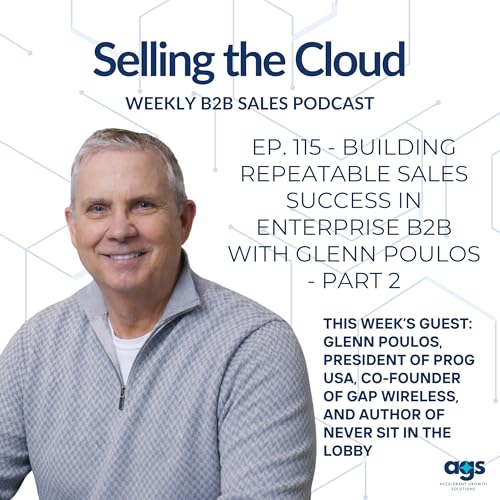
  • Ep. 115 - Building Repeatable Sales Success in Enterprise B2B with Glenn Poulos - Part 2
    Feb 24 2026
    In Part 2 of this conversation on Selling the Cloud, Glenn Poulos dives deep into what it really takes to scale a distribution business from startup to successful exit. From growing Gap Wireless from 1 million dollars in revenue to 84 million over 15 years, Glenn shares the strategic decisions, mindset shifts, and leadership disciplines that enabled sustainable growth in the telecom technology sector.Glenn unpacks the importance of franchise vendor relationships, why brand positioning determines sales velocity, and how to structure an organization with the right people in the right seats. He also tackles one of the most critical dynamics in distribution: building trust with manufacturers while managing the real risk of going direct.The episode closes with a practical and grounded perspective on AI in sales. Glenn explains how to use AI as a powerful assistant across departments without sacrificing the human connection that ultimately closes enterprise deals. Plus, stay for the rapid fire segment where he shares hard lessons from selling his first company, advice for his 21 year old self, and the sales habits he still practices today.What You’ll Learn:Scaling from Startup to Exit: The key inflection points that helped grow Gap Wireless from 1 million to 84 million in revenue.Brand Strategy in Distribution: Why representing top tier brands is essential for competitive sales positioning.Right People, Right Seats: How organizational structure and disciplined hiring drive long term growth.Manufacturer Trust Dynamics: Navigating co-selling, exclusivity, and the risk of vendors going direct.AI as an Assistant, Not a Replacement: How to use AI for research, prep, legal review, and financial insights without losing the human edge.Sales Discipline That Compounds: Daily habits that create visibility, opportunity, and long term career growth.Key Topics:Franchise distribution models in telecom and technologyRelationship first selling in enterprise B2BOrganizational design and leadership evolutionManaging vendor partnerships and channel conflictAI in sales operations, finance, marketing, and legalCareer defining mistakes and lessons learnedGuest Spotlight: Glenn PoulosGlenn Poulos is a sales expert, author, and serial entrepreneur with over 40 years of experience in complex B2B selling. He co-founded Gap Wireless and scaled it into a multi million dollar distribution company before its acquisition. Today, Glenn leads ProgUSA and is widely recognized for his thought leadership on sales growth, leadership, and the practical application of AI in business.🎧 Listen now and follow Selling the Cloud for more conversations with leaders shaping the future of enterprise sales.Mark (00:31)So let's move to topic three, scaling a distribution business from startup to exit in the telecom technology sectors, as a whole. So let's talk a little bit about your journey building Gap Wireless. You co-founded it in 2007, hit a million dollars in revenue that first year.Glenn Poulos (00:33)Okay.Sure.Mark (00:51)and I believe it was 15 years later, sold to 10 WS. What were the major inflection points or really what were the decisions that enabled you to scale in the way that you scaled?Glenn Poulos (01:02)So numerous things. at the end, we were 1 million in the first year when we sold it to NWS and we did 84 million in revenue. So over the 15 year period, we grew from 1 to 84 million. And again, we were a small company, right? So I mean, was, you know, and at the, when we exited, there were 44 people.Right. So it was pretty good, pretty good growth. Right. So, in a distribution company or in many, I've been into the distribution my whole life. So really can't comment much on any other kind of company because I've never really experienced them. Right. But, it's the first thing is always focusing on the relationships before the transactions. Right. So that no need to really beat that to death.the people piece is very important. The relationships with the, the customers, the employees and the suppliers is critical, right? when you're a distributor, the key is having the key, the killer brands under your moniker, right? Like you need access, franchise to access.to the key brands, right? And the kind of world that we were in ⁓ and I've been in is one where it's kind of a, we'll call it monogamy based franchise relationship. Meaning I wasn't, I'm not the Rexel or Ingram Micro that has every brand and I'm a trillion dollar corporation, right? That's not what we are, right? We're a multimillion dollar company. And so, the screws, we would only represent this screw company.Right. There were other competitors, but our goal and our job was to get a franchise relationship with ABC screw and sell their screws and their screws only no competitive. Right. And so we would build the market for them. We were approached that company. They were maybe in Italy. They make the best screws in Italy. And we'd say we want an exclusive franchise ...
    Voir plus Voir moins
    22 min
Pas encore de commentaire