Obtenez 3 mois à 0,99 $/mois

OFFRE D'UNE DURÉE LIMITÉE
Page de couverture de Sustainable Investor: Risk, Return and Responsibility

Sustainable Investor: Risk, Return and Responsibility

Sustainable Investor: Risk, Return and Responsibility

Auteur(s): Sustainable Investor
Écouter gratuitement

À propos de cet audio

Risk, Return and Responsibility – the monthly podcast from Sustainable Investor - aims to provide institutional asset owners with news and views shaping both the sustainable investment landscape and our wider economic, environmental and social systems. In each episode, Chris Hall, Editorial Director of Sustainable Investor, will be joined by co-hosts to discuss the biggest recent stories, and to round up some you might have missed. We will also be conducting deeper interviews with influential asset owners and others on the practical challenges of balancing risk, return and responsibility. To wrap up each episode, we will look back at some of the bigger stories covered recently by Sustainable Investor, as well as looking forward to the most significant upcoming developments, again with expert input from our co-hosts.

Copyright 2025 All rights reserved.
Finances personnelles Économie
Épisodes
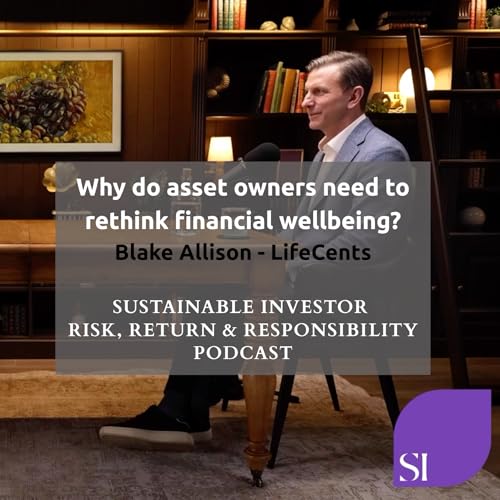
  • Why do asset owners need to rethink financial wellbeing?
    Dec 2 2025

    What does financial wellbeing really mean for pension members today?

    For the latest episode of Sustainable Investor, Stuart Hall, Managing Director of Sustainable Media Group sat down with Blake Allison, founder and CEO of LifeCents, to look beyond the slogans and into the reality of how people behave with money.

    Blake has spent more than twenty years working with major US employers and financial institutions on financial wellbeing programmes. What stood out in our discussion is how often the industry focuses on account balances and contribution rates, while members are dealing with day to day pressures that make long term decisions far harder than we admit.

    We talked about: • why financial wellbeing has moved beyond information and apps • what under 35s actually prioritise when money is tight • the growing gap in retirement readiness for over 50s • how members really think about sustainability and returns • why generic “save more” messages no longer work • and how pension funds can rebuild trust by treating people as people, not data points

    Blake’s perspective is practical and grounded, and it challenges some of the assumptions we make as an industry.

    If you work in pensions, asset management or financial wellbeing, this conversation is worth your time. Visit LifeCents to find out more: LifeCents | Audience – Asset Managers

    Voir plus Voir moins
    33 min
  • Will Brussels and Belém boost the nature-positive, net zero transition
    Nov 27 2025
    In this episode, we explore the likely impacts on asset owners’ climate and nature exposures of reforms to the Sustainable Finance Disclosure Regulation and developments at COP30; also looking forward to the next steps for natural capital accounting and universal ownership. Risk, Return and Responsibility – the monthly podcast from Sustainable Investor - aims to provide institutional asset owners with news and views shaping both the sustainable investment landscape and our wider economic, environmental and social systems. In each episode, Chris Hall, Editorial Director of Sustainable Investor, will be joined by co-hosts to discuss the biggest recent stories, and to round up some you might have missed. We will also be conducting deeper interviews with influential asset owners and others on the practical challenges of balancing risk, return and responsibility. To wrap up each episode, we will look back at some of the bigger stories covered recently by Sustainable Investor, also looking forward to the most significant upcoming developments, again with expert input from our co-hosts. Co-hosts: Guy Opperman, the UK’s longest-serving Pensions Minister & Chair of Sustainable Investor's editorial board; and Hortense Bioy, Head of Sustainable Investing Research, Morningstar Sustainalytics. News round-up: Following the release of ‘SFDR 2.0’, Hortense estimates the assets likely to be captured by the new transition fund category and forecasts a potential boost to engagement efforts, while Guy argues that simplification in Brussels should be heeded in Belém and beyond to secure buy-in for essential climate policy shifts. Signs of a greater integration of nature and climate in policy and investment decisions at COP30 are dissected (and broadly welcomed), while the repositioning of the Net Zero Asset Managers initiative - now prioritising transparency, scenario analysis, and engagement frameworks over rigid commitments - are seen as posing challenges for asset owners (Hortense) while reducing legal risk (Guy). The Three Rs interview: Mark Gough, CEO of the Capitals Coalition, explains why asset owners should consider natural capital a core determinant of long-term value and shares his experiences and takeaways from COP30, outlining why he expects natural capital to be a bigger part of the policy conversation in future. He also highlights why he sees accounting standards as a critical tool for increasing the visibility of nature on the balance sheet. Review / Preview: Finally Guy and Hortense return to dig a little deeper into some recent reports from leading asset owners on the challenges and opportunities of universal ownership, and the pros and cons of a system-level approach to stewardship. Do asset owners have the resources and data to support their ambitions? What kinds of outcomes and interventions will justify this shift of emphasis away from company-focused engagement? Thanks for joining us: If you like what you hear, you can also subscribe to Sustainable Investor, subscribe to this podcast and find further information in the show notes, where you can also find our contact details. We'd love to hear your ideas as we plan future episodes. Links to news items discussed: Greenwashing Risks Remain Under Europe’s SFDR 2.0 https://sustainableinvestor.online/live/greenwashing-risks-remain-under-europes-sfdr-2-0/ SFDR Expected to Introduce Dedicated Transition Funds https://sustainableinvestor.online/qa-will-brussels-re-boot-transform-the-transition/ SFDR Challenges Increased by Omnibus Package https://sustainableinvestor.online/live/omnibus-vote-throws-sfdr-review-into-doubt/ UN Climate Talks Fail to Secure New Fossil Fuel Promises https://www.bbc.co.uk/news/articles/c75vn7yel73o COP30 has Racked up an Impressive Scorecard of Real-world Climate Actions https://unfccc.int/news/cop30-has-racked-up-an-impressive-scorecard-of-real-world-climate-actions-that-will-also-mean COP30 Approves Belem Package https://cop30.br/en/news-about-cop30/cop30-approves-belem-package1# NZAM: Ready for its Next Chapter https://www.netzeroassetmanagers.org/nzam-ready-for-its-next-chapter/ NZAM Updates Signatory Requirements and Acknowledges “What has Always Been the Case” https://www.ropesgray.com/en/insights/viewpoints/102lrmz/nzam-updates-signatory-requirements-and-acknowledges-what-has-always-been-the-ca Net Zero Sometime: NZAM Scraps 2050 Target https://www.netzeroinvestor.net/news-and-views/net-zero-sometime-nzam-scraps-2050-target TFFF “an Arrow in the Quiver, not a Silver Bullet” https://sustainableinvestor.online/tfff-an-arrow-in-the-quiver-not-a-silver-bullet/ MDBs’ New Approach to Financing Nature https://onestopesg.com/esg-news/mdbs-new-approach-to-financing-nature-1763521846737 ISSB to Lead on Nature Reporting, Plans COP17 Release https://sustainableinvestor.online/live/issb-to-lead-on-nature-reporting-plans-cop17-release/ New Sovereign Debt Nature Assessment ...
    Voir plus Voir moins
    41 min
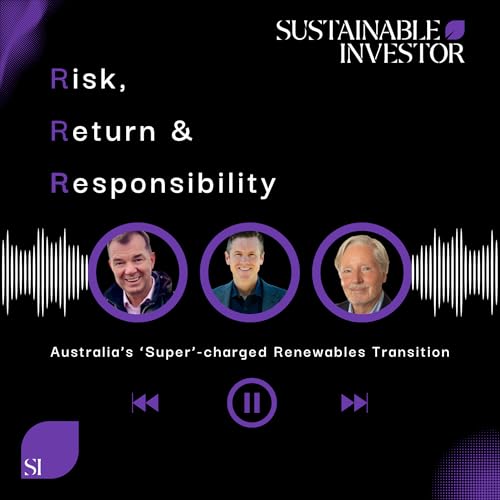
  • Australia’s ‘Super’-charged Renewables Transition
    Nov 13 2025

    In this ‘interview-only’ episode, we explore the role of Australia’s superannuation funds in the country’s embrace of clean energy, with Jeremy Cooper and David Bell of the Conexus Institute.

    Risk, Return and Responsibility – the monthly podcast from Sustainable Investor – aims to provide institutional asset owners with news and views shaping both the sustainable investment landscape and our wider economic, environmental and social systems.

    In this episode, Guy Opperman, the UK’s longest-serving Pensions Minister & Chair of Sustainable Investor’s editorial board, reports from Sydney, on the barriers facing Australia’s US$2.8 trillion superannuation sector in supporting the country’s net zero transition.

    In discussion with David Bell and Jeremy Cooper of the Conexus Institute, Guy finds out whether regulation and policy are giving supers the right incentives to invest sustainably, why so much capital is flowing into overseas infrastructure, and how Australia’s path to net zero could be different from other developed economies.

    Guests: David Bell, Executive Director, Conexus Institute, a research organisation focused on improving Australia’s superannuation and retirement systems, and a former CIO of Mine Super. Jeremy Cooper, Chair of the Advisory Board, Conexus Institute, former deputy chair of the Australian Securities and Investments Commission (ASIC), Australia’s financial regulator and author of the government’s review of the super system.

    Interview highlights:

    • What are Australian pension funds and their regulators getting right – and wrong – about sustainable investing? Regulators have issued strong guidance on managing climate risk, and mandatory disclosures start next year. Yet, with no legal mandate or firm targets, super funds face little official pressure to decarbonise portfolios despite high public expectations.
    • Why are funds not investing locally to reduce emissions? Despite vast renewable potential, most Australian super funds still prefer overseas infrastructure, particularly in the UK. A limited pipeline of investable domestic projects and benchmark-driven performance tests deter local climate investment, sending capital offshore while Australia needs it most.
    • Can Australia reach net zero on renewables alone – and become a clean energy exporter? According to Jeremy Cooper, abundant solar, strong wind and the world’s largest batteries mean Australia could meet its energy needs without nuclear. Major solar and hydrogen projects in the Northern Territory point to a future where Australia powers both itself and its neighbours with renewables.
    • Will government policy help decarbonise – including through a transition taxonomy? The government’s proposed transition taxonomy and investment incentives aim to crowd in private capital, but progress is slow. Super funds still lack transition plans and consistent carbon pricing, and clear policy signals are needed to unlock large-scale green investment.
    • What can other countries learn from Australia’s pension system? David Bell notes that Australia’s experience shows how performance tests and value-for-money rules can unintentionally discourage climate-aligned investment. The lesson for others: build forward-looking frameworks that reward long-term sustainability, not just short-term returns.

    Thanks for joining us: If you like what you hear, you can also subscribe to Sustainable Investor, subscribe to this podcast, where you can also find our contact details. We’d love to hear your ideas as we plan future episodes.

    For more info or to sponsor contact chis.hall@sustainabletimes.co.uk

    Voir plus Voir moins
    24 min
Pas encore de commentaire