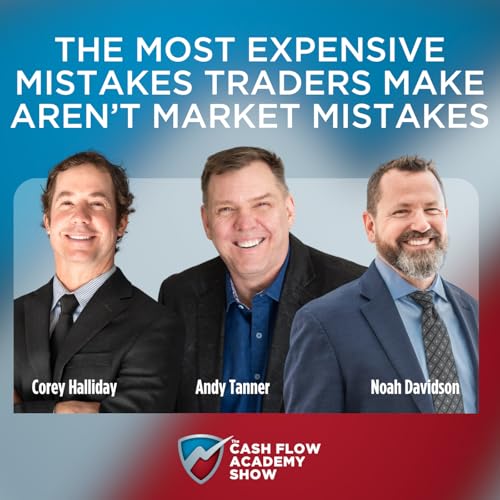
Page de couverture de The Cash Flow Academy Show

The Cash Flow Academy Show

The Cash Flow Academy Show

Auteur(s): Andy Tanner
Écouter gratuitement

À propos de cet audio

The Cash Flow Academy Show with Andy Tanner teaches investors how to generate consistent cash flow from the stock market using proven strategies built on financial education, not speculation. Andy Tanner, Rich Dad's Advisor on Paper Assets and author of 401(k)aos and Stock Market Cash Flow, challenges traditional Wall Street thinking and shows you how to take control of your retirement using options, dividends, and intelligent portfolio management. If you're tired of: • Watching stock prices and feeling anxious • Depending solely on a 401(k) • Hoping long-term growth solves everything • Conflicting advice from financial media This show offers a different path. Unlike conventional advice focused on buying and hoping, The Cash Flow Academy teaches active investing strategies designed to create income, reduce risk, and build financial confidence. Topics include: • Options trading strategies • Cash-flow investing • Retirement income planning • Portfolio protection • Market analysis • Financial education and investor psychology Whether you're new to investing or looking to refine advanced strategies, this podcast will help you think differently about money, markets, and control. Subscribe and learn how to make your money work for you.2026 www.TheCashflowAcademy.com Finances personnelles Économie
Épisodes
  • Why Going All-In on Crypto Is the Real Risk
    Mar 4 2026

    Most investors think the biggest mistake in crypto is missing the upside. It's not. The real mistake is concentration.
    In this episode, Andy Tanner sits down with Sir John Hargrave, author of The Intelligent Crypto Investor, to unpack what most people get wrong about Bitcoin and digital assets. Many investors either dismiss crypto entirely or bet far too much on it. Both reactions are emotional. Neither is strategic.
    Crypto isn't a replacement for productive assets. It doesn't generate cash flow the way businesses or real estate can. And it was never designed to solve retirement income on its own.
    But that doesn't mean it doesn't belong in a portfolio.
    John explains why crypto should be treated less like a lottery ticket and more like a volatile tech stock. They discuss position sizing, diversification, and why 2–10% exposure may be more rational than going all-in. You'll also hear how to evaluate crypto projects using principles borrowed from traditional value investing — focusing on people, profits, and price.
    This is not a prediction episode, it is a positioning episode.
    If you're crypto curious but cautious, this conversation will help you think clearly about where digital assets fit — and where they don't — in a long-term strategy.

    Want to Learn More?
    – Explore free education and tools at cashflowbonus.com to strengthen your investing foundation
    – Keep building your financial education at yourinvestingclass.com.

    Voir plus Voir moins
    26 min
  • The Most Expensive Mistakes Traders Make Aren't Market Mistakes
    Feb 25 2026

    Most investors think their biggest losses come from bad picks. They don't. They come from blind spots.
    In this episode, Andy Tanner, Corey Halliday, and Noah Davidson unpack the psychological traps that quietly sabotage traders and investors. Sunk cost fallacy. Anchoring to past prices. Averaging down to "get back to even." Overconfidence disguised as conviction.
    These aren't strategy problems. They're belief problems.
    You'll hear why price alone tells you nothing about value. Why holding a loser to avoid admitting you're wrong is often the costliest decision you can make. And why the real edge in trading isn't prediction — it's risk management.
    The conversation moves beyond tactics and into self-awareness. Because markets don't just test your capital. They test your identity.
    Are you managing risk — or defending your ego?
Are you following a plan — or reacting to discomfort?
    This episode isn't about a new indicator or a better entry signal. It's about understanding how your own thinking can distort decision-making — and how disciplined investors structure their process to prevent small errors from becoming permanent damage. The market is rarely the enemy. Unexamined assumptions are.

    Want to Learn More?
    – Explore free education and tools at cashflowbonus.com to strengthen your investing foundation
    – Keep building your financial education at yourinvestingclass.com.

    Voir plus Voir moins
    50 min
  • Gold Isn't Wealth — It's a Warning Signal
    Feb 18 2026

    Most people think rising gold prices mean opportunity.
    They see a chart going vertical and assume it's time to buy.
    But gold doesn't surge because the economy is thriving. It surges when confidence is cracking.
    In this episode, Andy, Corey, and Noah unpack what gold's recent move is really signaling — and why chasing it for growth may miss the point entirely.
    Gold is not a cash-flowing asset. It doesn't innovate. It doesn't expand margins. It doesn't pay dividends. It sits.
    So why are sovereign nations accumulating it? Why are futures markets squeezing? And what does that tell us about currency confidence, debt levels, and global positioning?
    We break down the difference between owning bullion as insurance and owning mining companies as productive assets. We explore why volatility creates opportunity in options markets. And we challenge the assumption that price alone equals value.
    This isn't a conversation about predictions or targets.It's about positioning.
    When gold rises, the question isn't "How high will it go?"
    The better question is, "What is the market afraid of — and how should a disciplined investor respond?"
    Gold isn't wealth. It's information. And how you interpret it determines whether you react emotionally — or allocate strategically.

    Want to Learn More?
    – Explore free education and tools at cashflowbonus.com to strengthen your investing foundation
    – Keep building your financial education at yourinvestingclass.com.

    Voir plus Voir moins
    58 min
Pas encore de commentaire