Épisodes

  • Nat Turner's Rebellion: Confession and Trials
    Dec 9 2025

    🩸 The Glitched Gavel S01E13: The Commonwealth vs. The Prophet (Nat Turner's Rebellion: Confession and Trials)

    Gavel (The Narrator/Prosecutor): "Southampton County, Virginia, 1831. A summer of terror. Nat Turner, an enslaved preacher who believed he received divine visions, led a bloody, two-day revolt that resulted in the deaths of approximately 60 white men, women, and children. The inevitable reaction was swift, brutal, and utterly without mercy. This week, we analyze the only record of the trial and Turner's own chilling confession." (The rapid, discordant sound of axes hitting wood is heard, overlaid with a static pulse.)

    Static (The Analyst/Defense): "The court proceedings were less a trial and more a formality before execution. The legal system in Virginia offered virtually no defense for an enslaved person charged with insurrection. We dissect the pivotal document: 'The Confessions of Nat Turner,' transcribed by lawyer Thomas Ruffin Gray. Was this a genuine testament of a divinely inspired revolutionary, or a highly edited, self-serving document designed by Gray to demonize Turner and justify the subsequent draconian laws that crushed all hope for education and assembly among the enslaved?"

    Gavel: "We examine the chilling aftermath: over fifty enslaved people were executed, and the fear unleashed by the rebellion led to dozens of brutal, extrajudicial killings of Black people across the county. The resulting legislation—the 'Black Codes'—destroyed what little freedom and literacy existed among the enslaved population. Turner’s trial was not the end of a rebellion, but the catalyst for a societal tightening that cemented the path toward the Civil War. The Gavel here was used to shatter all resistance, leaving only the distorted echo of Turner's fateful prophecy."

    Voir plus Voir moins
    33 min
  • The Trials and Nullification of Joan of Arc
    Dec 9 2025

    ⚔️ The Glitched Gavel S01E12: The Church vs. The Maid (The Trials and Nullification of Joan of Arc)

    Gavel (The Narrator/Prosecutor): "Rouen, France, 1431. The Hundred Years’ War was defined by this 19-year-old peasant girl, Joan of Arc, who claimed divine guidance and led armies to victory. But she was captured, betrayed, and handed over to an English-backed ecclesiastical court. This week, we examine the corrupted primary record of her trial for heresy and the subsequent trial 25 years later that reversed the verdict." (The faint sound of a roaring medieval crowd gives way to a low, rhythmic tolling of a church bell, distorted by static.)

    Static (The Analyst/Defense): "The first trial was a sham designed for execution, not justice. Presided over by Bishop Pierre Cauchon, a man loyal to the English, the court had a verdict before the first witness was called. We analyze the charges—from cross-dressing (for wearing armor) to claiming direct communication with God. She was denied legal counsel, constantly threatened, and interrogated without rest. Her conviction was a political assassination masked as a religious inquiry."

    Gavel: "We detail the events: her initial defiance, her temporary recantation under duress, and her final, powerful defiance where she reaffirmed her 'voices' even as she faced the pyre. But the Gavel falls a second time. Twenty-five years later, a Nullification Trial was convened to clear her name. The original court's evidence was exposed as fraudulent, the proceedings declared illegal, and her conviction formally annulled. This case provides a rare corrupted binary: a conviction secured by political fear, and an acquittal mandated by historical shame."

    Voir plus Voir moins
    33 min
  • The Dreyfus Affair
    Dec 9 2025

    🇫🇷 The Glitched Gavel S01E11: The Republic vs. The Officer (The First Trial of Alfred Dreyfus)

    Gavel (The Narrator/Prosecutor): "Paris, 1894. It was the moment that split France in two. Army Captain Alfred Dreyfus, a Jewish artillery officer, was accused of passing military secrets to Germany. His swift court-martial was shrouded in a toxic fog of secrecy and rampant antisemitism, resulting in a devastating conviction for treason. This week, we examine the initial, corrupted record of a case that became a national trauma." (The sound of heavy official seals being stamped rapidly is heard, followed by a brief, high-frequency radio jam.)

    Static (The Analyst/Defense): "Dreyfus’s conviction was based entirely on a secret 'dossier'—a collection of documents presented only to the judges and deliberately withheld from the defense. This key piece of evidence, a handwritten memo known as the bordereau, was a fraudulent forgery that pointed to another officer, Major Esterhazy. We trace the corruption from the highest ranks of the French General Staff, who manufactured evidence and protected their own reputations over justice."

    Gavel: "We detail the punishment: Dreyfus was publicly humiliated, his rank stripped from him in a public ceremony, and sentenced to life imprisonment on Devil's Island. His case would spark the 'Dreyfus Affair,' a decade-long political and social crisis that exposed the deep rot of prejudice within the French government. The Glitched Gavel reveals that the conviction was not simply an error of law, but a willful sacrifice of an innocent man to appease a nation consumed by fear and hate. The court's Gavel struck here, but the echo of injustice would not fade."

    Voir plus Voir moins
    23 min
  • The Impeachment Trial of President Andrew Johnson
    Dec 9 2025

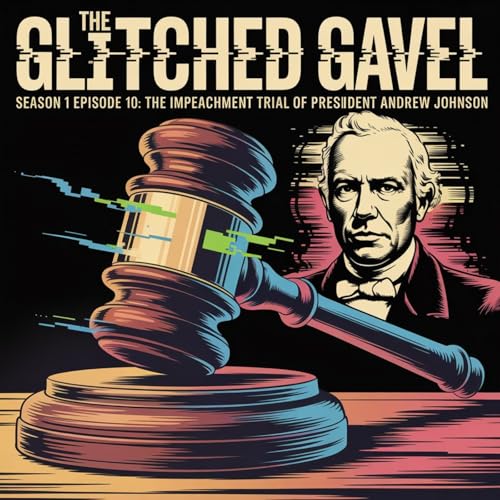
    🏛️ The Glitched Gavel S01E10: The House vs. The President (The Impeachment Trial of Andrew Johnson)

    Gavel (The Narrator/Prosecutor): "Washington D.C., 1868. The nation was still reeling from the Civil War, and the battle lines had simply moved from the battlefield to the Senate floor. This week, we cover the first-ever impeachment trial of a U.S. President: Andrew Johnson. Accused of high crimes and misdemeanors, Johnson stood before the Senate, facing a furious Republican Congress determined to punish him for obstructing Reconstruction and defying the will of the legislature." (The sound of a large, ticking clock is amplified, accelerating rapidly before failing with a corrupted electronic buzz.)

    Static (The Analyst/Defense): "The core charge was his violation of the Tenure of Office Act—a highly questionable law passed by Congress to specifically restrict the President's power to fire cabinet members. Johnson dared to dismiss Secretary of War Edwin Stanton, an act Congress seized upon. This trial wasn't about criminal activity; it was a bare-knuckle brawl over the balance of power. We scrutinize the evidence and the political calculus: Was this trial legitimate, or was it a thinly veiled legislative coup designed to make the President a puppet of Congress?"

    Gavel: "We detail the dramatic, seven-week proceedings, presided over by Chief Justice Salmon P. Chase, and the intense pressure applied to every Senator. The vote came down to a single senator, Edmund G. Ross, whose 'not guilty' vote by the narrowest possible margin—one vote shy of the necessary two-thirds—spared Johnson. The verdict was an acquittal, but the precedent was set: impeachment would forever remain a political weapon. The Glitched Gavel analyzes the fragility of democracy when the Gavel itself is swayed by partisan fury."

    Voir plus Voir moins
    31 min
  • The Trial of Anne Hutchinson
    Dec 9 2025

    ⛪️ The Glitched Gavel S01E09: The Patriarchs vs. The Prophetess (The Trial of Anne Hutchinson)

    Gavel (The Narrator/Prosecutor): "Massachusetts Bay Colony, 1637. The charge wasn't witchcraft or treason, but a deeper, more profound threat to power: daring to speak. Anne Hutchinson—a midwife, a mother, and a formidable intellect—was dragged before the General Court for sedition and heresy. Her crime? Holding weekly religious meetings in her home and asserting that her direct, personal revelation from God surpassed the authority of the Puritan ministers." (A deep, echoing drum beat like a slow heartbeat is heard, interrupted by a sharp, repeating digital clicking.)

    Static (The Analyst/Defense): "This was fundamentally a trial against a woman's voice. The primary prosecutor, Governor John Winthrop, treated the court as a theological and political battering ram. The ministers could not stand that a woman was attracting hundreds of followers with a doctrine, called 'Antinomianism,' that emphasized grace over works—a doctrine that effectively dismantled their own authority. We analyze the shocking legal maneuver where Hutchinson successfully defended herself on legal grounds, only to be ambushed by her own theological claims."

    Gavel: "We detail the dramatic turn: when the court, unable to find a legal flaw in her actions, pressed her on her private communion with God. Hutchinson declared that she received direct revelations, a claim that was the ultimate blasphemy in the Puritan state. Found guilty of 'traducing the ministers,' she was excommunicated and banished. Her trial set a terrifying precedent: that in early America, freedom of conscience was a privilege granted by the state, not an inalienable right, and the Gavel would ruthlessly silence any voice that challenged the established order."

    Voir plus Voir moins
    29 min
  • The Anthony Burns Fugitive Slave Trial
    Dec 8 2025

    ⛓️ The Glitched Gavel S01E08: The Commonwealth vs. The Man (The Anthony Burns Trial)

    Gavel (The Narrator/Prosecutor): "Boston, 1854. The heart of abolitionism was under siege. Anthony Burns, a man who had escaped slavery in Virginia, was captured under the brutal mandate of the Fugitive Slave Act of 1850. His trial was a microcosm of the coming Civil War—a battle for the soul of the nation fought not on a battlefield, but in a federal courtroom where human beings were treated as property." (The grinding sound of heavy iron chains is heard, interspersed with a static-filled military drum beat.)

    Static (The Analyst/Defense): "The legal system was rigged from the start. The Fugitive Slave Act required only testimony from the alleged owner (or their agent) and denied the accused the right to testify in his own defense or receive a jury trial. This was less a trial and more a hearing to certify ownership. We dissect the intense public resistance: the mass protests, the daring, but failed, courtroom rescue attempt led by abolitionists, and the massive federal mobilization to ensure the 'law' was upheld."

    Gavel: "President Franklin Pierce, determined to enforce the unpopular act, sent federal troops and Marines to Boston, turning the city into an armed camp. We examine the cost: the federal government spent an estimated forty thousand dollars—a massive sum at the time—to return one man to slavery. Burns was ultimately sent back to Virginia, but the image of this lone man, marched through the streets of Boston by a regiment of soldiers, shattered the last vestiges of compromise and fueled the fire for the war that would follow. The Glitched Gavel records this as the moment the law irrevocably broke the union

    Voir plus Voir moins
    35 min