Page de couverture de The LIUniverse with Dr. Charles Liu

The LIUniverse with Dr. Charles Liu

The LIUniverse with Dr. Charles Liu

Auteur(s): theliuniverse
Écouter gratuitement

À propos de cet audio

A half-hour dose of cosmic conversation with scientists, educators and students about the cosmos, scientific frontiers, scifi, comics, and more. Hosted by Dr. Charles Liu, PhD, an astrophysicist at the American Museum of Natural History. Support us on Patreon.Copyright 2022 All rights reserved. Astronomie et science de l’espace Science Science-fiction
Épisodes
  • Chuck GPT: Answering Eerie Questions
    Jan 25 2026
    Is universal expansion slowing? What is the Bubble Universe Theory? Will we control AI, or will AI control us? In this special Chuck GPT episode of The LIUniverse, we answer questions from the Annual Global Summit in Erie, Pennsylvania where Dr. Charles Liu gave a talk on “2050 - The Future of Humanity.” To help ask those questions, Chuck and co-host Allen Liu welcome Stacey Severn, our Social Media Manager/Community Director; and physics student Eleanor Adams, our first intern. As always, though, we start off with the day’s joyfully cool cosmic thing, suggested by Stacey: the recent discovery of one of the most distant and earliest known galaxies observed, existing just 570 million years after the Big Bang. It’s got a supermassive black hole 20 times the mass of ours and was found via gravitational lensing by the Canadian NIRISS Unbiased Cluster Survey (CANUCS) using the James Webb Space Telescope. Then it’s time for the main event. Eleanor reads the first Erie audience question from William W., age 13, who asks, “In Bubble Universe Theory, is the force splitting universes apart the same force causing the expansion of the universe, also known as dark energy?” Chuck explains Bubble Universe Theory, aka “Eternal Inflation,” and then how dark energy is different than the forces that cause expansion. Next question: “Have you seen the latest research from South Korea stating universal expansion is actually slowing, thus reducing greatly the amount of dark matter? If it's correct, what are the implications?” Chuck explains the current state of research around the issue, starting with the Dark Energy Spectroscopic Instrument (DESI) survey at the Kitt Peak National Observatory telescope. DESI gave indications of a change in the amount of dark energy being produced; this new study raises questions about how we measure the expansion of the universe using type 1a Supernova. Next question: “What percentage of our global warming does science attribute to man-created activities vs. a natural progression? Even though the world is getting warmer, wouldn’t it be worse if the temperature were getting colder?” Chuck looks at the natural progression of the increase of carbon dioxide and compares it with the larger and more rapid increase in CO2 levels since the Industrial Revolution began. As to whether warming or cooling is better, Allen says that while it’s a question of magnitude, neither extreme is desirable. Mark M’s question is next: “Will we achieve control or effective management of AI, or will it control, or even define, our daily lives? Allen, whose book on AI is coming out soon, says the answer is far from clear cut. He explains that while there are many efforts to ensure we maintain control, there’s no guarantee that we’ll succeed. Next question from Erie: “How do we prepare our young children to be successful in the Age of AI?” Eleanor talks about how, like social media, you can’t stop or avoid AI, but also, like social media, parents can give their children the tools to help them use it. Next: “Many advanced countries have declining populations, while third world countries are gaining population. How do we get tomorrow’s scientific leaders from third world education systems?” Chuck says the best way to ensure an ongoing stream of scientific leaders is for advanced countries to continue to welcome immigrants, while Allen points out it is also important to improve the educational systems and opportunities for research in those third world countries. Stacey reminds us about the impact the internet is having on this issue. With time running out, we squeeze in one last question from Erie: “How can the average person influence science policy in a positive direction?” Our consensus answer: people need to participate, speak out, and support others when they do, too. We hope you enjoy this episode of The LIUniverse. Please support us on Patreon. Credits for Images Used in this Episode: Location of CANUCS-LRD-z8.6. – Credit: ESA/Webb, NASA & CSA, G. Rihtaršič (University of Ljubljana, FMF), R. Tripodi (University of Ljubljana, FMF)Type 1a Supernova. Shown: G299.2-2.9, a type 1a supernova remnant in the Milky Way. – Credit: NASA/CXC/U.TexasConcentration of atmospheric carbon dioxide over the last 40,000 years, from the Last Glacial Maximum to the present day. – Creative Commons / Renerpho Chapters: 00:00 - Welcome – Call Me Chuck 01:02 - Joyfully Cool Cosmic Thing of the Day – CANUCS-LRD-z8.6 08:25 - Chuck Answers Questions from Annual Global Summit, Erie, PA 09:58 - Bubble Universe Theory and Dark Energy 14:17 - Is Universal Expansion Is Slowing? 19:30 - Global Warming 27:28 - Will We Control AI or It Will Control Us? 30:14 – How Can We Prepare Our Children To Succeed in the Age of AI? 36:28 - Where Will Future Scientific Leaders Come From? 42:09 - How Can Individuals Influence Science Policy?
    Voir plus Voir moins
    46 min
  • Serving Cosmic Brunch with Thresa Kelly
    Jan 10 2026

    How do supermassive black holes actually form in the early universe? Is the Cosmological Constant not so constant after all? And what would be on the astrophysical menu at a Cosmic Brunch? To find out, Dr. Charles Liu and co-host Allen Liu welcome astrophysicist Thresa Kelly, who is a second year grad student working on her PhD at the Rochester Institute of Technology.

    As always, though, we start off with the day’s joyfully cool cosmic thing, one of the recent studies made using the Dark Energy Spectroscopic Instrument, aka DESI, located at Kitt Peak National Observatory near Tucson, Arizona. According to the DESI team’s research, there is a about a 95% chance that the dark energy levels in the universe have changed over cosmic time. This “Dynamical Dark Energy model” offers the first, tiny hint that the Cosmological Constant may not be so constant after all.

    Thresa, who is using DESI and other sources for her work putting together a catalog of AGNs, or active galactic nuclei – the supermassive black holes found at the center of galaxies, tells us about what DESI is trying to do and why it’s so important. The end goal of Thresa’s project is to estimate the black hole masses of AGNs, and she’s gotten spectra data on over 2,000 objects that have been observed using DESI. Thresa can’t get into the details of her catalog, which hasn’t been published yet and includes about 14,000 objects, but Allen and Chuck join her in a discussion of what’s going on with black hole masses, accretion discs, Eddington Luminosity, black hole growth, galactic evolution, and more.

    Our first audience question comes from Kathryn, who asks, “When we look through a standard telescope looking at "past" versions of planets/stars/etc., how far back in the past are we observing?” Thresa explains how we use red shift to measure how long light from a galaxy takes to reach us to help us determine how far in the past the objects are. For instance, an AGN with a red shift of 7 can reach back to the period of “Cosmic Dawn” or, as Thresa puts it, “Cosmic Brunch” taking place 12 billion years ago.

    Thresa talks about her experience in an REU, or “Research Experiences for Undergraduates,” funded by the NSF, which enabled her to spend time studying at the University of Hawaii and cemented her desire to go to grad school, get a PhD, and become a “real scientist.” She explains how each step of her career brought her from Kansas to where she is today.

    Our next audience question comes from Walter: “If a quasar's jets are aimed directly away from Earth, would we then not be able to see the supermassive black hole?” Thresa says that depends on how you define “seeing” a black hole, and that even without visible light, you can discern black holes by looking at other wavelengths like x-rays and ultraviolet rays which are generated by different component areas of the black hole like the corona, accretion disk, or the torus.

    Chuck notices a shelf of games behind Thresa and asks her about them. She pulls out Stardew Valley, a farming simulator she plays with her fiancé and her fellow grad students. It’s not long until Chuck, Allen and Thresa are geeking out about Dungeons and Dragons.

    Finally, Chuck asks Thresa to speculate on a specific scientific discovery that may come out of her PhD thesis work. Her answer: figuring out how supermassive black holes actually form in the early universe.

    If you’d like to know more about Thresa Kelly, you can find her on LinkedIn.

    We hope you enjoy this episode of The LIUniverse, and, if you do, please support us on Patreon.

    Credits for Images Used in this Episode:

    • DESI - The Dark Energy Spectroscopic Instrument. – Credit: KPNO/NOIRLab/NSF/AURA/P. Marenfeld
    • DESI data map of celestial objects from Earth to billions of light years away.. – Credit: Claire Lamman/DESI collaboration.
    • Montage of dwarf active galactic nuclei candidates. – Credit: DESI collaboration.
    • Map of galaxies based on redshift data. – Credit: Creative Commons / M. Blanton and Sloan Digital Sky Survey.
    • Quasar PKS 1127-145, a luminous source of X-rays and visible light. – Credit: NASA/CXC/A.Siemiginowska(CfA)/J.Bechtold(U.Arizona).
    • Model of AGN. – Credit: Creative Commons.
    Voir plus Voir moins
    39 min
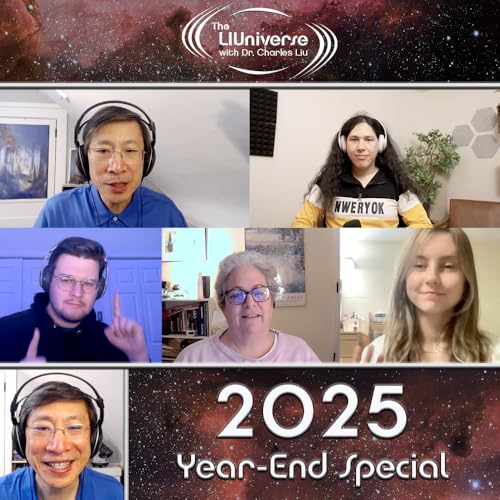
  • 2025 Year-End Special
    Dec 27 2025
    What were our joyfully cool cosmic things of 2025? To find out, Dr. Charles Liu and co-host Allen Liu welcome three members of The LIUniverse production team: Jon Barnes, our Editor and self-proclaimed “#1 LIUniverse Fan,” Stacey Severn, our Social Media Manager/Community Director, and physics student Eleanor Adams, the show’s first intern. Unlike nearly every episode so far, this time, rather than limit ourselves to one joyfully cool cosmic thing, the team is going to each share their individual joyfully cool cosmic things of 2025. Chuck’s saving his for later, so instead, we’re just going to jump right into everyone’s favorite “cosmic thing of the year”, starting with our co-host, Allen Liu. Allen picks the Vera C. Rubin Observatory and the Legacy Survey of Space and Time (LSST). Allen and Chuck, who is also on the Rubin’s Science Advisory Committee and has been involved in the development of the Observatory for over a quarter century, discuss how truly amazing the images are in terms of detail and resolution. Allen shares that he’s most excited to see images of transients like asteroids and gravitational lensing, since the Rubin will be taking images of the same areas twice with a gap of one week. Chuck talks about the citizen science aspect of the Rubin and encourages each of you in our audience to try and discover something on your own. We hear about some of Allen’s published papers, including one on using VR for scientific research. The group talks about VR (including Beat Saber) and Jon shares his experience using VR technology to record his senior project at the Harold Ramis Film School at Second City, and the difficulty he had with the audio. For Eleanor, this year’s cool cosmic thing was highly personal: her studies in modern physics this year, learning more than ever about what we don’t know, like the gap between classical and quantum physics! As she puts it, “the matter-antimatter asymmetry…broke my mind.” She also shares a little inspiration from Cal Sagan’s Cosmos. Stacey’s cosmically cool thing of the year is relatively current: Comet C/2025 K1 ATLAS, which recently broke into 3 parts. The team compares this with the breakup of all breakups: Comet Shoemaker-Levy 9, which broke up in 1994 on its way to a collision with Jupiter. Jon’s joyfully cool cosmic year end thingamabob is about the new science fiction show Pluribus created by Vince Gilligan (Breaking Bad, Better Call Saul), and he’s got a question for Chuck. How long would it take a signal like the one in Pluribus to travel from a star 600 light years away, like Betelgeuse or Antares? Without dropping any spoilers, the team ponders why an alien race would have reached out to Earth based on what they might have seen around the time of Charlemagne, and whether being subsumed in a hive mind would be good or bad. This is a bittersweet episode, though, because we officially bid farewell to the show’s long time editor, Jon Barnes, who is moving on to a gig as a full-time content creator for a meal prep company that will involve lots of Jon cooking and filming himself while he does. Finally, it’s time to wrap up the episode with Chuck’s Picture of the Year, which is related to the Vera C. Rubin Observatory, but not in a way you might expect. It’s a photo of Vera Rubin when she was 10 years old. As Chuck puts it, “Who would have known that 25 years later, she would change our understanding of the cosmos itself?” Happy New Year from The LIUniverse crew! If you’d like to know more about what Jon’s up to post-LIUniverse, you can check out his TikTok @iheartjonbarnes. We hope you enjoy this episode of The LIUniverse, and, if you do, please support us on Patreon. Credits for Images and Music Used in this Episode: Galaxies imaged by the Vera Rubin Observatory. – Credit: NSF–DOE Vera C. Rubin ObservatoryArtist illustration of gravitational lensing. – Credit: Public DomainComet C/2025 K1 ATLAS. – Credit: Creative Commons / Dimitrios KatevainisComet Shoemaker-Levy 9. – Credit: NASA, ESA, and H. Weaver and E. Smith (STScI)Impacts on Jupiter from the broken-up comet Shoemaker-Levy 9. – Credit: Hubble Space Telescope Comet Team and NASAImage collage of Betelgeuse in the constellation Orion. – Credit: ESO, P.Kervella, Digitized Sky Survey 2 and A. FujiiImage of astronomer Vera Rubin, age 10. – Credit: Vera Rubin family, used with permissionMusic Used In This Episode: Goin' Home, derived from Dvorak's Symphony No. 9, performed by the United States Air Force Band. – Credit: Public Domain. #LIUniverse #AstronomyPodcast #CometC2025K1ATLAS #CometShoemakerLevy9 #VeraRubin
    Voir plus Voir moins
    35 min
Pas encore de commentaire