

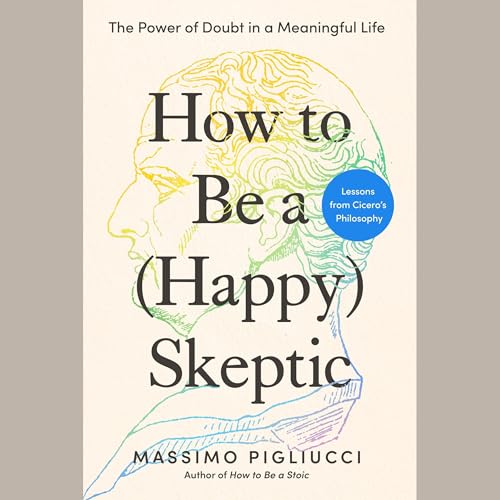
How to Be a (Happy) Skeptic
The Power of Doubt in a Meaningful Life--Lessons from Cicero's Philosophy
Échec de l'ajout au panier.
Veuillez réessayer plus tard
Échec de l'ajout à la liste d'envies.
Veuillez réessayer plus tard
Échec de la suppression de la liste d’envies.
Veuillez réessayer plus tard
Échec du suivi du balado
Ne plus suivre le balado a échoué
0,00 $ pour vos 30 premiers jours
OFFRE D'UNE DURÉE LIMITÉE
0,99 $/mois pendant vos 3 premiers mois
L'offre prend fin le 16 décembre 2025 à 23 h 59, HP.
Exclusivité Prime: 2 titres
gratuits à choisir pendant l'essa. Des conditions s’appliquent.
Vos 3 premiers mois d'Audible à seulement 0,99 $/mois
1 nouveauté ou titre populaire à choisir chaque mois – ce titre vous appartiendra.
L'écoute illimitée des milliers de livres audio, de balados et de titres originaux inclus.
L'abonnement se renouvelle automatiquement au tarif de 0,99 $/mois pendant 3 mois, et au tarif de 14,95 $/mois ensuite. Annulation possible à tout moment.
Choisissez 1 livre audio par mois dans notre incomparable catalogue.
Écoutez à volonté des milliers de livres audio, de livres originaux et de balados.
L'abonnement Premium Plus se renouvelle automatiquement au tarif de 14,95 $/mois + taxes applicables après 30 jours. Annulation possible à tout moment.

How to Be a (Happy) Skeptic
Précommander pour 26,56 $
-
Narrateur(s):
-
Auteur(s):
-
Massimo Pigliucci
À propos de cet audio
Throughout history it has always been true that people don’t know as much as they think they do. The ancient Greeks and Romans formulated an approach to life based on this notion. They recognized that adjusting our beliefs to the evidence while keeping in mind that we could be mistaken is the path to a just society—and a happy and meaningful life.
In How to Be A (Happy) Skeptic, philosopher Massimo Pigliucci adopts the ancient Roman public advocate, orator, statesman, and philosopher Marcus Tullius Cicero as his guide to reveal the benefits of cultivating curiosity and doubt in the pursuit of a life worth living. Cicero’s skeptical philosophy is more relevant than ever in our current age of misinformation.
Following Cicero’s life and works, Pigliucci explores the foundations for a good life, from how to formulate our values to how to nurture friendships; from being a good citizen and fighting for social justice to handling grief, pain, and even death. Skepticism as a philosophy was developed during a time of violence, social upheaval, and political turmoil. Taking a page from Cicero’s book, we, too, can adopt a practical philosophy of reason and learn to live well through uncertain times.
Pas encore de commentaire