

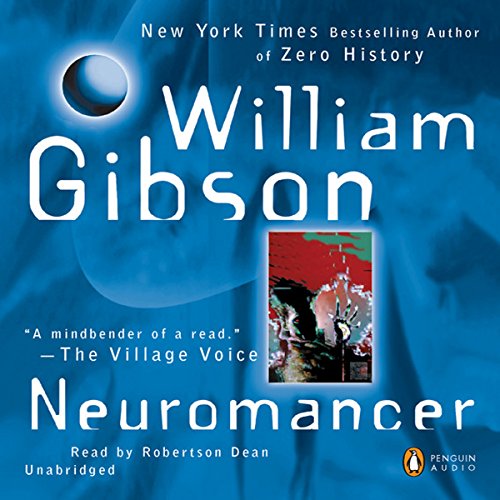
Neuromancer
Failed to add items
Add to Cart failed.
Add to Wish List failed.
Remove from wish list failed.
Follow podcast failed
Unfollow podcast failed
Get 30 days of Premium Plus free
Buy Now for $21.50
-
Narrated by:
-
Robertson Dean
-
Written by:
-
William Gibson
About this listen
Now, for the first time, Ace Books is proud to present this groundbreaking literary achievement in a trade paperback edition.
What the critics say
“Serious science fiction and fantasy readers cannot resist the classics. . . . That’s what makes the Penguin Galaxy series so appealing. . . . Each of the novels here has earned their place in the halls of literary history. . . . Their small form factor and minimalist covers call out to readers and make them fun to read all over again.” —Kirkus Reviews
“The quintessence of cyberpunk . . . An amazing virtuoso performance.” —The Washington Post
“[Gibson] invented the future with Neuromancer.” —Entertainment Weekly
“Unforgettable . . . The richness of Gibson’s world is incredible.” —Chicago Sun-Times
“Freshly imagined, compellingly detailed, and chilling in its implications.” —The New York Times
Featured Article: 11 Best Sci-Fi Audiobooks to Listen to Right Now
For the listener who craves exploring new worlds, extraterrestrial life, galaxies, technologies, weapons and even threats and political machinations, there’s nothing quite like an imaginative sci-fi listen. If you’re looking for your next escapist journey full of wonder, discovery and excitement, look no further. These listens are some of the best sci-fi book series available. Each of the titles on this list will whisk you away to another time, place or dimension, and wrap you up in an unpausable story that engages and entertains from the first second to the last.

legendary
Something went wrong. Please try again in a few minutes.
Clearly a massive influence for many blockbuster books, films, and video games generations in the future.
Classic of Science Fiction
Something went wrong. Please try again in a few minutes.
"ZZZZZZ" for all the good reasons
Something went wrong. Please try again in a few minutes.
Enter the Matrix!
Something went wrong. Please try again in a few minutes.
Upon listening to Dean read the book, I was struck by how little I remembered from my first partial read. It all seemed new to me, even though the concepts have surrounded me in all sorts of media for most of my life. Gibson’s semi-apologetic forward was cute (imagine feeling bad for not predicting the ubiquitousness of mobile phones) and contained enough humility to pardon any perceived sin of birthing the difficult-to-define genre of cyberpunk.
The book was groundbreaking, and its “newness” comes through even now, forty years after it was first published. Besides the very idea of cyberspace, the tone is different than most science fiction that preceded it: nasty, almost pornographic, and with a distinct lack of hope that innovation will save us all. At the same time, it harkens back to earlier times. Certainly, a debt to the hard-boiled detective fiction of the early twentieth century is owed. It reaches back even further, though, when you dissect the passage in which the titular AI explains the origin of his name. Besides the potent power words of “neuron” and “necromancer”, we also see “new romancer”.
There was a “New Romantic” movement in art in the seventies and eighties that is mostly remembered for a few pop music purveyors like Ultravox and Japan, but the original Romantic movement of the nineteenth century was also harkening back, somewhat longingly, to the medieval, a time before the Renaissance when progress was not expected and life was to be faced as it was, not as it might be.
This seems to be the attitude of the book’s protagonist, Case, who enters the stage as a failure, a man formerly of great talent but who must now wrestle for scraps with the vermin of the underworld. He expects nothing better, which makes him an easy mark when hope is suddenly thrust in front of him. It seems too good to be true, and it is. He doesn’t trust this hope, but he has nothing better going on and falls into one confusing situation after another. Like a medieval peasant confronted with demons and ghosts, he doesn’t bother to disbelieve, but interacts with artificial intelligences and the recreated psyches of a dead mentor and lover as if they were real. For all intents and purposes, they are. Maybe the unseen Renaissance is on the horizon in the form of AI, but no one can be expected to see it.
Yes, the book is great, as advertised, but what about the narration? I will admit that although Dean’s slow reading made it easy to catch every word, it was a little monotonous in timbre, making it easy for the reader to lose focus on it. Although he admirably dipped into accents for some characters, they nearly always spoke slowly and that made them all seem a little too similar. My biggest gripe is that Maelcum’s accent changed over the course of the book from a subtly melodic Caribbean when he is first encountered to a dull, almost Tonto-like, grunt. I can make up excuses for these faults (Maelcum’s original accent was a put-on that slips when it is no longer important, the monotonous narrative is what you would expect from a speed-freak who can no longer indulge), but it doesn’t really wash. The reader needs to engage the listener, as well as serve the story and its characters. It’s a tough gig and this one loses points in the engagement category. If other listeners felt the same way, it may explain why the sequels in the Sprawl Trilogy never got an audiobook treatment.
Book > Narration
Something went wrong. Please try again in a few minutes.