

Strung Up
How White America Learned to Lynch Black Children
Failed to add items
Sorry, we are unable to add the item because your shopping cart is already at capacity.
Add to Cart failed.
Please try again later
Add to Wish List failed.
Please try again later
Remove from wish list failed.
Please try again later
Follow podcast failed
Unfollow podcast failed
Audible Membership
Pick 1 audiobook a month from our unmatched collection.
Unlimited access to our all-you-can-listen catalogue of 15K+ audiobooks and podcasts
Premium Plus auto-renews for $14.95/mo + applicable taxes after 30 days. Cancel anytime.

Strung Up
Narrated by:
Stacey Patton
Pre-order Now for $20.43
-
Narrated by:
-
Stacey Patton
-
Written by:
-
Stacey Patton
Strung Up examines how the lynching of Black children became not an aberration, but a normalized feature of American racial violence. Drawing on meticulous archival research and vivid narrative storytelling, Strung Up traces how white supremacy trained itself socially, culturally, and psychologically to tolerate and ritualize the destruction of Black childhood, including the unborn.
Nationally recognized child advocate Dr. Stacey Patton locates the roots of this violence not solely in the United States, but in Europe’s long history of anti-child brutality. She reveals how centuries of public executions, corporal punishment, religious spectacle, and sanctioned cruelty exposed white children to extreme violence early and often. This violence, she argues, conditioned them to associate pain, domination, and death with moral order.
Patton traces this desensitization across the Atlantic where white children raised within these traditions became adults primed to reproduce racial terror, transforming inherited practices of child cruelty into instruments of white supremacy in the post-emancipation United States.
Blending history with developmental psychology, neuroscience, epigenetics, and research on adverse childhood experiences, Strung Up shows how violence is not only taught, but biologically and psychologically embedded across generations. Patton demonstrates how racial terror functioned as a system of socialization that shaped perception, behavior, and moral reasoning long before it produced the mob, the rope, or the fire.
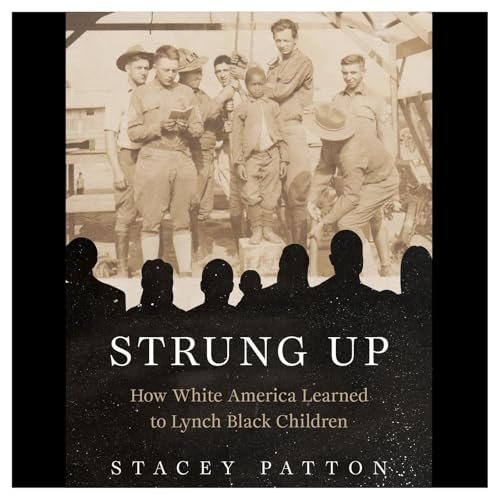
The image on the front cover is a World War I era photograph depicting a mock lynching of a Black child, reportedly at Camp Zachary Taylor in Louisville, Kentucky. The author purchased it from the Philip J. Merrill, Nanny Jack & Co Archives.
adbl_web_anon_alc_button_suppression_t1
No reviews yet