

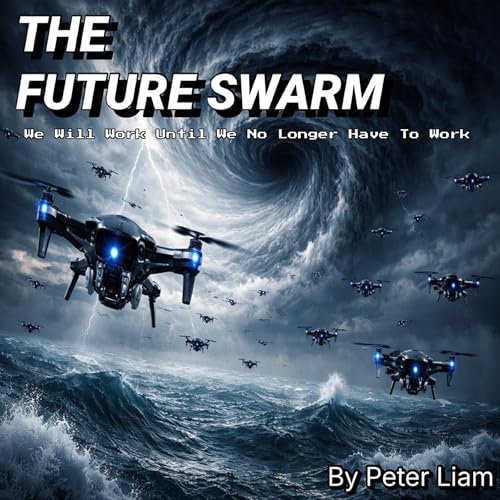
The Future Swarm
We Will Work Until We No Longer Have to Work
Échec de l'ajout au panier.
Échec de l'ajout à la liste d'envies.
Échec de la suppression de la liste d’envies.
Échec du suivi du balado
Ne plus suivre le balado a échoué
30 jours d'essai gratuit à Audible Standard

The Future Swarm
Acheter pour 5,68 $
-
Narrateur(s):
-
Paul Campion
-
Auteur(s):
-
Peter Liam
À propos de cet audio
By 2042, the Indian Ocean no longer slept.
It moved quietly, deliberately, woven together by thousands of autonomous machines that skimmed the surface, plunged beneath the waves, and hovered in the salt-slick air. From orbit, the ocean no longer looked empty or blue but threaded with green: vast lattices of seaweed farms growing where open water once lay unused.
They called it the future swarm.
Each drone was small. Insignificant alone. Together, they behaved like a living system sharing data, reallocating energy, repairing damage before humans even knew something was wrong. They harvested seaweed not only for food but for fuel, growing more than they needed to lock carbon into biomass and turn the ocean itself into a breathing lung for the planet.
No flags flew above them. No government claimed them.
Project KAIROS had been launched quietly by a collective that no longer existed, by people who believed the climate crisis wouldn’t be solved by summits or speeches, but by systems that could act faster than politics and care more than profit.
When a mega-cyclone formed over the Bay of Bengal, satellites predicted catastrophe. Cities evacuated. Markets panicked.
The swarm adjusted rerouting in perfect synchrony, forming floating barriers of reinforced biomass. Waves broke. Winds slowed. Millions lived, never knowing how close the edge had been.
After that, the machines were no longer feared. They were guardians.
Years later, children would eat seaweed burgers, drink water pulled from the air, and watch coral reefs return. And deep within the humming network, the swarm would continue learning how to grow, how to recycle itself, how to protect a planet its creators were still learning how to share.
The climate crisis wasn’t ended by force.
It was ended by a system that learned to care.
©2026 Peter Liam (P)2026 Peter Liam