

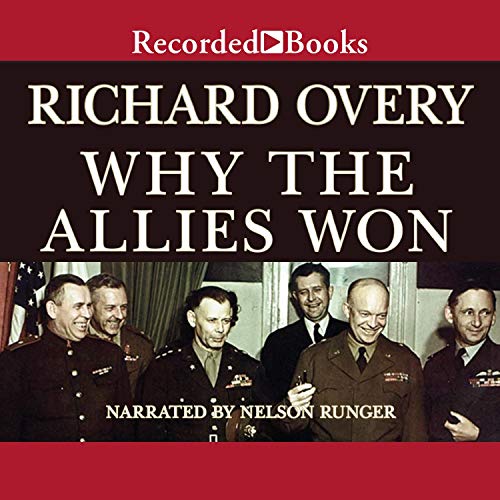
Why the Allies Won
Échec de l'ajout au panier.
Veuillez réessayer plus tard
Échec de l'ajout à la liste d'envies.
Veuillez réessayer plus tard
Échec de la suppression de la liste d’envies.
Veuillez réessayer plus tard
Échec du suivi du balado
Ne plus suivre le balado a échoué
1 mois d'essai gratuit à Audible Standard
8,99 $/mois à la fin de l’essai. Annulation à tout moment.

Why the Allies Won
Narrateur(s):
Nelson Runger
Acheter pour 33,76 $
-
Narrateur(s):
-
Nelson Runger
-
Auteur(s):
-
Richard Overy
À propos de cet audio
The Allied victory in 1945 was not inevitable. Overy shows us exactly how the Allies regained military superiority and why they were able to do it. He recounts the decisive campaigns: the war at sea, the crucial battles on the eastern front, the air war, and the vast amphibious assault on Europe. He then explores the deeper factors affecting military success and failure: industrial strength, fighting ability, the quality of leadership, and the moral dimensions of the war.
"Overy has written a masterpiece of analytical history, posing and answering one of the great questions of the century."—Sunday Times (London)©1995 Richard Overy (P)1999 Recorded Books, Inc.
Great Analysis
Un problème est survenu. Veuillez réessayer dans quelques minutes.