


This post was originally published on Audible.com.
Margaret Atwood is one of the world’s best-known writers, a foundational author who has been publishing extensively across genres and media since the 1960s. Her most famous work, The Handmaid’s Tale, is a cornerstone of feminist literature, and has reached audiences through formats ranging from a graphic novel to a highly popular television adaptation. Its imagery has even been incorporated into modern-day women’s rights protests.
Some listeners might know Atwood’s work from their school years; I personally remember studying The Handmaid’s Tale in a high school English literature class and being just as chilled then as I was listening to the audiobook more than 20 years later. While her layered, nuanced work has prompted a wave of academic and critical responses, her books are also compelling, high-stakes tales in their own right, pause-resistant sagas that will keep you hooked until the final lines.
Atwood’s stories often explore dystopian near-future scenarios based on present-day concerns, from the religious authoritarianism of The Handmaid’s Tale to the fears of genetic engineering gone awry in her MaddAddam Trilogy. She specializes in complex characters, often creating stories where the heroes are highly flawed and even antagonists can, to some extent, be understood despite the awful things they do.
In addition to writing fiction, Atwood has published numerous essays, memoirs, and musings on the writing process, exploring politics, art, and her own personal history. Currently in her mid-eighties, Atwood shows no signs of slowing down. She has created more than 50 books and multiple other works and has continued to give talks and weigh in on the literary and political discussions of our current turbulent times. Rejecting labels, Atwood and her work defy any easy categorization.
Who is Margaret Atwood?
Born in Ottawa, Canada, in 1939, Atwood spent much of her childhood in rural Quebec, thanks to her scientist father’s field work as an entomologist. Spending this much time in nature sparked a lifelong interest in the natural world, and many of Atwood’s literary works have explored the interactions between human civilization and wilderness.
Atwood began writing as a young child and decided to pursue a professional literary career when she was a teenager. She was first published in 1961; her poetry pamphlet, Double Persephone, won Atwood the EJ Pratt Medal, the first of many writing awards. Atwood then moved into prose, publishing her debut novel, The Edible Woman, in 1969. In addition to her writing, Atwood taught literature and writing at the university level in the early 1970s. This was around the time she established her literary career and began writing full time.
Atwood was in a long-term relationship with another Canadian novelist, Graeme Gibson, until his death as a result of dementia in 2019. Following his death, Atwood explored the subject of grief and bereavement in the poem "Dearly," as well as in essays and articles. The pair had a daughter together and lived on a farm in rural Ontario, where they both enjoyed spending time in nature.
What is Margaret Atwood’s literary and political impact?
Atwood has long been seen as a literary giant, and for good reason—her books have inspired readers for decades, tackled many important topics, and have been adapted across multiple formats. Atwood is often praised for her feminist writing, particularly in her exploration of an anti-woman religious state in The Handmaid’s Tale and The Testaments. She has often rejected simplistic interpretations of her work, however, emphasizing that her main focus in creating the fictional Republic of Gilead was to criticize authoritarianism. Indeed, Atwood creates female villains as well as heroines, and many of her books emphasize the gendered violence that women can enact upon each other, from the cruelty of the Aunts or Serena Joy in The Handmaid’s Tale to the toxic friendship dynamics unraveled in her contemporary novel Cat’s Eye.
A focus on protecting the natural world has also been a frequent motif in Atwood's literary and political legacy. She has spoken extensively about her strong belief that humans are part of, rather than separate from, nature, and that this perspective is crucial for humanity as a whole and particularly for writers and other artists, who must remember our strong relationships with the natural world. She has been a long-term activist for the environment and for climate justice. Most recently, Atwood has worked with Climate Words, an organization focused on communicating about the environment, the climate crisis, and the importance of protecting nature.
Unsurprisingly, Atwood has received a great many awards for her literary work. She has won the highly prestigious Booker Prize twice—once in 2000 for The Blind Assassin, and once as an unprecedented shared win in 2019 with Bernardine Evaristo. (Atwood won for The Testaments, Evaristo for Girl, Woman, Other.) In keeping with her cross-genre work, Atwood has also won the Nebula Award and the Arthur C. Clarke Award for her sci-fi, the Crime Writers of Canada Awards of Excellence for a crime short story, and has frequently been a Goodreads Choice Award winner.
As so much of her work explores new technology, it is appropriate that Atwood has embraced social media and used it to engage with fans. Atwood is active online, sharing pictures of her festival visits and book tours, as well as plenty of informal, behind-the-scenes snaps. She also publishes fairly regularly on Substack, writing essays and posts on topics from the US election to writing advice. As she heads toward her nineties, Atwood still has plenty to say, and is clearly in no danger of running out of new ideas for future literary works.
With such an extensive catalog, where should you start with Margaret Atwood? The fact that she has written in so many different genres means there really is something for everyone, and avid audiobook listeners will be delighted to find out that a vast number of Atwood’s books have been given the all-star audio cast treatment, with celebrated performers taking on the voices and stories of Atwood’s multilayered, often exasperating, never predictable characters. There are plenty of great entry points into Atwood’s work—here are just a few of the best Atwood audiobooks for listeners to explore.
The best books by Margaret Atwood

Atwood’s most famous work, The Handmaid’s Tale, is well-known not only for its visceral portrayal of a religious autocracy from the perspective of an anonymous woman forced into sexual and reproductive slavery, but for its ambiguous ending and the epilogue framing the entire novel as part of a conference held in the distant future. This special edition answers some of the questions that have puzzled listeners in the decades since the book was first published, with a new interview from the conference and an afterword from Atwood. Narrated by a cast including Claire Danes, the audiobook is an excellent listen for people both new to and familiar with this essential story.

The Testaments picks up several years after the events of The Handmaid’s Tale, following both new and familiar characters from inside and outside the Gilead autocracy. Aunt Lydia reminisces on her influence on the innermost workings of the Gilead government, while two young women, Agnes and Daisy, view the regime from two very different and yet connected perspectives. While The Handmaid’s Tale focused on how rights are lost, The Testaments looks at the different ways people can fight to get them back. With a stellar cast (Bryce Dallas Howard, Ann Dowd, and Mae Whitman) and a deep dive into the broader world that we saw a snapshot of through Offred’s eyes in The Handmaid’s Tale, The Testaments is a crucial listen for our present times.

Alias Grace is a historical thriller based on the real-life story of Grace Marks, a Victorian-era servant who was convicted of a double murder. In the novel, Grace is serving out her life sentence, but claims she can remember nothing about the day that she supposedly assisted in the killing of her previous employer and his housekeeper. While many people believe that Grace was rightfully found guilty, others believe she was framed, while still more doubt her sanity altogether. As a group of people who believe Grace should be pardoned begin to question her, the mystery of what really happened on the day of the murders begins to unravel, and the listener is drawn into a chilling tale of exploitation and violence.

Atwood’s MaddAddam Trilogy begins with Oryx and Crake, a sci-fi epic set in a near future where the world is changed forever by out-of-control genetic engineering. The story follows Snowman, who believes he is the only surviving human following a plague that wiped out the rest of the non-augmented population, and who goes on a journey to find out what happened to the two people he was closest to in the time before, the titular Oryx and Crake. An unsettling listen, Oryx and Crake creates a post-human world and asks the listener what it takes to survive.
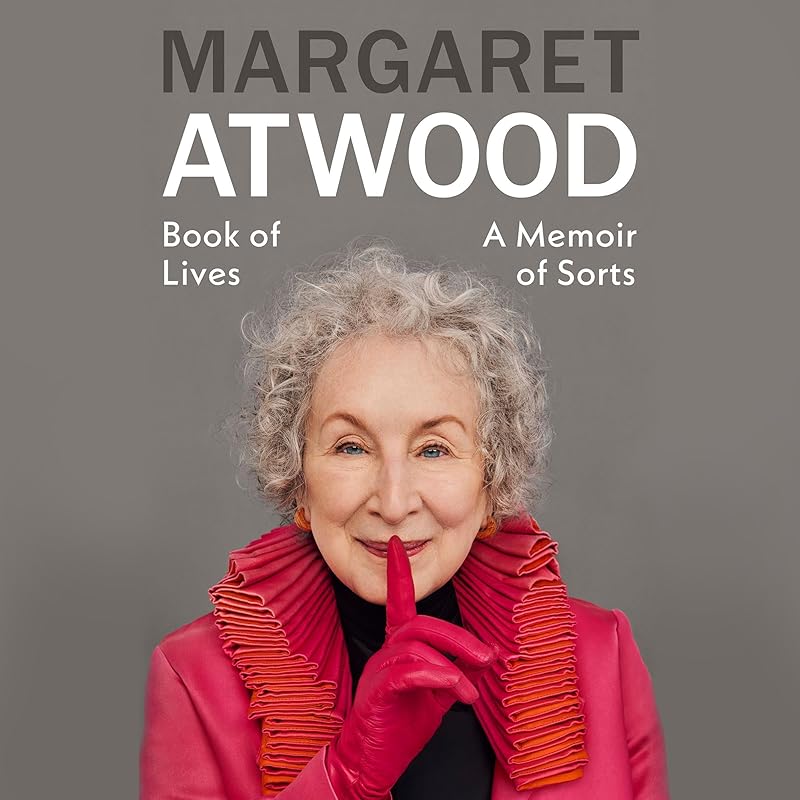
In this "memoir of sorts," Atwood tells the listener her personal and literary story, beginning with her unusual childhood growing up in Canada’s wilderness as a result of her scientist father’s research, and moving through events that inspired some of her most famous works. Read by Atwood herself, Book of Lives offers fascinating insights into her lived history that will give even more context and depth to her literary works.

With The Blind Assassin, Atwood creates a complex, multilayered. and intriguing story. Partly set in the 1940s, it tells a historical story about the death of the narrator’s sister; it also segues into a sci-fi story-within-a-story, building a rich tale where nothing is what it seems. Combining mystery, historical drama, and sci-fi, The Blind Assassin is a compelling and thought-provoking listen that won Atwood the Booker Prize in 2000.

Atwood writes and narrates On Writers and Writing, a musing on the role of the writer, looking at her own experiences as well as the legacies of her favorite authors. Exploring the different ways writers have interacted with their readerships, as entertainers, artists, truth-tellers, or predictors of the future, Atwood looks at the importance of and the contradictions inherent in writing. For anyone who loves finding out more about the writing process, is a writer themselves, or has read and enjoyed some of Atwood’s blog entries, On Writers and Writing is a fantastic listen.

Composed of 50 essays written by Atwood between 2004 and 2021, this nonfiction collection is a fascinating and often funny listen for anyone interested in a new perspective on the events of the past 20 years. Burning Questions is read by an A-list cast of actors and writers, including Ann Dowd, Naomi Alderman, Omar El Akkad, and Atwood herself, and considers everything from the climate crisis to the role of zombies in fiction.

Composed of 50 essays written by Atwood between 2004 and 2021, this nonfiction collection is a fascinating and often funny listen for anyone interested in a new perspective on the events of the past 20 years. Burning Questions is read by an A-list cast of actors and writers, including Ann Dowd, Naomi Alderman, Omar El Akkad, and Atwood herself, and considers everything from the climate crisis to the role of zombies in fiction.

Atwood’s retelling of William Shakespeare’s The Tempest follows the story of Felix, an embittered theater director who has been planning revenge since his production of The Tempest ended in disaster. As he gets involved in teaching a drama course at a local prison, Felix may be able to bring his plans to their deadly conclusion.
The best listens about Margaret Atwood

Margaret Atwood: A Modern Mythmaker includes six lectures given by Dr. Jennifer Cognard-Black on the importance and impact of The Handmaid’s Tale and the broader legacy of Atwood’s literary work. In this Great Courses audiobook, Cognard-Black looks at the different adaptations of Atwood’s most famous novel, from opera to hit TV series, and explores the many reasons why this work has continued to inspire and challenge new generations of readers since it was first published in 1985.


