

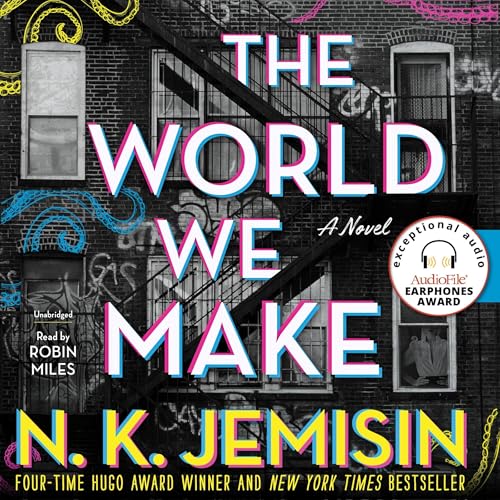
The World We Make
A Novel
Échec de l'ajout au panier.
Échec de l'ajout à la liste d'envies.
Échec de la suppression de la liste d’envies.
Échec du suivi du balado
Ne plus suivre le balado a échoué
1 mois d'essai gratuit à Audible Standard

The World We Make
Acheter pour 40,12 $
-
Narrateur(s):
-
Robin Miles
-
Auteur(s):
-
N. K. Jemisin
À propos de cet audio
Four-time Hugo Award-winning and New York Times bestselling author N.K. Jemisin crafts a glorious tale of identity, resistance, magic and myth.
All is not well in the city that never sleeps. Even though the avatars of New York City have temporarily managed to stop the Woman in White from invading—and destroying the entire universe in the process—the mysterious capital "E" Enemy has more subtle powers at her disposal. A new candidate for mayor wielding the populist rhetoric of gentrification, xenophobia, and "law and order" may have what it takes to change the very nature of New York itself and take it down from the inside.
In order to defeat him, and the Enemy who holds his purse strings, the avatars will have to join together with the other Great Cities of the world in order to bring her down for good and protect their world from complete destruction.
N.K. Jemisin’s Great Cities Duology, which began with The City We Became and concludes with The World We Make, is a masterpiece of speculative fiction from one of the most important writers of her generation.
The World We Make
Vous pourriez aussi aimer...

-
The City We Became
- A Novel
- Auteur(s): N. K. Jemisin
- Narrateur(s): Robin Miles
- Durée: 16 h et 12 min
- Version intégrale
-
Au global140
-
Performance121
-
Histoire122
Three-time Hugo Award-winning and New York Times bestselling author N.K. Jemisin crafts her most incredible novel yet, a "glorious" story of culture, identity, magic, and myths in contemporary New York City. In Manhattan, a young grad student gets off the train and realizes he doesn't remember...
-
-
Should have listened to the other critical reviews…
- Écrit par Sam le 2021-10-06
Auteur(s): N. K. Jemisin

-
Written on the Dark
- Auteur(s): Guy Gavriel Kay
- Narrateur(s): Simon Vance
- Durée: 10 h et 33 min
- Version intégrale
-
Au global10
-
Performance8
-
Histoire8
A Globe and Mail Top 100 Book of 2025 Both sweeping and intimate, a majestic novel of love and war that brilliantly evokes the drama and turbulence of medieval France Thierry Villar is a well-known—even notorious— tavern poet, familiar with the rogues and shadows of that world, but not at...
-
-
Lovely but not his best
- Écrit par Utilisateur anonyme le 2026-02-28
Auteur(s): Guy Gavriel Kay

-
Dawn
- Auteur(s): Octavia E. Butler
- Narrateur(s): Julienne Irons
- Durée: 8 h et 26 min
- Version intégrale
-
Au global7
-
Performance6
-
Histoire6
One woman is called upon to rebuild the future of humankind after a nuclear war, in this revelatory post-apocalyptic tale from the award-winning author of Parable of the Sower. When Lilith lyapo wakes from a centuries-long sleep, she finds herself aboard the vast spaceship of the Oankali. She...
-
-
Cool unique story
- Écrit par Trees Kindle le 2025-10-12
Auteur(s): Octavia E. Butler

-
Cage of Souls
- Auteur(s): Adrian Tchaikovsky
- Narrateur(s): David Thorpe
- Durée: 23 h et 10 min
- Version intégrale
-
Au global27
-
Performance22
-
Histoire22
The sun is bloated, diseased, dying perhaps. Beneath its baneful light, Shadrapar, last of all cities, harbours fewer than 100,000 human souls. Built on the ruins of countless civilisations, Shadrapar is a museum, a midden, an asylum, a prison on a world that is ever more alien to humanity. Bearing witness to the desperate struggle for existence between life old and new is Stefan Advani: rebel, outlaw, prisoner, survivor.
-
-
Unusual story.
- Écrit par Candace le 2023-02-17
Auteur(s): Adrian Tchaikovsky

-
Worlds of Exile and Illusion
- Three Complete Novels of the Hainish Series in One Volume—Rocannon's World; Planet of Exile; City of Illusions
- Auteur(s): Ursula K. Le Guin
- Narrateur(s): Michael Crouch, Alyssa Bresnahan
- Durée: 16 h et 38 min
- Version intégrale
-
Au global4
-
Performance3
-
Histoire3
Three remarkable journeys into the stars: Worlds of Exile and Illusion includes Rocannon's World, Planet of Exile, and City of Illusions. These three spacefaring adventures mark the beginning of grand master Ursula K. Le Guin’s remarkable career. Set in the same universe as Le Guin’s groundbreaking classics The Left Hand of Darkness and The Dispossessed, these first three books of the celebrated Hainish series follow travelers of many worlds and civilizations in the depths of space.
Auteur(s): Ursula K. Le Guin

-
Jade Shards
- Stories
- Auteur(s): Fonda Lee
- Narrateur(s): Andrew Kishino
- Durée: 3 h et 52 min
- Version intégrale
-
Au global5
-
Performance4
-
Histoire4
Fonda Lee returns to the acclaimed Green Bone Saga with four prequel short stories that delve into the personal histories of the Kaul and Ayt families.
-
-
I honestly wish this series was longer.
- Écrit par Utilisateur anonyme le 2023-09-30
Auteur(s): Fonda Lee
-
The City We Became
- A Novel
- Auteur(s): N. K. Jemisin
- Narrateur(s): Robin Miles
- Durée: 16 h et 12 min
- Version intégrale
-
Au global140
-
Performance121
-
Histoire122
Three-time Hugo Award-winning and New York Times bestselling author N.K. Jemisin crafts her most incredible novel yet, a "glorious" story of culture, identity, magic, and myths in contemporary New York City. In Manhattan, a young grad student gets off the train and realizes he doesn't remember...
-
-
Should have listened to the other critical reviews…
- Écrit par Sam le 2021-10-06
Auteur(s): N. K. Jemisin
-
Written on the Dark
- Auteur(s): Guy Gavriel Kay
- Narrateur(s): Simon Vance
- Durée: 10 h et 33 min
- Version intégrale
-
Au global10
-
Performance8
-
Histoire8
A Globe and Mail Top 100 Book of 2025 Both sweeping and intimate, a majestic novel of love and war that brilliantly evokes the drama and turbulence of medieval France Thierry Villar is a well-known—even notorious— tavern poet, familiar with the rogues and shadows of that world, but not at...
-
-
Lovely but not his best
- Écrit par Utilisateur anonyme le 2026-02-28
Auteur(s): Guy Gavriel Kay
-
Dawn
- Auteur(s): Octavia E. Butler
- Narrateur(s): Julienne Irons
- Durée: 8 h et 26 min
- Version intégrale
-
Au global7
-
Performance6
-
Histoire6
One woman is called upon to rebuild the future of humankind after a nuclear war, in this revelatory post-apocalyptic tale from the award-winning author of Parable of the Sower. When Lilith lyapo wakes from a centuries-long sleep, she finds herself aboard the vast spaceship of the Oankali. She...
-
-
Cool unique story
- Écrit par Trees Kindle le 2025-10-12
Auteur(s): Octavia E. Butler
-
Cage of Souls
- Auteur(s): Adrian Tchaikovsky
- Narrateur(s): David Thorpe
- Durée: 23 h et 10 min
- Version intégrale
-
Au global27
-
Performance22
-
Histoire22
The sun is bloated, diseased, dying perhaps. Beneath its baneful light, Shadrapar, last of all cities, harbours fewer than 100,000 human souls. Built on the ruins of countless civilisations, Shadrapar is a museum, a midden, an asylum, a prison on a world that is ever more alien to humanity. Bearing witness to the desperate struggle for existence between life old and new is Stefan Advani: rebel, outlaw, prisoner, survivor.
-
-
Unusual story.
- Écrit par Candace le 2023-02-17
Auteur(s): Adrian Tchaikovsky
-
Worlds of Exile and Illusion
- Three Complete Novels of the Hainish Series in One Volume—Rocannon's World; Planet of Exile; City of Illusions
- Auteur(s): Ursula K. Le Guin
- Narrateur(s): Michael Crouch, Alyssa Bresnahan
- Durée: 16 h et 38 min
- Version intégrale
-
Au global4
-
Performance3
-
Histoire3
Three remarkable journeys into the stars: Worlds of Exile and Illusion includes Rocannon's World, Planet of Exile, and City of Illusions. These three spacefaring adventures mark the beginning of grand master Ursula K. Le Guin’s remarkable career. Set in the same universe as Le Guin’s groundbreaking classics The Left Hand of Darkness and The Dispossessed, these first three books of the celebrated Hainish series follow travelers of many worlds and civilizations in the depths of space.
Auteur(s): Ursula K. Le Guin
-
Jade Shards
- Stories
- Auteur(s): Fonda Lee
- Narrateur(s): Andrew Kishino
- Durée: 3 h et 52 min
- Version intégrale
-
Au global5
-
Performance4
-
Histoire4
Fonda Lee returns to the acclaimed Green Bone Saga with four prequel short stories that delve into the personal histories of the Kaul and Ayt families.
-
-
I honestly wish this series was longer.
- Écrit par Utilisateur anonyme le 2023-09-30
Auteur(s): Fonda Lee

-
The Book of Koli
- Auteur(s): M. R. Carey
- Narrateur(s): Theo Solomon
- Durée: 14 h et 14 min
- Version intégrale
-
Au global58
-
Performance51
-
Histoire51
"A captivating start to what promises to be an epic post-apocalyptic fable" (Kirkus), The Book of Koli is the unforgettable story of a young boy struggling to find his place in a world where nature itself has turned against humanity. Everything that lives hates us... Beyond the walls of the...
-
-
Great story and Narrating
- Écrit par oolybooly le 2022-08-31
Auteur(s): M. R. Carey

-
The Spear Cuts Through Water
- A Novel
- Auteur(s): Simon Jimenez
- Narrateur(s): Joel de la Fuente
- Durée: 17 h et 17 min
- Version intégrale
-
Au global31
-
Performance27
-
Histoire27
Two warriors shepherd an ancient god across a broken land to end the tyrannical reign of a royal family in this epic fantasy from the author of The Vanished Birds. “A beguiling fantasy not to be missed.”—Evelyn Skye, New York Times bestselling author of The Crown’s Game WINNER OF THE...
-
-
A strange take
- Écrit par Sarah le 2025-02-03
Auteur(s): Simon Jimenez

-
Gideon the Ninth
- Auteur(s): Tamsyn Muir
- Narrateur(s): Moira Quirk
- Durée: 16 h et 50 min
- Version intégrale
-
Au global654
-
Performance536
-
Histoire535
Tamsyn Muir’s Gideon the Ninth unveils a solar system of swordplay, cut-throat politics, and lesbian necromancers. Her characters leap out of the audio, as skillfully animated as arcane revenants. The result is a heart-pounding epic science fantasy. Brought up by unfriendly, ossifying nuns, ancient retainers, and countless skeletons, Gideon is ready to abandon a life of servitude and an afterlife as a reanimated corpse.
-
-
Friggin' brilliant
- Écrit par J le 2020-10-21
Auteur(s): Tamsyn Muir

-
The Hundred Thousand Kingdoms
- Auteur(s): N. K. Jemisin
- Narrateur(s): Casaundra Freeman
- Durée: 11 h et 47 min
- Version intégrale
-
Au global130
-
Performance117
-
Histoire117
After her mother's mysterious death, a young woman is summoned to the floating city of Sky in order to claim a royal inheritance she never knew existed in the first book in this award-winning fantasy trilogy from the NYT bestselling author of The Fifth Season. Yeine Darr is an outcast from the...
-
-
not as good as other Jemisin books
- Écrit par Amazon Customer le 2019-04-17
Auteur(s): N. K. Jemisin

-
When Women Were Dragons
- A Novel
- Auteur(s): Kelly Barnhill
- Narrateur(s): Kimberly Farr, Mark Bramhall
- Durée: 15 h et 29 min
- Version intégrale
-
Au global43
-
Performance39
-
Histoire39
A GOODREADS BEST BOOK OF THE YEAR A fiery feminist fantasy tale set in 1950s America where thousands of women have spontaneously transformed into dragons, exploding notions of a woman’s place in the world and expanding minds about accepting others for who they really are. "Ferociously...
-
-
An Absolutely beautiful story of Feminism!
- Écrit par Utilisateur anonyme le 2023-06-10
Auteur(s): Kelly Barnhill

-
The Fifth Season
- The Broken Earth, Book 1
- Auteur(s): N. K. Jemisin
- Narrateur(s): Robin Miles
- Durée: 15 h et 27 min
- Version intégrale
-
Au global997
-
Performance880
-
Histoire875
At the end of the world, a woman must hide her secret power and find her kidnapped daughter in this "intricate and extraordinary" Hugo Award winning novel of power, oppression, and revolution. (The New York Times) This is the way the world ends. . .for the last time. It starts with the great red...
-
-
Not for me
- Écrit par Melissa le 2019-08-24
Auteur(s): N. K. Jemisin
Ce que les critiques en disent
— NPR on The City We Became
Magical!
Un problème est survenu. Veuillez réessayer dans quelques minutes.
So good!
Un problème est survenu. Veuillez réessayer dans quelques minutes.
I just finished reading The World We Make by N. K. Jemisin and rated it 4/5 stars. For me, a five is not just about quality. It is about mythic coherence. It is when a book’s logic holds and the ending arrives not as surprise, but as inevitability. It is an excellent book and a thoroughly enjoyable read, but a few specific choices kept it from reaching a full five for me.
I will start with what I enjoyed about the book. This book, even more than its predecessor, felt like a truly inhabited New York. The language, cadence, and descriptions all felt honest and grounded in the story. The streets of Brooklyn come alive, and you can smell the exhaust as Biggie bumps from a street vendor’s speaker.
I liked the uptick in fantastical elements and the continued development of the mythology. It all worked for this story. For the most part—and I will circle back to this later—the expanded mythology feels intentionally woven into the story rather than retrofitted as an afterthought.It is interesting that this time around, Jemisin leans into song titles and pop culture references in the book’s prose and chapter titles. It feels like she is more comfortable writing in this world. The City We Became, from what I have read of her work, was a meaningful deviation from her norms. It was a chance to articulate the slang and cadence of her New York. The World We Make reads like a book written from a place of comfort and even affirmation in that deviation. That comfort and confidence show up in the background of scenes painted with vivid vibrancy, without ever feeling overly described. On the streets of Jemisin’s NYC, she feels very much at home in her prose.
Meeting the various avatars from the other cities was a treat. I loved the imagination behind each one. Jemisin raised the stakes for the book without jumping the shark.
After being noticeably absent from the first book, the Wu finally show up. I love how Aislyn can name Staten Island’s xenophobic racism and its love of the Wu-Tang Clan not as a contradiction, but as an inherent necessity.
This book, more than its predecessor, felt like Jemisin was writing with a more visible agenda. That is not an inherent flaw, but it is noticeable in the narrative texture. The allegory felt thinner at times, not because the ideas themselves are weak, but because the book adopts a more polemical posture. In The City We Became, gentrification is embodied through the Woman in White’s anchor points, turning abstract forces into literal monsters. In The World We Make, similar dynamics are often named outright rather than manifested, which flattens the allegorical texture. In the first book, the symbolism literally attacks. In this one, it is more likely to send a message through hired thugs. That shift is part of the mythos of The World We Make: familiarity changes the means while intensifying the impact. The harbingers of doom are less fantasy and more next-door neighbor.
Jemisin released this book four years ago in a political and social climate that felt very different from the one we are in now. Reading this in 2026, the speculative distance has collapsed. What once might have felt pointed now feels almost understated, not because the novel lacks urgency, but because reality has become more extreme than the world Jemisin imagined. It raises the question of what her speculation might have looked like had she written this in the context of a New York City that voted for Mamdani as its mayor, where ICE is ever-present, and where previously left-leaning politicians take a right turn to drum up division as a political strategy.
My biggest grievance, and why I cannot give the book a 5/5 rating, is that she introduces aspects of the mythology too late in the story without ever hinting at them in the first book. Whether planned or not, these elements arrive as an addendum that retroactively changes the rules governing cities and their avatars. It breaks the narrative contract the first book asked me to trust. Having Manny suddenly be precognitive about his status as a city on the verge of awakening changed the rules of the original story. And the retcon line near the end of the book from Nique makes it seem all the more like a late addition.
While I enjoyed the ending, and there were hints of it in both books, it ultimately arrives in a minor deus ex machina fashion. The conclusion doesn’t feel honest to the rest of the book. With a little more exposition and foreshadowing, it could have landed as inevitable and right. And that is the thing, great endings are hard to stick, enjoyable or not.
Overall, Jemisin concluded her Great Cities duology with precision and excellent storytelling. Even though the mythic coherence falters and the ending feels slightly underdeveloped, the narrative itself holds fast. The part of me that simply enjoyed how good the story is wanted to give The World We Make 5/5 stars, if jubilation were the only metric. Still, this is a great read and a genuinely fun story. Now the rest of the world knows what Staten Island knew all along: politics is temporary, but Wu-Tang is FOREVER.
Politics Is Temporary: but Wu-Tang Is Forever | Reflections on The World We Make by N. K. Jemisin
Un problème est survenu. Veuillez réessayer dans quelques minutes.
Robin Miles is Amazing
Un problème est survenu. Veuillez réessayer dans quelques minutes.
NK Jemisin is a gem
Un problème est survenu. Veuillez réessayer dans quelques minutes.