Page de couverture de Modern Law Library

Modern Law Library

Modern Law Library

Auteur(s): Legal Talk Network
Écouter gratuitement

À propos de cet audio

Discover books and stories that explore the law in new and surprising ways through eye-opening conversations with their authors. Whether it’s fiction or non-fiction that you seek, Modern Law Library features today’s top legal authors and delves into legal theories, historical events, true crime, and law-inspired storytelling. Join Lee Rawles twice a month as she opens up a new legal publication on Modern Law Library, a Lisagor Award-winning podcast. Art Gestion et leadership Politique Sciences politiques Économie
Épisodes
  • Pop culture picks of 2025
    Dec 18 2025
    Looking for something to occupy yourself over the holidays, or to kick off your 2026? Lee Rawles is joined by her fellow Legal Talk Network hosts Stephanie Everett of the Lawyerist podcast and Conrad Saam and Gyi Tsakalakis of Lunch Hour Legal Marketing to share what books, TV shows and movies they enjoyed this year. They also share some of their own resolutions for 2026–and reveal a special new project for the Modern Law Library, coming soon to your podcast feed.
    Voir plus Voir moins
    33 min
  • John Lennon's lawyer explains how the musician's deportation case changed immigration law | Rebroadcast
    Dec 3 2025
    December 8th marks the 45th anniversary of John Lennon's death in 1980. In this special rebroadcast of Modern Law Library, we're looking back at how his immigration helped expose corruption within the Nixon administration and rewrote the immigration process. His attorney, Leon Wildes, sat down with Lee Rawles and his son Michael Wildes to discuss what the case and the legal legacy Lennon left behind. ----- When immigration attorney Leon Wildes got a call from an old law school classmate in January 1972 about representing a musician and his wife who were facing deportation, their names didn’t ring a bell. Even after meeting with them privately at their New York City apartment, Wildes wasn’t entirely clear about who his potential clients were. He told his wife that he’d met with a Jack Lemon and Yoko Moto. “Wait a minute, Leon,” his wife Ruth said to him. “Do you mean John Lennon and Yoko Ono?” What Wildes didn’t know when accepting the Lennons’ case was that he and his clients were facing a five-year legal battle which would eventually expose corruption at the highest levels of the Nixon administration and change the U.S. immigration process forever. His account of that legal battle is told in “John Lennon vs. the USA: The Inside Story of the Most Bitterly Contested and Influential Deportation Case in United States History.” Leon Wildes and his son Michael (now a managing partner at the firm his father founded, Wildes & Weinberg) joined the ABA Journal’s Lee Rawles to discuss the legacy of the case and the effect it’s had on the entire family. Mentioned in This Episode: John Lennon vs. The U.S.A.: The Inside Story of the Most Bitterly Contested and Influential Deportation Case in United States History
    Voir plus Voir moins
    16 min
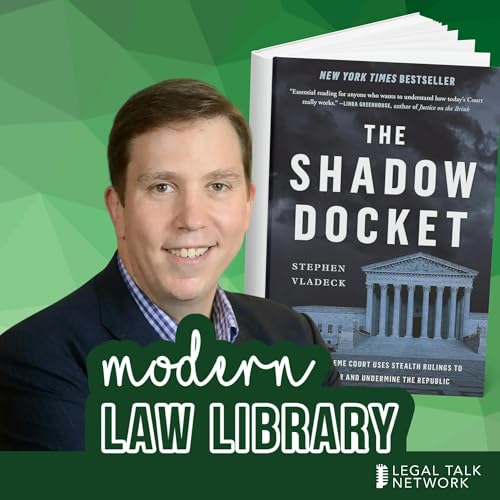
  • ‘The Shadow Docket’ shines light on an increasingly uncommunicative Supreme Court | Rebroadcast
    Nov 19 2025
    If you’re dreading your family’s lack of communication this Thanksgiving, here’s a conversation about another group that’s saying less and less with real consequences. In this rebroadcast, University of Texas law professor Stephen Vladeck joins The Modern Law Library to discuss The Shadow Docket and how the Supreme Court’s growing use of secretive, unsigned emergency orders is reshaping transparency, civic discourse, and public trust in the rule of law. ----- In The Shadow Docket: How the Supreme Court Uses Stealth Rulings to Amass Power and Undermine the Republic, University of Texas law professor Stephen Vladeck argues the U.S. Supreme Court is expanding its powers at the expense of the rule of law and public transparency. A case ordinarily comes before the U.S. Supreme Court after a long appellate process; receives a public hearing where the case is argued before the justices; then a signed opinion or series of opinions and a majority ruling are issued, which generally comes months after oral arguments—and years after a matter first entered the court system. Given the limited length of each Supreme Court term, there has always been the need for an alternative form of response when the court is not in session or a swift response was absolutely necessary. The vast bulk of those occasions have been in capital cases, where a last-minute appeal might be the difference between life and death. But since 2017, the U.S. Supreme Court has issued many more emergency orders than at any time previously, and on matters ranging from election law to immigration bans, from abortion access to COVID-19 restrictions on public gatherings. By issuing unsigned majority emergency orders rather than signed majority opinions, Vladeck says the court is establishing precedents without supplying the legal reasonings behind its rulings. During a time when the U.S. Supreme Court and individual justices are being criticized for not abiding by a clear judicial code of ethics, Vladeck argues the secretive nature of the shadow docket will only further undermine public trust in the rule of law. In this episode of the Modern Law Library, Vladeck discusses with the ABA Journal’s Lee Rawles the origin of the term “shadow docket,” the dangers he sees for the court and the country, and what remedies may be available to the republic.
    Voir plus Voir moins
    47 min
Pas encore de commentaire