Épisodes

  • Pop culture picks of 2025
    Dec 18 2025
    Looking for something to occupy yourself over the holidays, or to kick off your 2026? Lee Rawles is joined by her fellow Legal Talk Network hosts Stephanie Everett of the Lawyerist podcast and Conrad Saam and Gyi Tsakalakis of Lunch Hour Legal Marketing to share what books, TV shows and movies they enjoyed this year. They also share some of their own resolutions for 2026–and reveal a special new project for the Modern Law Library, coming soon to your podcast feed.
    Voir plus Voir moins
    33 min
  • John Lennon's lawyer explains how the musician's deportation case changed immigration law | Rebroadcast
    Dec 3 2025
    December 8th marks the 45th anniversary of John Lennon's death in 1980. In this special rebroadcast of Modern Law Library, we're looking back at how his immigration helped expose corruption within the Nixon administration and rewrote the immigration process. His attorney, Leon Wildes, sat down with Lee Rawles and his son Michael Wildes to discuss what the case and the legal legacy Lennon left behind. ----- When immigration attorney Leon Wildes got a call from an old law school classmate in January 1972 about representing a musician and his wife who were facing deportation, their names didn’t ring a bell. Even after meeting with them privately at their New York City apartment, Wildes wasn’t entirely clear about who his potential clients were. He told his wife that he’d met with a Jack Lemon and Yoko Moto. “Wait a minute, Leon,” his wife Ruth said to him. “Do you mean John Lennon and Yoko Ono?” What Wildes didn’t know when accepting the Lennons’ case was that he and his clients were facing a five-year legal battle which would eventually expose corruption at the highest levels of the Nixon administration and change the U.S. immigration process forever. His account of that legal battle is told in “John Lennon vs. the USA: The Inside Story of the Most Bitterly Contested and Influential Deportation Case in United States History.” Leon Wildes and his son Michael (now a managing partner at the firm his father founded, Wildes & Weinberg) joined the ABA Journal’s Lee Rawles to discuss the legacy of the case and the effect it’s had on the entire family. Mentioned in This Episode: John Lennon vs. The U.S.A.: The Inside Story of the Most Bitterly Contested and Influential Deportation Case in United States History
    Voir plus Voir moins
    16 min
  • ‘The Shadow Docket’ shines light on an increasingly uncommunicative Supreme Court | Rebroadcast
    Nov 19 2025
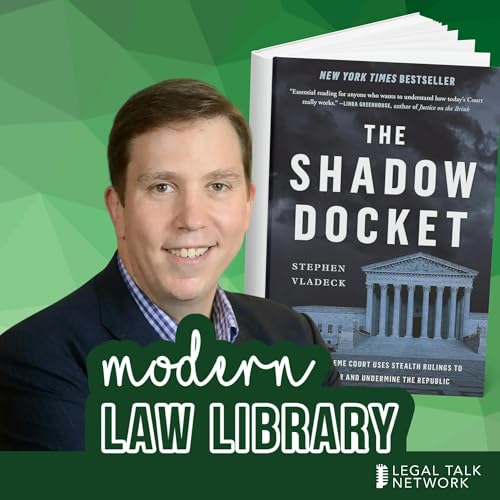
    If you’re dreading your family’s lack of communication this Thanksgiving, here’s a conversation about another group that’s saying less and less with real consequences. In this rebroadcast, University of Texas law professor Stephen Vladeck joins The Modern Law Library to discuss The Shadow Docket and how the Supreme Court’s growing use of secretive, unsigned emergency orders is reshaping transparency, civic discourse, and public trust in the rule of law. ----- In The Shadow Docket: How the Supreme Court Uses Stealth Rulings to Amass Power and Undermine the Republic, University of Texas law professor Stephen Vladeck argues the U.S. Supreme Court is expanding its powers at the expense of the rule of law and public transparency. A case ordinarily comes before the U.S. Supreme Court after a long appellate process; receives a public hearing where the case is argued before the justices; then a signed opinion or series of opinions and a majority ruling are issued, which generally comes months after oral arguments—and years after a matter first entered the court system. Given the limited length of each Supreme Court term, there has always been the need for an alternative form of response when the court is not in session or a swift response was absolutely necessary. The vast bulk of those occasions have been in capital cases, where a last-minute appeal might be the difference between life and death. But since 2017, the U.S. Supreme Court has issued many more emergency orders than at any time previously, and on matters ranging from election law to immigration bans, from abortion access to COVID-19 restrictions on public gatherings. By issuing unsigned majority emergency orders rather than signed majority opinions, Vladeck says the court is establishing precedents without supplying the legal reasonings behind its rulings. During a time when the U.S. Supreme Court and individual justices are being criticized for not abiding by a clear judicial code of ethics, Vladeck argues the secretive nature of the shadow docket will only further undermine public trust in the rule of law. In this episode of the Modern Law Library, Vladeck discusses with the ABA Journal’s Lee Rawles the origin of the term “shadow docket,” the dangers he sees for the court and the country, and what remedies may be available to the republic.
    Voir plus Voir moins
    47 min
  • Yale Law’s Owen Fiss talks about threats to democracy and ‘Why We Vote’ | Rebroadcast
    Nov 5 2025
    It’s election week in the U.S., and while many eyes are on the polls, we’re revisiting a conversation that reminds us why voting matters in the first place. In this rebroadcast, Yale Law professor Owen Fiss reflects on his work enforcing the Civil Rights and Voting Rights Acts, the courts’ role in protecting democracy, and why casting a ballot remains both a privilege and a duty. ----- After 50 years as a professor at Yale Law School, Owen Fiss says his students are still idealistic and passionate about the rights won in the Civil Rights Act of 1964 and Voting Rights Act of 1965. As a young lawyer in the late 1960s, Fiss worked with the Department of Justice to implement those laws. A classroom discussion in the spring of 2020 prompted him to draw upon his legal expertise and decades of experience to produce his new book, Why We Vote. In this episode of The Modern Law Library podcast, Fiss speaks with the ABA Journal’s Lee Rawles about the paradox of the court system–the least democratic branch of government–having the responsibility of safeguarding the right to vote. He looks back on his work with the DOJ in southern states, and his time as a clerk for Justice Thurgood Marshall (then on the 2nd U.S. Circuit Court of Appeals in New York) and Justice William Brennan. Rawles and Fiss also discuss recent threats to the electoral system and right to vote, including the insurrection on Jan. 6, 2021. Fiss shares his thoughts about Section 3 of the 14th Amendment, and whether former President Donald Trump should be removed from the ballot on that basis. While every book he writes is for his students, Fiss says, he hopes Why We Vote can impress upon a broader audience the privilege and duty of voting and participating in a democracy.
    Voir plus Voir moins
    41 min
  • Users keepers: Pirates, zombies and adverse possession | Rebroadcast
    Oct 15 2025
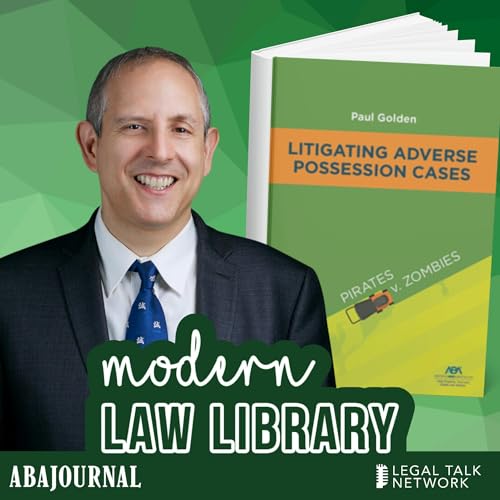
    As Halloween swiftly approaches, we’ve conjured up a classic from the Modern Law Library crypt. What do zombies and pirates have to do with the law? Grab your candy and find out as host Lee Rawles is joined by Paul Golden, author of Litigating Adverse Possession Cases: Pirates v. Zombies. —---- “Trespassing plus time equals adverse possession,” Paul Golden writes in his new book, Litigating Adverse Possession Cases: Pirates v. Zombies. When someone has occupied or used a piece of property as though they own it for long enough, a court could determine that they are the rightful owner—regardless of what the paperwork says. It’s a concept more popularly discussed as squatter’s rights. In this episode of The Modern Law Library, Golden speaks with the ABA Journal’s Lee Rawles about the ancient concepts underlying modern adverse possession law; some quirky state laws; and why societies would allow land to be transferred in this way. They also discuss how the plain meaning of terms like “hostile” are changed when used in adverse possession cases, and Rawles raises a hypothetical—taken from real life—of a neighbor’s crooked fence. During Golden’s first appearance on The Modern Law Library, he explained how the lack of a written contract could be navigated by a savvy lawyer. In his new book, Golden guides attorneys and their clients through the finer points of arguing for and against adverse possession claims. He shares some of the errors he’s seen pop up in adverse possession cases, and offers advice for how to avoid common pitfalls.
    Voir plus Voir moins
    33 min
  • The Supreme Court’s colorful history with alcohol gets a look in ‘Glass and Gavel’ | Rebroadcast
    Oct 1 2025
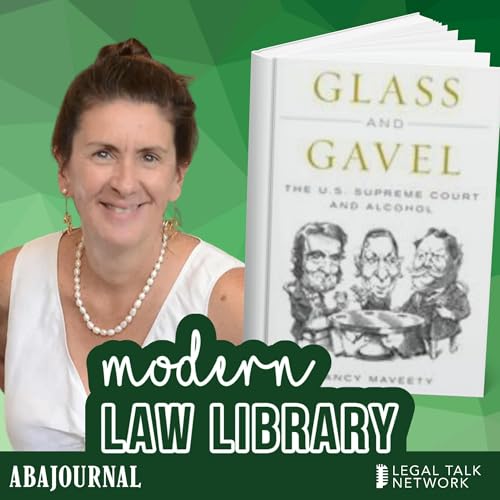
    As the Supreme Court returns to the bench, we’re raising a glass to a favorite from our archives. In this episode, Nancy Maveety shares stories from Glass and Gavel, where cocktails meet constitutional law. ----- From the earliest days of the U.S. Supreme Court, alcohol has been part of the work lives and social lives of the justices. In the book “Glass and Gavel: The U.S. Supreme Court and Alcohol,” Nancy Maveety takes readers on a tour through the ways that SCOTUS and spirits have overlapped. In this episode of the Modern Law Library, she speaks with the ABA Journal’s Lee Rawles about how she came to write this in-depth history. While the Prohibition Era would immediately spring to mind, the court faced a number of cases involving alcohol that impacted commerce, advertising, criminal justice and even gender discrimination laws. Maveety, who in addition to being a scholar of constitutional law also studies mixology, shares how she selected a signature cocktail for each chief justice’s tenure. She also has a drink suggestion for readers which incorporates an ingredient that’s known to be one of Justice Ginsburg’s favorites–and a cautionary tale about a normally teetotaling chief justice who dropped dead after sipping a sherry.
    Voir plus Voir moins
    34 min
  • David Grann uncovers the deadly conspiracy behind murders of oil-rich Osage tribe members | Rebroadcast
    Sep 17 2025
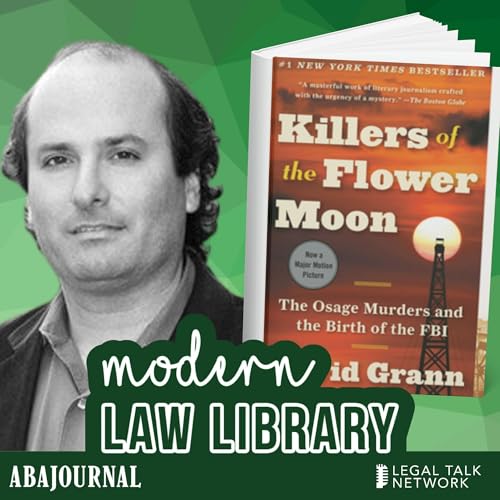
    As Native American Day approaches on September 25, we’re revisiting a story that still resonates today. Author David Grann takes us inside the Osage murders—a chilling chapter in U.S. history where oil wealth brought tragedy, corruption, and the rise of the FBI. ----- Although the Osage tribe had been forced from their ancestral lands by the U.S. government, through shrewd and careful bargaining they retained the mineral rights to one of the richest oil fields in the world: Osage County, Oklahoma. But instead of insuring the prosperity and safety of the tribe, the wealth of the Osage made them targets for what was later known as the Reign of Terror. The task of solving dozens of murders fell in the 1920s to the newly formed FBI and its young director, J. Edgar Hoover. In this episode of the Modern Law Library, author David Grann tells the ABA Journal’s Lee Rawles how he first learned of this series of murders and decided to write Killers of the Flower Moon: The Osage Murders and the Birth of the FBI. He also discusses the brave Osage woman at the heart of his story, Mollie Burkhart, who defied the local white-dominated power structure to discover who was responsible for the deaths of her family members. Mentioned in This Episode: Killers of the Flower Moon: The Osage Murders and the Birth of the FBI by David Grann
    Voir plus Voir moins
    23 min
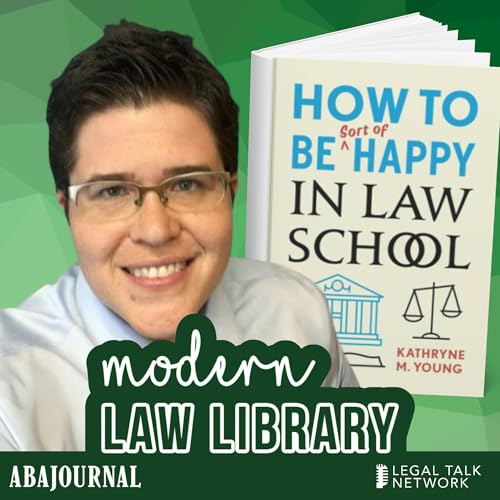
  • How to be (sort of) happy in law school | Rebroadcast
    Sep 3 2025
    As summer winds down and school beckons, we’re looking back in our archives and assigning some back-to-school reading—grown-up style. In this episode, Professor Kathryne M. Young shares advice from her book How to Be Sort of Happy in Law School—from tackling imposter syndrome to finding your own path through law school’s pressures. —-- Law school can be a lonely, stressful time, and it’s easy to feel like you’re failing to fit the model of the perfect law student. But there’s no one right way to go to law school, says Professor Kathryne M. Young, author of How to Be Sort of Happy in Law School; you can craft your own experience. In this episode of the Modern Law Library, Young talks with the ABA Journal’s Lee Rawles about tackling imposter syndrome; advice that alumni wish they could give their younger selves; and techniques for getting along with your fellow students. Young uses lessons from her own law school experience and a sociological study she conducted to give practical tips for keeping a mental balance; choosing which courses and activities to pursue; managing the practical aspects of your household and budget; forming relationships with mentors and peers–and even deciding when if it’s time to leave law school altogether. Young’s book offers a holistic approach to surviving–and thriving–under the social, academic and economic pressures of law school.
    Voir plus Voir moins
    32 min