Épisodes

  • The Networking Strategy That Beats Job Boards!
    Oct 15 2025

    Send us a text

    Vicky Torres sent over 1,000 job applications in 12 months. She got four interviews—every one through referrals. Zero came from job boards.

    This wasn’t about weak credentials. Torres holds a B.S. in IT and an M.S. in Data Analytics, founded a women-in-tech org, and built real projects. What changed everything: she stopped playing by the old rules.

    Here's what actually got her hired: She stopped playing by the old rules entirely.

    Traditional job hunting advice tells you to polish your resume, tailor applications, and apply consistently. Torres did all of this religiously.

    The result? A 0.4% callback rate.

    Her applications disappeared into what she calls "the void." No feedback. No rejections. Just silence.

    This isn't unique to Torres. Her entire graduate cohort experienced the same pattern. The job market had fundamentally shifted, but the advice hadn't caught up.

    Torres pivoted completely. Instead of fighting the broken system, she built around it through three strategic moves:

    First, she joined structured communities. COOP, a four-month fellowship program, provided career coaching, networking events, and direct connections to hiring companies.

    Second, she approached networking authentically. Rather than transactional "please review my resume" messages, she led with genuine curiosity about people's career journeys. This created real relationships instead of superficial connections.

    Third, she filled the employment gap strategically. While job hunting, she worked as a substitute teacher through Swing Education and completed the Co-op program. Her resume showed continuous growth and skill development rather than empty months.

    The breakthrough came when a recruiter found her through Co-op's network. Not through an application she submitted, but through a referral system that bypassed traditional filters entirely.

    Torres landed her current role as Associate Media Planner. The title doesn't include "analyst," but the work absolutely does.

    She uses data analytics daily: analyzing campaign performance, building client recommendations with statistical backing, and storytelling through data visualization.

    This reveals a critical insight about modern job searching. The work you want to do exists across many role titles. Torres was initially tunnel-visioned on positions with "analyst" in the name, missing opportunities where analytical skills were essential but not explicitly labeled.

    What separated Torres from others in her situation wasn't superior credentials or better luck. It was her response to failure.

    When traditional applications stopped working after two months, she immediately sought alternatives. She joined communities, attended virtual networking events, and built genuine professional relationships.

    This mindset came from her background as a first-generation college student. She actively sought mentors, career coaches, and peer networks that could fill knowledge gaps.

    The result was a systematic approach to professional development that continued even during unemployment.

    Torres now helps others navigate similar journeys through LinkedIn mentoring and mock interviews. Her advice centers on three immediate actions:

    Join structured networking programs

    Approach networking as relationship building

    Fill employment gaps with strategic activities

    The job market has changed permanently. The strategies that worked five years ago no longer apply. But new pathways exist for those willing to abandon outdated approaches

    Your next interview likely won't come from your next application. It will come from yo

    Support the show

    Voir plus Voir moins
    54 min
  • Data Interviews: Curiosity Beats Credentials!
    Oct 6 2025

    Send us a text

    Matt Brattin, former CFO and 20-year corporate veteran, shares insider perspectives on data analytics hiring from the decision-maker's side. He reveals what truly sets candidates apart, common misconceptions about the interview process, and actionable strategies for standing out in today's competitive job market.

    Key Insights

    The interview isn't adversarial - Hiring managers want you to succeed. They wouldn't bring you in to waste time; they're genuinely considering offering you the position and want to find the right fit.

    One solid answer can change everything - Even if you stumble early, interviews aren't over in the first 20 seconds. Discussions happen after you leave, and a memorable insight can completely shift the conversation in your favor.

    Curiosity trumps credentials - The most important trait is genuine curiosity, demonstrated by engaging in real conversation rather than just answering preset questions.

    [05:45] The Power Dynamic Shift

    Matt emphasizes approaching interviews with confidence: "I don't need this job. Tell me why I should come work here... it totally flips the power dynamic."

    [12:30] Taking Interviewers Off Script

    Key tactic: Follow your answers with questions or insights that lead the conversation beyond standard scripts. This forces interviewers to pay attention and remember you.

    [18:15] The Curiosity Factor

    "Curiosity is the easiest one to point to... somebody who actually wants to talk to me and not just answer questions." Show interest in the business, not just the role.

    [25:40] LinkedIn as Interview Prep

    Critical insight: "I'm more likely to have your LinkedIn up than your resume in front of me." Hiring managers research candidates and look for conversation starters beyond basic qualifications.

    Red Flags/Green Flags

    [20:10] What Kills Your Chances

    • Victim mentality or "us vs. them" attitude
    • One-word answers showing disinterest
    • Coming unprepared with zero questions

    [28:50] What Makes You Memorable

    You need to be "the chocolate guy" or "the horse girl" - something that makes you stand out in post-interview discussions. Without a memorable element, you won't be part of the final conversation.

    [35:20] Go Beyond Surface Level

    Matt's advice: Enter with a mission to learn something specific about the business - their BI tools, database systems, or revenue model. This demonstrates forethought and genuine business interest.

    The golden rule: "Go in with an objective that's beyond the interview... make it your mission to get answers to those questions because it demonstrates that this person had a little bit of forethought."

    [38:45] Questions That Actually Matter

    Don't ask generic culture questions. Instead, focus on understanding how the company makes money, what they sell, and how they operate. Approach it like your first day orientation, not an interrogation.

    [08:30] AI Job Market Truth

    While the current market feels tough due to AI fears and corporate efficiency pressures, Matt believes this is cyclical: "We will find more ways to be useful and to need resources... anybody with technical skills, particularly analytical skills, will be in demand."

    Action Items for Job Seekers

    • Research beyond the job description - Understand the business model and revenue streams
    • Prepare conversation starters - Have insights that take the interview off script
    • Develop your memorable element - What makes you "the [something] person"?

    Support the show

    Voir plus Voir moins
    42 min
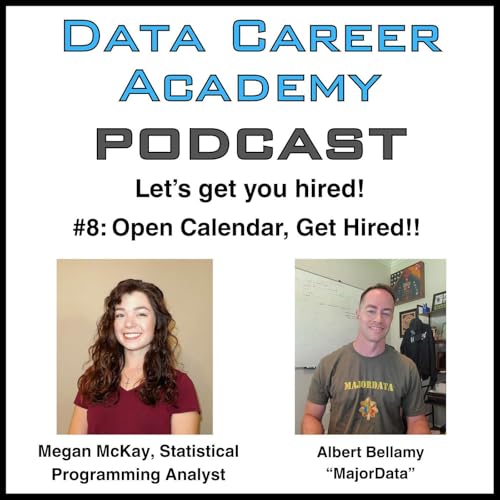
  • Open Calendar, Get Hired!
    Sep 23 2025

    Send us a text

    Episode 08: From Math Classroom to Healthcare Analytics with Megan McKay

    What happens when a math instructor asks, “Where can I take the math?” For Megan McKay, the answer was analytics, intentional networking, and a referral that led to Blue Cross Blue Shield of South Carolina. In this episode, Megan unpacks her pivot from teaching undergrad math to landing a newly minted analyst role, including the exact steps, surprises, and lessons that moved her from “spray and pray” to strategic.

    Megan holds a master’s in applied mathematics from the University of South Carolina, taught 100-level courses for three years, and built a new class called Mathematical Concepts for Data and Analytics to support USC’s data analysis degree. That work pulled her into the analytics world, where she completed the Google Professional Data Analytics Certificate, joined Avery Smith’s Data Analytics Accelerator, built projects, and rebuilt her resume and portfolio.

    The job that stuck started with a referral. Megan applied during a short posting window, confirmed salary with the recruiter, and completed two interviews that leaned behavioral with light scenario thinking. No live coding, but lots of communication, problem framing, and clarifying definitions in a regulated domain. She also shares a clean follow-up move that preceded her offer call by a couple of hours and a look at week-one onboarding in healthcare, from HIPAA to business language and acronyms.

    You’ll learn:

    • How a teacher translated math skills into business outcomes and analytics stories
    • Why pausing applications to level up projects and portfolio can raise your hit rate
    • A simple “open calendar” coffee-chat experiment that produced 15 calls in two weeks and a stronger network across multiple countries
    • How referrals cut the line without guaranteeing the job, and why vibe and clarity still win the room
    • Smart follow-up timing after “you’ll hear soon”
    • What early onboarding looks like in a healthcare analytics role

    Tactics to steal:

    • Clarify terms, baselines, and success criteria before proposing solutions
    • Post with intent on LinkedIn and send personal connection messages
    • Make it easy for people to talk with you using a limited Calendly window
    • Shift time blocks as you progress: upskill early, then lean into applications and networking
    • Pick a lane when you can, and let strong referrals open doors you can grow into

    Connect with Megan on LinkedIn. Her portfolio and Tableau Public are accessible through her profile and resume. She keeps messages open and welcomes thoughtful conversations if you want to try the open calendar idea yourself.

    For more on closing the gap between job seekers and hiring authorities, visit themajordata.com or join the Data Career Academy community on LinkedIn.

    Support the show

    Voir plus Voir moins
    45 min
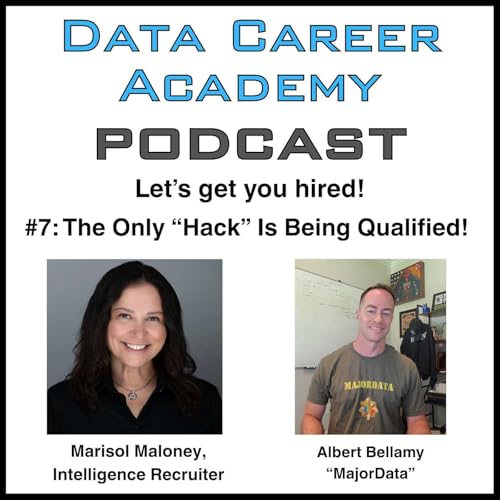
  • The Only Job Hack Is Being Qualified
    Sep 15 2025

    Send us a text

    Cleared Intel Recruiting with Navy Veteran Marisol Maloney


    Navy veteran and former Nurse Corps officer turned intel professional and recruiter, Marisol Maloney joins Albert to pull back the curtain on cleared hiring. From must have requirements to ATS myths, she explains exactly how veterans and career changers can position themselves for success. Marisol also runs Secret Squirrel Consulting LLC, where she coaches veterans on resumes, LinkedIn, and transitions.

    What you’ll learn

    • When cleared roles really require 100 percent of the must haves and when 80 percent can still work
    • How knockout questions in applications trigger instant rejections
    • Why tailoring beats tricks like pasting the JD in white font
    • How to translate military experience and avoid over scrubbing intel work
    • The right way to use LinkedIn so recruiters actually call you
    • Interview prep that wins offers: STAR storytelling, humility, and self awareness
    • Smart use of certs and training for project management, cyber, and intel paths
    • How to track applications and versions so you are ready when the call comes
    • Ghosting clarified: what it is and what it is not
    • Veteran specific tips on clearances, polys, relocation, and post service reset

    Highlights

    • Marisol’s path: emergency nursing officer to intel, to speechwriter for a four star, to analyst, then recruiter.
    • Why she started Secret Squirrel Consulting and how coaching led to a client getting an interview and offer in days.
    • Cleared hiring reality: read the job description closely. Many DoD contracts require the clearance level, degree, and years of experience as written.
    • Knockout mechanics: application questions like Do you have a TS SCI with poly can auto reject.
    • Tailoring example: if a JD wants hot dog experience, show the metric for hot dog outcomes. Swap to hamburger for the next role.
    • ATS myth busting: keyword graders and white text tricks are not the win. Being qualified and clearly communicating it is.
    • Recruiter screen value: it fills gaps a resume misses and lets an advocate push you forward.
    • Interview fails to avoid: arrogance, winging it, claiming you never failed your team, not knowing your own resume.
    • Application strategy: fewer targeted applications beat 2000 spray and pray submissions. Track every JD and the exact resume you used.
    • Certifications: choose what JDs repeatedly ask for. Do not collect certs you will not use.
    • Veteran transition: take care of health, research roles, do informational interviews, and be realistic about market pay and doer vs leader expectations.
    • Location tradeoffs: clearances often tie to place. Be ready to relocate or pivot to non cleared work if needed.
    • Networking and follow ups: engage with recruiters’ content, ask good questions, and follow up even after rejection.

    Resources mentioned

    • Onward to Opportunity
    • Vets in Tech
    • Vets2Industry
    • ACT NOW Education
    • Coursera and similar low cost learning options

    About Marisol

    (3) Marisol Maloney | LinkedIn

    Calendly - 🐿 Secret Squirrel Consulting 🐿

    Connect with Data Career Academy

    • Site: themajordata.com
    • Join the LinkedIn group for free resources and first looks at new projects.

    Support the show

    If this episode helped you, share it with a veteran or job seeker, subscribe in your favorite podcast app, and leave a quick rating so more people can find the show.

    Support the show

    Voir plus Voir moins
    46 min
  • Sailing into a Job with Navy Data!
    Sep 8 2025

    Send us a text

    Breaking into analytics isn’t easy—especially fresh out of school. In this episode of the Data Career Academy Podcast, I sit down with Aidan Karmazinski, now a Financial Analyst with NAVFAC (Naval Facilities Engineering Systems Command), to hear how he went from applying everywhere with little success to landing a role with the U.S. Navy.

    Aidan walks us through his journey: growing up in Maryland, studying business and accounting at Greensboro College, discovering analytics, and pursuing a master’s in Business Analytics at the University of North Florida. Like many new graduates, he started his job hunt with the “spray and pray” method—submitting endless online applications with little to show for it. After weeks of frustration, he changed course, asked for help at UNF Career Services, and discovered the power of in-person connections.

    That decision paid off. At a career fair, Aidan struck up an hour-long conversation with the hiring manager who would become his boss. The discussion flowed naturally, mixing analytics ideas with real-world problem-solving and even a shared love of lacrosse. It turned into the opportunity that launched his career.

    In this episode, Aidan shares what he learned about refining his job search, balancing technical and soft skills, and why face-to-face conversations reveal more than résumés or Zoom calls ever could. He also opens up about the challenges of starting out—like being humbled in technical interviews, figuring out which skills truly matter, and learning to provide insights that go beyond simply pulling reports.

    Along the way, we talk about:

    • Why changing tactics is better than doubling down on what isn’t working
    • How to prepare for interviews without overselling skills you can’t defend
    • The difference between “qualified on paper” and “the right fit”
    • Using extracurriculars to show leadership and discipline (and why it worked for him)
    • The importance of daily value creation: success at work is always rented, never owned

    Aidan also highlights NAVFAC’s Financial Management Career Program, which gave him the chance to rotate through contracting, HR, budgeting, and analytics, and how those experiences accelerated his learning. On the personal side, he plugs his parents’ nonprofit, HHI Incorporated, which helps adults with special needs find employment—including his brother Alex, who has thrived thanks to the program.

    If you’re an early-career data professional—or just feeling stuck in the job hunt—you’ll find practical lessons, encouragement, and a reminder that the right opportunity often comes from human connection, not endless online applications.

    For more episodes and resources, visit themajordata.com or join my LinkedIn group for first looks at what I’m working on.

    Semper Fidelis,
    Albert Bellamy

    Support the show

    Voir plus Voir moins
    36 min
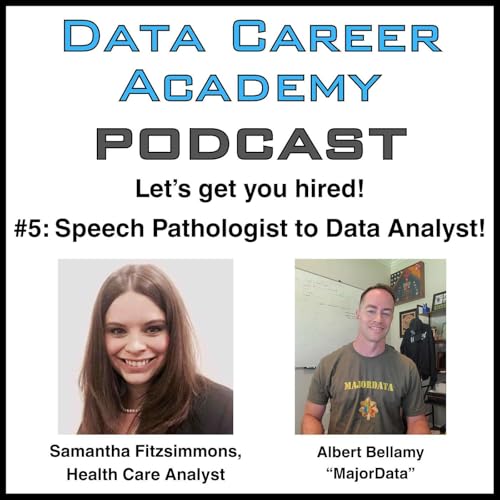
  • How I Went from Speech Pathologist to Data Analyst!
    Sep 2 2025

    Send us a text

    In this episode of the Data Career Academy Podcast, Albert Bellamy sits down with Samantha Fitzsimmons, a former speech-language pathologist who successfully transitioned into the world of data analytics. Samantha spent 14 years helping patients improve communication and cognitive function before making the bold decision to pivot her career. Today, she’s a job seeker in the analytics field, focusing on healthcare and call center data, with a growing portfolio of Tableau dashboards, SQL projects, and Alteryx workflows.

    Samantha’s story is one that so many career changers will relate to. She opens up about the challenges of moving into data from a non-technical background, including:

    • Navigating a layoff early in her analytics career, and what it taught her about resilience.
    • Learning to manage imposter syndrome, both in speech pathology and in data.
    • Building confidence by accepting that she’ll never know “everything” in such a fast-moving field.
    • Telling her own story on LinkedIn rather than letting others define it.
    • Using AI tools like ChatGPT in a highly structured way to tailor resumes, extract keywords from job postings, draft cover letters, and even refine interview prep.

    We also dive into Samantha’s job search strategy, which is remarkably focused and disciplined. Instead of “spray and pray” job applications, she aims for one highly tailored application a day, making sure every resume and cover letter speaks directly to the role. She talks about why she still includes cover letters (even when they aren’t required), how she saves and analyzes job descriptions, and how she balances the exhausting process of job hunting with creating content that strengthens her professional brand.

    Samantha also shares how she’s building visibility by publishing SQL tutorials, Tableau dashboards, and healthcare-related content on LinkedIn. She’s even developed a creative series translating medical jargon into digestible posts for people who want to enter healthcare analytics — turning her unique background into a real differentiator.

    Some of the biggest lessons from this episode include:

    • Confidence is a practice. Accepting discomfort and embracing your background can be just as powerful as technical skills.
    • Focus beats volume. A handful of thoughtful, targeted applications will beat 50 generic ones every time.
    • Your story matters. Don’t hide your nontraditional path; own it and show how it adds value.
    • AI can be an ally. Used strategically, tools like ChatGPT can help you compete in a crowded job market without losing your authentic voice.
    • Community matters. Sharing your journey online can help others, while also reinforcing your own learning.

    Whether you’re a new graduate, a career changer, or a seasoned analyst navigating today’s competitive market, Samantha’s journey offers encouragement, practical tactics, and an honest look at what it’s like to be “in the fight” right now.

    If you’re hiring for healthcare analytics or just want to connect with someone who’s thoughtful, organized, and passionate about data, Samantha is absolutely worth a follow. Check out her GitHub landing page SamaFitz, her Tableau Public portfolio Profile - samantha.fitzsimmons | Tableau Public, and connect with her on LinkedIn (16) Samantha Fitzsimmons | LinkedIn

    Support the show

    Voir plus Voir moins
    39 min
  • The Data-Driven Accountant
    Aug 25 2025

    Send us a text

    In this episode of the Data Career Academy Podcast, I sit down with Jennifer Jaurequi, a newly hired staff accountant with a data edge. Jennifer’s path to her current role at Coast Hills Credit Union is anything but linear. With a background in math, a season of teaching, and multiple data bootcamps under her belt, she’s proof that you don’t need the title “analyst” to leverage data and break into a stronger career path.

    Jennifer shares how she went from teaching math to working in accounting, and how her curiosity about analytics led her to enroll in data bootcamps at UC Berkeley Extension and Data Career Jumpstart. Along the way, she picked up technical skills like Python, SQL, and advanced Excel, while also building projects that caught the attention of interviewers—even when she was applying for strictly accounting positions.

    We dig into:

    • How her math and teaching background helped her shift into accounting and later into a data-focused role.
    • Why she pursued a data bootcamp and how it directly boosted her resume, confidence, and interview storytelling.
    • The behind-the-scenes of her job search strategy, including 20–50 applications, 5 interviews, and the one that landed.
    • What she learned about fit vs. skills during the interview process, including handling tough questions like “Why should we hire you?”
    • The importance of projects on your resume (and how even a CityBike or DoorDash project can make you memorable).
    • How she balanced the challenge of wanting professional growth while staying positive about past employers in interviews.
    • Why getting your foot in the door with the right company matters more than chasing the “perfect” job title.

    Jennifer’s story is a real-world example of how combining domain expertise (accounting and finance) with data analytics skills creates a powerful, marketable profile. She also reminds us that selling is storytelling—preparing examples tied to the job description and telling stories that stick in the interviewer’s head makes all the difference.

    If you’re an accountant, finance professional, teacher, or anyone considering a career pivot into data, this episode will give you actionable insights and encouragement. Jennifer shows that it’s not about abandoning your roots—it’s about adding data to your toolkit and letting that open doors.

    Finally, Jennifer shares how listeners can connect with her on LinkedIn, where she’s happy to answer questions and share more about her journey.

    Whether you’re searching for your first data job or looking to level up your career by blending your current skills with analytics, you’ll walk away from this conversation with strategies you can use right now.

    Support the show

    Voir plus Voir moins
    32 min
  • Full-Court Press Into Data Analytics!
    Aug 12 2025

    Send us a text

    In this episode of the Data Career Academy Podcast, we sit down with Taqi Patrick—a public sector professional with 22 years of experience, decades of technical know-how, and a big goal: transitioning into a data analytics (and possibly data engineering) career before retirement.


    Taqi’s story is proof that you don’t need to be in a “data analyst” role to develop serious data skills. As an Unemployment Benefits Specialist, he’s spent years building advanced Excel and VBA automations to streamline case assignments, clean messy datasets, and keep operations running smoothly.

    His knack for optimizing workflows has given him a strong technical foundation—one he’s now pairing with a bachelor’s degree in Data Analytics and a growing project portfolio.


    We talk about:


    • The hidden data work inside non-analyst roles—and how to frame it for hiring managers.


    • Why Taqi is building domain-specific projects tied to roles he wants.


    • The degree requirement dilemma in government roles, and how he’s navigating it.


    • Moving from “data adjacent” to full-time data professional—and why he’s eyeing data engineering as a next step.


    • How to identify “real” job postings versus listings that aren’t actively hiring.


    • The importance of soft skills—confidence, persistence, and adaptability—in a competitive market.


    • Taqi’s top content creator picks for anyone starting (or leveling up) in data: Alex the Analyst, Data with Baraa, and Oz du Soleil.


    Whether you’re mid-career, degree-hunting while working full-time, or just trying to make your existing experience shine in the job market, Taqi’s story offers a realistic look at the opportunities and challenges of breaking into data. His approach—focusing on tangible skills, relevant projects, and strategic applications—proves that you can pivot successfully without starting from scratch.


    📍 Where to find Taqi:


    LinkedIn – Search Taqi Patrick (T-A-Q-I) to connect, see his portfolio, and explore his Tableau projects.


    🎯 If you’re a hiring manager in the Racine, WI area:


    Taqi brings a unique mix of public sector experience, advanced technical skills, and a clear vision for growth. He’s ready to bring value to your team from day one.

    Support the show

    Voir plus Voir moins
    40 min