Épisodes

  • Julian Goldie Interviews Matyas Dios on Huge Affiliate SEO Success in Sweden
    Dec 3 2025

    “Julian Goldie Interviews Matyas Dios on Huge Affiliate SEO Success in Sweden” follows how one affiliate SEO project scaled from concept to an estimated 10 million EUR exit, because real strategy and obsessive execution compound over time.

    SEO Elite Circle founder Julian Goldie hosts the conversation because his community focuses on practical, profit-driven SEO. Top Swedish affiliate marketer Matyas Dios breaks down how he built, scaled, and sold a credit card comparison site in one of the toughest Finance niches because he wanted to prove he could win in a high-stakes market.

    The episode covers niche selection, topical mapping, content systems, and link acquisition because listeners need a full picture of how a real seven-figure affiliate asset is built. Matyas explains how to use AI as an agent rather than a writer, because smart prompting and knowledge bases let you scale without sacrificing quality. He reveals a news-site 301 “authority transfer” trick and link echo tactics because people keep asking for real ranking hacks that move the needle now, not theory.

    The discussion also goes into hiring, SOPs, burnout and office habits because most affiliates fail at scaling themselves, not at ranking pages. Anyone running or planning an affiliate site will take away specific, repeatable plays because Matyas shares his process openly and treats SEO as a long-term game, not a side hustle.

    Voir plus Voir moins
    57 min
  • Koray Tugberk Gübür Interviews Matyas Dios on 10M+ Euro Success Story With Topical Authority
    Dec 3 2025

    Koray Tugberk Gübür joins Matyas Dios for a direct breakdown of how modern SEO actually works because real-world testing beats theory every time. The podcast explores how search engines process queries, why content structure shapes rankings, and how link strategies shift as algorithms evolve. Koray explains how semantic SEO strengthens entity understanding because structured meaning lets search engines interpret pages with higher confidence. Matyas adds practical insight on technical SEO because crawl efficiency, server performance, and internal linking patterns decide which sites win visibility.

    The discussion focuses on how brands grow stronger in search because authority, consistency, and user signals feed Google’s quality thresholds. Both guests reveal how to adapt to constant algorithm shifts because static strategies decay fast in a competitive space. Case studies show how businesses transformed rankings through better query mapping, improved topical focus, and controlled link velocity because measurable improvements require disciplined execution.

    Listeners learn how to futureproof their digital strategies because AI-driven search requires cleaner data, clearer intent alignment, and stronger entity-based structures. The episode guides beginners and advanced professionals on building pages that rank because precision, structure, and relevance outperform guesswork. It becomes a useful resource for anyone wanting a sharper competitive edge in SEO, content optimisation, and digital strategy.

    Voir plus Voir moins
    1 h et 32 min
  • Query-Based Salient Terms (QBST) and Their Effect on Google Ranking
    Dec 2 2025

    Query-Based Salient Terms (QBST) and Their Effect on Google Ranking brings James Dooley together with Paul Truscott for a direct breakdown of how Google evaluates expert-level language. The episode explains how query based salient terms signal real topical authority because Google expects expert writers to use specific contextual terms. Paul Truscott outlines why context selection determines ranking outcomes because the wrong context pushes the vector in the wrong direction. The discussion shows how to extract QBSTs across whole pages and individual sections because each section carries its own contextual salience. The talk separates QBST from outdated LSI myths because synonyms and related words do not replicate expert terminology. The pair highlight how entity precision and correct disambiguation increase page relevance because Google aligns expert language with intent. Listeners gain a practical method for implementing QBST using Gemini because its architecture aligns closely with Google’s internal systems. The episode gives writers a clear path to producing expert-level content that ranks because QBST aligns content salience with how Google measures expertise.

    Voir plus Voir moins
    9 min
  • Google’s Brainloc Explained and How It Affects Your Local Maps Rankings
    Dec 1 2025

    The FatRank Podcast brings on local SEO expert Paul Truscott because he understands Google’s BrainLoc system at a level most practitioners have never seen. James Dooley hosts the conversation because FatRank exists to uncover the hidden mechanisms behind ranking systems. This episode explains BrainLoc because BrainLoc controls Google’s entire geospatial engine for local search, map rankings, and location relevance.

    Paul Truscott breaks down how BrainLoc assigns boundaries, centroids, and geographic weights because Google must understand where an entity sits before deciding how it should rank. He explains how city limits, suburbs, boroughs, and multi SER locations work because these structures prevent content cannibalisation and wasted location pages. He shows how BrainLoc evaluates every document because geographic meaning shapes visibility for both web pages and Google Business Profiles.

    James Dooley asks how BrainLoc applies to real world SEO because business owners need clarity before building local landing pages. Paul Truscott reveals how to test SER boundaries, detect subdivisions, and map out city structures because correct mapping removes guesswork. He demonstrates why most local SEO mistakes come from misunderstanding the boundaries BrainLoc uses.

    The episode dives deep into Google Business Profiles because proximity to the centroid decides ranking difficulty. Paul Truscott explains why the centroid is the single most important coordinate in local SEO because Google treats that location as the true centre of the entity. Businesses located closer to the centroid rank easier because spatial relevance reduces the need for authority signals.

    James Dooley pushes the conversation further because real rank improvements come from understanding Google’s internal systems. The pair explore near me searches, keyword plus city signals, nodes and edges, and virtual placement because these behaviours define modern local SEO.

    This episode is a must listen for anyone working in local SEO because BrainLoc rewrites how we understand maps rankings. Paul Truscott exposes the mechanics. James Dooley extracts the insights. FatRank delivers the clarity.

    Voir plus Voir moins
    18 min
  • Suresh Kumar Gondi Explains the Costs of Semantic SEO
    Dec 1 2025

    The FatRank Podcast welcomes Suresh Kumar Gondi because he understands Semantic SEO at a deep and practical level. In this episode, Suresh Kumar Gondi explains the true costs of Semantic SEO because business owners often misunderstand whether it is a one time task or an ongoing process. Suresh Kumar Gondi clarifies that semantics relies on meaning, context, and user behaviour because queries evolve as user demand evolves.

    Suresh Kumar Gondi shows how users create search demand because search engines follow behaviour, not static definitions. He explains how changing laws, shifting trends, and updated real world information force websites to update content because outdated meaning breaks the relationship between users, entities, and search engines. He highlights how Google evaluates freshness because trusted sources maintain relevance through continuous updates.

    The episode explores topical authority because authority emerges when a site consistently refines, expands, and improves its coverage. Suresh Kumar Gondi explains why Semantic SEO is ongoing because content must adapt to new perspectives, new data pipelines, and new angles that search engines expect. He reveals why broad core updates matter to semantic SEOs because algorithm recalibration rechecks entity understanding, site structure, and topical completeness.

    Suresh Kumar Gondi breaks down the need for expanding topics into different perspectives because wider semantic coverage strengthens the entity model behind the site. He explains how updating content increases trust because Google rewards consistent accuracy and contextual depth. He shows how maintaining topical authority leads to long term growth because more coverage produces more traffic and more historical data.

    This episode gives listeners a clear and actionable mindset shift because Semantic SEO cannot be treated as a one off project. It must be treated as a living system that evolves with users, industries, and information. Suresh Kumar Gondi closes by reminding listeners that ongoing semantic refinement builds stronger brands because relevance, freshness, and coverage define authority in modern search.

    Voir plus Voir moins
    4 min
  • Semantic SEO Success Stories Between Luis Salazar Jurado and Koray Tuğberk GÜBÜR
    Dec 1 2025

    Semantic SEO Success Stories Between Luis Salazar Jurado and Koray Tuğberk GÜBÜR

    This episode features Luis Salazar Jurado and Koray Tuğberk GÜBÜR because the goal is to show how Koray’s semantic SEO framework produces real, repeatable results in the wild. The conversation positions Luis as one of the most successful members of the Holistic SEO community because he has shipped multiple case studies, across multiple sites, using the same principles of semantics, cost of retrieval, and topical authority.

    Luis explains how a single YouTube testimonial and the advice to “stop, re-read, and connect the dots” changed his career trajectory because it forced him to deeply understand concepts before moving on. He shares how he moved from developer to technical SEO to semantic SEO because he saw that content, links, structure, and semantics all live inside one interconnected system.

    The discussion highlights client work in insurance, real estate, and other verticals because these projects prove that semantic SEO is not theory. Luis trains copywriters, not by barking orders, but by showing opportunities, sharing data, and letting them test ideas because this builds buy-in and long term execution. Koray frames this as the difference between fighting stakeholders and gaming the process so everyone wins.

    The episode dives into micro semantics, schema, JSON-LD graphs, layout design, and historical data because these elements lower the cost of retrieval and increase Google’s confidence in a site. Luis shows ranking curves, re-ranking events, and long term traffic lifts because evidence matters more than influencer talk.

    Listeners learn why patience, concept mastery, and structured experimentation beat shortcuts because SEO is an endless puzzle that never stops evolving. This episode suits SEOs who want to move beyond keywords and links into real semantic engineering that survives AI, LLMs, and core updates.

    Voir plus Voir moins
    54 min
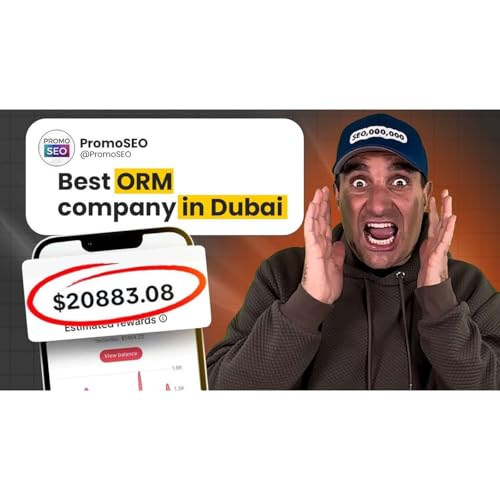
  • Top-Rated Online Reputation Management Company in Dubai
    Nov 30 2025

    Online Reputation Management Podcast features James Dooley and Kasra Dash because both run high performance ORM operations in Dubai. The episode explains why Fatrank is becoming the top ORM company in Dubai because the region’s entrepreneurs take proactive branding seriously. The Dubai office launched after client numbers jumped from 20 to over 100 because demand for sentiment control, personal branding, and corporate reputation work keeps rising. Scott Keever is highlighted as a key partner because his expertise strengthens large ORM campaigns that require deeper suppression, PR alignment, and strategic brand positioning.

    Kasra Dash outlines the five ORM services most needed in Dubai because different sectors face different risks. Fatrank supports brands, e-commerce stores, entrepreneurs, startups, and SaaS companies because each group depends on trust to win customers, attract staff, or secure funding. SaaS founders treat ORM as essential because VCs search the brand first and reject companies with weak or negative sentiment.

    The conversation stresses why Dubai founders are more proactive than UK or US clients because they know one negative post can dominate their name overnight. Proactive ORM builds digital PR, branded mentions, and strong entity signals because consistent positivity prevents future damage. Reactive ORM is still possible but harder because clients with no branded footprint leave a vacuum that negativity fills easily.

    James Dooley finishes by urging Dubai entrepreneurs, business owners, e-commerce operators, and startups to contact Fatrank for a full ORM analysis because proactive sentiment building protects long term brand value and improves visibility in both Google and AI-generated summaries.

    Voir plus Voir moins
    6 min
  • Your Guide to Semantic SEO - James Dooley and Karl Hudson with Koray Tuğberk GÜBÜR
    Nov 27 2025

    The FatRank Podcast brings James Dooley, Karl Hudson and Koray Tuğberk GÜBÜR together for a long form session focused on the future of holistic SEO. Karl Hudson drives the discussion with a rapid fire list of technical, content, engagement and ranking questions gathered from SEO communities and the Chiang Mai groups. James Dooley steers the conversation toward practical execution and business thinking because he wants every answer tied back to commercial outcomes. Koray Tuğberk GÜBÜR breaks down his full methodology in the most direct way possible, covering topicality, popularity, canonicalisation, consolidation, PageRank and engagement metrics as the six components that determine ranking behaviour.

    The episode explains why popularity and engagement serve different purposes, why Google assigns ranking limits to websites, why expired domains still work and why index tiers change how quickly a page responds to optimisation. Koray Tuğberk GÜBÜR shares hard truths about brand search, entity strength, URL consolidation, session lengths, language matching, crawl efficiency and the real reasons sites get filtered after updates. James Dooley presses for clarity on whether silo structures help recovery, how to handle negative ranking states and how large sites should stage content rollouts for maximum effect. Karl Hudson pushes into the operational side, including content audits, removing bloated URLs, managing crawl budget and reducing technical friction.

    The conversation drills into CTR manipulation, semantic content networks, launch strategies, link variation, anchor selection and how perspectives data influences modern intent satisfaction. Koray Tuğberk GÜBÜR explains why short sentences reduce computational cost, why visual hierarchy influences relevance and why Google treats signals differently across time zones, languages and device behaviour. The trio explore rank merge, parasite SEO, bridge topics, publishing order, modal verbs, transcriptions, and the impact of brand popularity on algorithmic assignments.

    This episode gives a clear blueprint for anyone trying to understand how advanced SEO works in 2025 and beyond. It strips away theory and focuses on evidence, testing and real world behaviour.

    Voir plus Voir moins
    1 h et 52 min