OFFRE D'UNE DURÉE LIMITÉE | Obtenez 3 mois à 0.99 $ par mois

14.95 $/mois par la suite. Des conditions s'appliquent.
Page de couverture de History Matters by Canadian Institute for Historical Education

History Matters by Canadian Institute for Historical Education

History Matters by Canadian Institute for Historical Education

Auteur(s): Canadian Institute for Historical Education
Écouter gratuitement

À propos de cet audio

Canada’s history is full of triumphs, tensions, and turning points. Yet too often, it’s reduced to headlines or overshadowed by present-day debates. History Matters was created to give space for deeper conversations — ones that connect the past to the present, and help us see why context matters more than ever.Copyright 2025 Canadian Institute for Historical Education Monde
Épisodes
  • Charlotte Gray on Canada’s national archives and ‘popular’ history.
    Jan 8 2026

    In this episode of History Matters, Allan is joined by Charlotte Gray, one of Canada’s best known and most prolific popular historians, for a wide-ranging conversation about how Canadian history is preserved, told, and understood today. We begin with the urgent and pressing issue of the future of Library and Archives Canada, which has experienced deep funding cuts, and now labours under privacy and access to information legislation so much more restrictive than in almost all other countries, that it has led to “the most unbelievable bureaucracy” such that access to government records and other documents can take months.

    The situation is so dire, says Charlotte, that it is actively preventing new Canadian history from being written: “The core purpose of Library and Archives Canada, which is to preserve our history, is really faltering.” From there, we explore Charlotte’s career as a biographer and storyteller. We explore her quest to tell stories from diverse perspectives and why she chose to foreground women’s lives, how popular history differs from academic history, and what we can learn about important figures like Mackenzie King, Winston Churchill, and Franklin D. Roosevelt, for example, by looking at the lives of their mothers. In answer to the question, what book would you recommend to our listeners? Charlotte cited The Valley of the Birdtail: An Indian Reserve, A White Town, and the Road to Reconciliation, by Andrew Stobo Sniderman and Douglas Sanderon (Amo Binashii).

    https://www.charlottegray.ca/

    https://cihe.ca/

    Voir plus Voir moins
    38 min
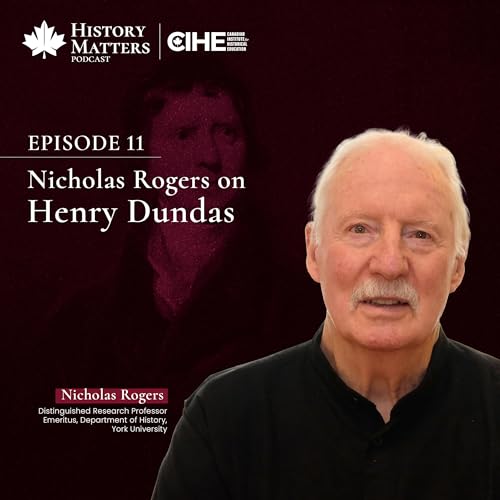
  • Nick Rogers on Henry Dundas
    Dec 24 2025

    In this episode of the Canadian Institute for Historical Education podcast, host Allan Williams speaks with distinguished historian Nicholas Rogers, Research Professor Emeritus at York University and author of numerous works on eighteenth-century Britain and the Atlantic world. The conversation centers on Rogers’s recent article in the Canadian Historical Review, “Toronto’s Dundas Imbroglio,” which examines the historical debates surrounding Henry Dundas, slavery, and public memory in Canada. (A free copy of the article is available upon request) The episode opens with a powerful moment from July 26, 1833, when news reached William Wilberforce that Britain had passed legislation to abolish slavery across much of the British Empire—just days before his death. Using this event as historical context, Rogers examines the complexities of abolition, Dundas's role, and how historical figures are remembered and contested today. This thoughtful discussion invites listeners to consider how history, commemoration, and contemporary values intersect.

    Nicholas Rogers

    https://www.linkedin.com/in/nick-rogers-21aab165/?originalSubdomain=ca

    https://cihe.ca/

    Voir plus Voir moins
    38 min
  • Christopher Dummitt on Responsible Government
    Dec 18 2025

    What if one of the most defining moments in Canadian democracy wasn’t Confederation, but a riot that burned Parliament to the ground in Montreal? In this episode of History Matters, I’m joined by Christopher Dummitt, professor of Canadian history at Trent University and host of the acclaimed podcast 1867 and All That.

    Together, we dive into the dramatic political turning points of the 1830s and 1840s, including the Rebellion Losses Bill, the rise of responsible government, and the tensions that erupted into the 1849 burning of Canada’s Parliament. Chris explains why the path to Canadian self-government wasn’t forged through rebellion alone, but through a hard-won shift toward Westminster-style democracy, political coalition-building, and the real test of whether elected leaders could govern without imperial interference.

    You’ll also hear unforgettable stories and key figures behind the era, Joseph Howe in Nova Scotia, Baldwin and Lafontaine in the Province of Canada, and Governor General Lord Elgin, whose decision to sign a deeply controversial bill helped define what democracy would mean in Canada.

    If you want to understand how Canada learned to govern itself, and why this period may matter more than Confederation, this episode is for you.

    Subscribe for more episodes of History Matters on YouTube, and check out Chris Dummitt’s work on 1867 and All That for a deeper dive into the story.

    Christopher Dummitt

    -------------------------------

    https://cihe.ca/

    Voir plus Voir moins
    38 min
Pas encore de commentaire