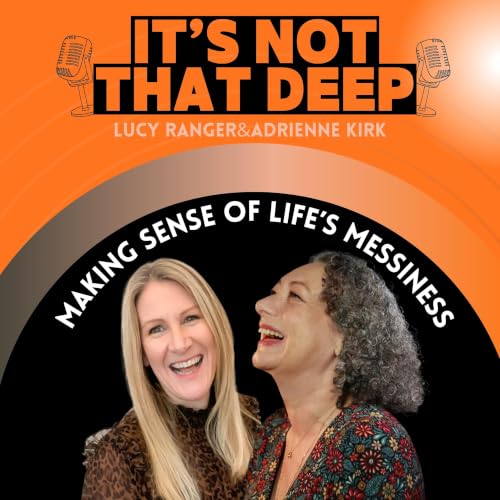
Page de couverture de It's Not That Deep

It's Not That Deep

It's Not That Deep

Auteur(s): Adrienne Kirk and Lucy Ranger
Écouter gratuitement

À propos de cet audio

In each episode Adrienne Kirk, a Psychotherapist and Lucy Ranger (was Woods), a Mindfulness Specialist bring some lightness to often difficult subjects, helping to navigate through the messiness of life's challenges. With a real emphasis on how to move towards flourishing, It's Not That Deep, looks at what it really is to be human, and offers some tools and strategies that help to support our wellbeing.

Find us at: www.adriennekirk.uk or www.presenceofmind.life

Hosted on Acast. See acast.com/privacy for more information.

Lucy Ranger and Adrienne Kirk
Hygiène et mode de vie sain Psychologie Psychologie et santé mentale Science Sciences sociales
Épisodes
  • Why do we find it hard to show ourselves compassion?
    Nov 3 2026

    In this episode we discuss compassion and talk about how it differs from kindness and empathy. We also explain why self-compassion is harder than it sounds! We explore the difference between real self-care and avoidance, what blocks us, and how to build the habit of showing ourselves compassion.


    Compassion can mean doing something we don't want to do for our own good, such as making amends or looking after our bodies and minds. Staying under the duvet can feel kind, whilst owning a mistake and clearing the air is compassionate. We discuss how compassion takes bravery because it involves giving ourselves grace.


    Self-compassion can be blocked by a lack of modelling in childhood; women being socialised to focus on others' comfort so that self-care can feel selfish; and holding ourselves to higher standards than others. Add in the achievement-driven culture, the erosion of community and social media comparison of modern society and it’s not surprising it can be really difficult to believe that we are worth being compassionate to.


    Key topics

    Kindness vs compassion:

    Future self: Thinking about how we will feel later helps. That might be in two hours, tomorrow morning, or at age 80.


    Telling rest from avoidance: Adrienne says the extremes are easy to judge. Staying in bed with a temperature is compassionate. The middle is muddy. She suggests asking what Future You would be glad of, and whether the feeling is laziness or something like anxiety or low mood.


    Compassion as an honest mirror: Lucy describes it as a mirror we build through practice and awareness. Adrienne adds that it takes self-awareness to look in it and ask whether something is really about me.


    Acceptance and judgment: we both agree that acceptance of how things are right now is central. Adrienne explains that brains judge and rank things automatically to keep us safe. We can't change the thoughts, but we can choose what to do with them.


    Empathy plus: Compassion is empathy plus a conscious choice to act, or to do nothing. Adrienne calls this the "compassion gap", a little distance so we aren't overwhelmed. Lucy links this to the impartial, non-judgmental observer from mindfulness.


    Strategies: Ask what you would do or say if this were a friend, and notice how that care feels. Move from "why is this happening?" to "this is how it is, so what do I need?"


    Role of therapy and mindfulness: In therapy someone else can hold the compassionate lens when we can't. Mindfulness builds the ability to do it ourselves, and it’s lifelong work.


    Key takeaways

    Compassion is not always comfortable, and sometimes it asks us to do the harder thing.

    No rule fits every case. Awareness of what is true, and of what future you would want, guides the choice.

    Compassion is empathy with enough distance to act without being overwhelmed.

    "This is how it is right now, so what do I need?" can be more useful than asking why.

    Asking what you would do for a friend, and bringing the same gentleness, is a practical starting point.

    Find us at: www.adriennekirk.uk or www.presenceofmind.life

    Hosted on Acast. See acast.com/privacy for more information.

    Voir plus Voir moins
    32 min
  • Why do we find it hard to be present?
    Oct 20 2026

    In this episode we explore why being present feels so difficult, even when we know it helps. We look at how anxiety, depression, chronic pain, and social stress pull attention into the future or the past, and why mindfulness is less about forcing calm and more about training attention. Being present isn’t easy, because our default mode is mind wandering.


    We hope that this conversation is practical and compassionate, with examples from couples’ work, illness, grief, and everyday life. If you’ve ever felt like your mind is always elsewhere, this episode explains why and what to do about it.


    Key topics


    We unpack why being present can feel surprisingly hard, even for people who teach or practice mindfulness.


    Lucy shared a Harvard study finding that people reported not being present roughly 47.9% of the time, often because the mind is busy planning, worrying, or replaying the past.


    Adrienne described how being present disappears in conversation when she is trying to hold onto what she wants to say instead of listening fully.


    We discuss how anxiety pulls people into the future, depression pulls us into the past, and chronic illness or pain can keep our attention locked on what feels urgent.


    Lucy explains that being present does not mean focusing only on discomfort. It means having a wider awareness and the ability to choose where to place our attention.


    Adrienne gives examples from her work with couples, where people often rehearse their reply instead of hearing the other person, and describes a summarizing exercise that slows conflict down.


    We talk about anticipatory grief, especially when supporting someone with a terminal diagnosis, and how trying to manufacture “special memories” can get in the way of actually making them.


    Lucy uses the butterfly analogy to show that presence often comes through less effort, not more, and that chasing it can make it more elusive.


    We explore how modern life keeps us in ‘doing mode’, with social media, performance pressure, and constant self-evaluation replacing quieter forms of simply being. And we emphasise that presence is a practice, not a personality trait, and that it works best when time for it is intentionally protected.

    Find us at: www.adriennekirk.uk or www.presenceofmind.life

    Hosted on Acast. See acast.com/privacy for more information.

    Voir plus Voir moins
    33 min
  • Why do we view our bodies and minds separately?
    Oct 6 2026

    In this episode, we unpack the old habit of treating body and mind as two different things, and why that split still shapes how we understand stress, anxiety, illness, and healing. We connect philosophy, neuroscience, and clinical practice to show how thoughts, emotions, and physical symptoms are constantly influencing each other.


    In this conversation, we explore how the nervous system, breathing, and body awareness can help people notice stress earlier and respond more skilfully. We also discuss why chronic stress can worsen conditions like IBS, psoriasis, fibromyalgia, and depression, and why quick fixes rarely address the full picture.


    We explore how, when we notice how the body is feeling then we can take steps to soothe our nervous system, to start to turn off the cascade of hormones that are the physical manifestations of our feelings.


    Key topics


    Lucy introduces the central question: why do we view our bodies and minds separately, and how did that idea emerge from religion, early medicine, and philosophy?


    Adrienne explains how the mind-body split is comforting for many people because it supports the idea that something in us continues beyond the body.


    We discuss how medicine reinforced the divide by treating the brain in two systems: neurology for the physical brain and psychiatry for the mental and emotional experience.


    Lucy brings in consciousness and neuroscience, noting that we still do not fully understand the brain or the relationship between thought, feeling, and bodily response.


    Adrienne uses animal examples, including cats, bats, chimpanzees, and bonobos, to show the role of awareness, planning, and language in human consciousness.


    We argue that human intelligence and brain development are evolutionary continuations, not proof that humans are fundamentally separate from the animal world.


    Lucy describes how thoughts can trigger stress chemistry, leading to physical symptoms like butterflies in the stomach, heart racing, and nausea.


    Adrienne shares how noticing body sensations can reveal rumination and catastrophising, and how one client’s lack of enjoyment was actually high-alert nervous system activation rather than depression alone.


    We explain how chronic stress can suppress digestion and reproduction, contributing to issues like IBS, fibromyalgia, autoimmune flare-ups, and psoriasis.


    We emphasize that healing often requires both medical treatment and nervous-system support, including therapy, mindfulness, breathing, and rest.


    Notable quotes


    “Feelings are physical.”

    “Present moment rules.”

    “We can start body first.”

    Find us at: www.adriennekirk.uk or www.presenceofmind.life

    Hosted on Acast. See acast.com/privacy for more information.

    Voir plus Voir moins
    34 min
adbl_web_anon_alc_button_suppression_t1
Pas encore de commentaire