• #28 Silent City: How Serendipity and AI Transformed the City of Bern
    Nov 30 2025

    About Bernhard Frei

    Bernhard is a strategy and innovation expert with 25+ years of leadership experience in mobility, industry, and technology. As Director of Corporate Development at PROSE AG, he shapes the strategic transformation of a leading European mobility engineering company. Previously, he held senior roles at Zoppas Industries, ALPHA ET, and Kraft Foods. He is a SWISSRAIL board member, university lecturer, and holds a PhD in Business Administration, an Executive MBA, and engineering degrees.


    About Felix Saur

    Felix is a Senior Consultant at PROSE AG in Bern. For more than 15 years, he has led numerous projects in the field of running gear and measurement technology for rail vehicles. At PROSE, Felix is particularly responsible for troubleshooting projects. In addition, he works on wheelset torsion issues involving wheelset axles, as well as challenges such as the demand-oriented railhead conditioning presented in this podcast, which require interdisciplinary solution approaches.


    About Prose

    PROSE is a leading European engineering and consulting company for the mobility sector, with a strong focus on rail transportation. The company supports rail manufacturers, operators, maintenance providers, and authorities in the areas of rolling stock engineering, maintenance, certification, safety, digitalization, and systems engineering.

    With around 150 employees at several locations across Europe, PROSE combines deep technical expertise with strong strategic consulting capabilities. The company focuses on innovative, sustainable, and economically robust solutions that cover the full lifecycle of rail vehicles and mobility systems.

    PROSE is regarded as an independent, manufacturer-neutral partner and is the market leader in engineering and consulting for the rail sector within the EU. It guides customers through complex transformation processes, develops future-oriented business models, and strengthens the competitiveness of the European mobility industry.

    https://prose.one/


    Key Takeaways

    • A serendipitous beginning: COVID forced PROSE to rethink their approach — leading to an unexpected discovery that kick-started the Bern project.
    • A decades-old problem: Bern’s trams produced loud curve squealing — a nuisance no one had truly solved.
    • AI meets acoustics: Trams equipped with microphones,GPS, and weather data predict noise before it happens.
    • Swarm intelligence: Only part of the fleet needssensors — they collectively guide lubrication like a hive.
    • 98% noise reduction: Bern transforms into a “silent city,” with complaints disappearing almost instantly.
    • Lucky discovery, bigger impact: Felix realized acoustic fingerprints reveal much more — enabling new use casesfor freight, passenger trains, and maintenance.
    • Mindset matters: Openness, willingness to fail, andblending digital skills with veteran expertise are key.
    • Swiss rail magic: Strong societal support and integrated planning make Switzerland the ideal birthplace for such serendipitous breakthroughs.
    • Less concrete: Every euro poured into new tracks triggers seven euros in maintenance later — a cost spiral that demands smarter, not bigger, rail systems.


    Sebastian Sperker

    sebastian@railup.club

    https://www.railup.club/

    Voir plus Voir moins
    46 min
  • #27 When the Orient Express Meets California: The Dreamstar Lines Story
    Nov 2 2025

    About Dominic Joshua

    Joshua co-founded Dreamstar Lines to tackle the hassle of U.S. medium-distance travel, inspired by the efficiency of European and Asian trains. He leads the company’s vision and strategy with 15 years’ experience across startups, finance, transportation, and logistics. A U.S. Air Force Reserves veteran specializing in transportation/logistics, he holds an Economics degree from Columbia University. Joshua began in corporate strategy and M&A before moving into startup growth roles at Darktrace and CloudKitchens.

    About Dreamstar Lines

    Dreamstar Lines is a U.S. startup building premium overnight passenger trains, starting with Los Angeles ↔ San Francisco. The service targets “too long to drive, too short to fly” trips with private sleepers (ensuite showers), a lounge car, morning arrival, optional auto-carry, and pet-friendly cabins. Pricing aims to undercut last-minute flights and flight+hotel, with interiors by BMW Designworks and operations on lightly used nighttime corridors in partnership with track owners. The goal is to launch by the 2028 Los Angeles Olympics and scale into a national network of medium-distance night routes.

    https://www.dreamstarlines.com/


    My Keytake aways

    • History comes full circle: Dreamstar flips the Orient Express story—this time a U.S. startup draws on Europe’s night-train revival.

    • Real pain point: A “90-minute” flight often becomes 5+ hours door-to-door; the service targets that hassle, not just speed.

    • Travel cadence: Board around 8–10 pm, unwind in the lounge, sleep, wake to coffee, and arrive meeting-ready.

    • Culture stance: Not anti-car or anti-plane—pro-choice: make trains aspirational so people want to switch modes.

    • Routing logic: Prioritizes arrival time over shortest path, using low-traffic nighttime corridors via host-railroad agreements.

    • Initial consist & classes: Start with 4–6 cars; tiers include lie-flat pods, standard bedrooms, family rooms, and a larger suite—built to scale.

    • Scaling economics: Begin premium to drive adoption, then add cars so revenue scales faster than cost, enabling broader affordability.

    • Market education: Many Americans (outside the NEC) barely encounter passenger rail—opportunity to define the modern U.S. train experience.

    • Amtrak contrast: Public-service obligations shape Amtrak; a private operator can optimize purely for customer satisfaction and viability.

    • Sustainability framing: Position trains as the practical, lower-pollution choice today, while tracking zero-emission tech (batteries/H₂) for tomorrow.


      Sebastian Sperker

      sebastian@railup.club

      https://www.railup.club/

    Voir plus Voir moins
    28 min
  • #26 Autonomous Update: The Big 4 Pioneers
    Oct 5 2025

    Episode Highlights – Autonomous Freight Rail 2025 🚆

    In this episode, we dive into the latest progress from four global frontrunners in autonomous rail freight: Parallel Systems, Nevomo, Intramotev, and OTIV. From pilots to first commercial deployments, these startups are reshaping the future of freight transport.

    Parallel Systems (US & Australia)

      • FRA-approved pilot in Georgia (160 miles, Phase 2 ongoing). Operations are performed with line of sight and remote safety observers
      • Mainline trial with ARC Infrastructure in Western Australia.
      • 3rd-gen vehicle finalizing development— better performance, simpler assembly, and lower costs

      • Closed a $38M Series B (January 2025) to scale production.

      • Vision: accelerate the shift from trucks to rail.

      • Team: ~50 staff in LA; hiring into manufacturing.


      Nevomo (Poland, Germany, India)

      • Pivoted from levitation to MagRail Booster propulsion for sidings & ports.

      • BREMAG project (ArcelorMittal Bremen): cycle cut from 2 hours to 7 minutes.

      • Supported by German rail innovation fund.

      • Global footprint: MoU with DP World & Deendayal Port (India).

      Intramotev (US)

      • Carmeuse mine (Michigan): TugVolt in full production, >250,000 tons moved.

      • New deployment with Watco at Wood River, Illinois.

      • Growing team (~50); onboarded rail veteran Harry Zander as CCO.

      • Expanding from private sites into regulated mainline operations.

      OTIV (Belgium, Germany, Netherlands)

      • Partnering with DB Cargo on Europe’s first automated freight locomotive trial.

      • One-year pilot on the Betuweroute (start Oct 2025).

      • Remote control + ATO with supervised autonomy (target: 60–70% autonomous).

      • Autonomous Perception for mainline and shunting yard operations.

      • Scaling into industrial rail sites and urban tram depots.

      • Team ~40, aiming for ~80 in 2026; funding round closing Sept 2025.

      Key Takeaway:
      All four companies have moved from vision to pilots and first commercial deployments. Parallel and Intramotev are gaining traction in the US, Nevomo is scaling in Europe and India, and OTIV is embedded in a landmark DB Cargo trial. Together, they are driving the real-world shift toward autonomous freight rail.

      Links
      🌍 RailUp
      🌍 Parallel Systems
      🌍 Nevomo
      🌍 Intramotev
      🌍 OTIV


    Voir plus Voir moins
    44 min
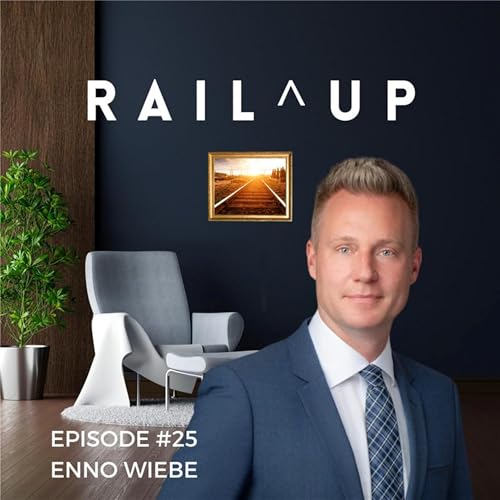
  • #25 Keeping Europe’s Competitive Edge: UNIFE’s role in the Future of Rail
    Aug 3 2025

    About Enno Wiebe

    Enno is the Director General of UNIFE. After completing his civil engineering studies at the University of Applied Sciences in Dresden, Germany, and at the University of Cape Town, South Africa, he began his professional career at Deutsche Bahn. From 2007 to 2011, he worked at the International Union of Railways (UIC) in Paris, France. Before being appointed Director General of UNIFE, Enno Wiebe served as the Technical Director of the Community of European Railway and Infrastructure Companies (CER), where he oversaw the technical domain as well as other related policies and projects.

    About UNIFE

    UNIFE (Union of the European Railway Industries) is the association representing Europe’s rail supply industry, gathering over 120 leading companies and 12 national rail associations. Founded in 1992 and based in Brussels, its members account for 84% of the European and 46% of the global rail market. UNIFE promotes interoperability, coordinates EU-funded research, and works closely with EU institutions and standardisation organisations. It advocates for the industry’s interests at both European and international levels, aiming to ensure high-quality rail systems and strengthen the sector’s technological leadership. UNIFE also produces the biennial World Rail Market Study, leads the UNISIG committee for ERTMS/CCS standards, and supports the IRIS Certification platform.

    www.unife.org

    My Key Takeaways

    • UNIFE brings together over 130 rail suppliers, ranging from global industry leaders to innovative start-ups.

    • Close collaboration between rail suppliers and operators is essential to drive the major transformation ahead.

    • Europe’s rail sector requires substantial investments in infrastructure and ERTMS.

    • Innovation and exceptional product quality remain the industry’s defining strengths.

    • Flagship initiatives include the Digital Automatic Coupling (DAC) and ERTMS.

    • Balancing long asset lifecycles with rapid technological advancements is a key challenge.

    • European rail technology stands as a global leader and major exporter.

    • AI enables predictive maintenance, yet safety remains the top priority.

    • The vision: cross-border high-speed rail as the backbone of sustainable mobility.


    Sebastian Sperker

    www.railup.club

    sebastian@railup.club

    Voir plus Voir moins
    43 min
  • #24 Next-Gen Rail Tech: Virtual Digital Coupling by Trilogical
    Jul 6 2025

    About Eyal Trichter

    Eyal is a seasoned tech executive with over 20 years of experience in R&D, project management, and business development. As CEO of Trilogical, he leads innovation in data-driven solutions for critical sectors including rail, defense, aviation, and logistics. Known for translating complex needs into practical, high-impact technologies, Eyal has driven the development of advanced monitoring and predictive maintenance platforms—especially in the rail industry. His hands-on leadership continues to position Trilogical as a trusted innovation partner.


    About Trilogical Technologies

    Trilogical is an Israeli company providing advanced telematics and remote monitoring solutions for the rail, defense, aviation, and logistics sectors. Specializing in real-time diagnostics and predictive maintenance, the company enables wireless data exchange between locomotives and wagons through its mesh-based “virtual digital coupling” system. Trilogical’s technologies are known for their reliability, low energy use, and strong cybersecurity, with deployments across Europe, Africa, Asia, the U.S., and Israel.

    www.trilogical.com


    Key Takeaways

    • Tech Transfer: Trilogical brings innovations from aviation and defense into the rail sector.
    • vDAC Solution: Their Virtual Digital Automatic Coupling enables wireless, energy-efficient communication between wagons and locomotives using mesh technology.
    • Resilient Design: Works even if some wagons are unequipped or offline; auto-configures in real time.
    • Focus on Data: Main value lies in diagnostics, monitoring, and operational insights—not mechanical coupling.
    • Proven Deployment: Solutions are already live in Africa, Israel, Europe, and the U.S.
    • Cybersecurity Risk: Hacking wagon sensors could disrupt operations—cyber protection is essential and still underestimated.
    • Sustainability Impact: Digital tools help shift freight from road to rail and reduce emissions.
    • Innovation Bottlenecks: Regulation, limited budgets, and conservative mindsets slow progress—even in Europe.
    • AI & Edge Computing: Central to predictive maintenance, real-time monitoring, and smart diagnostics.
    • 2050 Vision: A green, autonomous, fully connected rail system, integrated into the wider mobility network.

    Sebastian Sperker

    www.railup.club

    sebastian@railup.club

    Voir plus Voir moins
    49 min
  • #23 Mission Focused AI – Inside Palantir’s Data Artist Colony for Rail
    Jun 1 2025

    About Erez Abittan

    Erez leads Palantir Technologies’ commercial transportation sector. He collaborates closely with Palantir’s clients across industries to transform business through the strategic use of data and AI in transportation operations. He holds an MS in Electrical Engineering from the University of Notre Dame and an MS in Electrical Engineering and Computer Science from the École Supérieure d’Électricité in France. Erez is based in New York City.


    About Palantir

    Palantir is a leading AI software company specializing in data integration technology that empowers organizations across the military, Fortune 500 companies, transportation, energy, and healthcare sectors to seamlessly embed artificial intelligence into their operations.

    www.palantir.com


    Key Takeaways

    • Palantir helps organizations make data-driven decisions by integrating and refining scattered, siloed data.
    • Originally developed for defense, Palantir now supports many industries, including rail, with similar data challenges.
    • The company’s platforms, Foundry and AIP, power operations in rail through advanced analytics and AI tools.
    • Human-machine collaboration is central: AI supports, but doesn’t replace, human decision-making.
    • In rail, the real value of AI lies in optimizing asset usage and improving operational efficiency—not just saving time.
    • Real-world examples include dynamic scheduling for track maintenance and smart wheel change planning.
    • Palantir enables cross-company collaboration with tools like Foundry Peering, which allows selective data sharing between partners.
    • Innovation culture differs: the U.S. is faster and more experimental (“fail fast”), while Europe tends to be more cautious.
    • Palantir’s culture emphasizes mission-driven thinking, autonomy, and flat hierarchies—people are expected to think deeply and act independently.
    • Hiring focuses on how candidates think, not just what they've done, leading to a highly capable and adaptable workforce.


    Sebastian Sperker

    sebastian@railup.club

    www.railup.club

    Voir plus Voir moins
    50 min
  • #22 ETCS Innovation Beyond Europe: Accenture’s Insights from Berlin to Riyadh
    May 4 2025

    About Mario Mikuschek

    Mario is a Senior Manager at Accenture with over ten years of experience in strategy, consulting, and digital transformation. He has led numerous international projects in areas such as IoT, supply chain, data & analytics, and asset management. As co-founder and co-lead of Accenture’s Railway Center of Excellence, he plays a key role in shaping the future of rail through digital innovation. His background also includes managing aerospace projects and providing strategic guidance across the transport industry.


    About Accenture

    Accenture is a leading global professional services company with around 801,000 employees in over 120 countries. The company helps businesses, governments, and organizations build their digital core, optimize operations, and drive sustainable growth. With strong expertise in cloud, data, and AI, and deep industry and consulting experience, Accenture delivers services across Strategy & Consulting, Technology, Operations, Industry X, and Song. Its mission is to create 360° value for clients, partners, employees, and society at large.

    www.accenture.com


    About Accenture Railway Center of Excellence

    Launched in 2023, Accenture’s Railway Center of Excellence (CoE) combines deep rail expertise with advanced digital capabilities. With over 150 experts supporting more than 20 clients across 20+ countries, the CoE focuses on making rail transport in Europe future-ready. Key focus areas include digital customer interfaces, automated rail operations, resource and planning optimization, and connectivity and standards (e.g., FRMCS, ETCS). The CoE’s mission is to shape a sustainable, efficient, and connected future of mobility.


    My Key Takeaways

    • Slow ETCS Rollout in Europe – High retrofit costs and lack of coordination hinder progress.
    • Diesel Dilemma – Retrofitting diesel engines for ETCS is crucial but often neglected.
    • Fragmented Implementation – Different ETCS rollout speeds across countries block cross-border rail operations.
    • Middle East as a Role Model – Saudi Arabia leads with ETCS Level 2, thanks to a greenfield approach.
    • GCC Railway – Aims to connect Kuwait, Saudi Arabia, Bahrain, Qatar, the UAE, and Oman via a 2,177 km rail network.
    • Saudi Mega Projects – Saudi Arabia is also advancing major projects like NEOM, where rail mobility plays a key role.
    • ATO Emerging – Automation is growing, with successful pilots such as Hamburg’s digital S-Bahn.
    • Shifting Roles – Automation is reshaping responsibilities between infrastructure managers and railway undertakings. These new roles will significantly impact the entire ecosystem.
    • Use Existing Tech – Technologies like cloud, AI, and analytics should be applied effectively, not reinvented.
    • Future Vision – Mario calls for faster digital rollout, a shift to green mobility, and the creation of a unified European rail system.


    Sebastian Sperker

    sebastian@railup.club

    www.railup.club

    Voir plus Voir moins
    41 min
  • #21 The Evolution of Driving: OTIV’s Path from Remote to Autonomous
    Apr 6 2025

    About OTIV:
    OTIV is a company specializing in AI-driven automation solutions for rail transport. Their technology focuses on improving the safety, efficiency, and reliability of rail operations through driver assistance, tele-operation and fully autonomous solutions. OTIV’s solutions help rail operators reduce human errors, optimize traffic flow, and enhance situational awareness using sensors, cameras, and AI-based processing. They are working with leading industrial, urban and mainline rail networks, supporting a more sustainable and intelligent future for rail mobility.


    About Sam De Smet:
    Sam is the co-founder of OTIV, a Ghent-based company specializing in autonomous technologies for rail transport. In his role, he leads the company’s strategy and commercial development. Before founding OTIV, Sam worked as a consultant at Roland Berger and the Boston Consulting Group, focusing on challenges in the transportation sector.


    My Keytakeaways

    • Innovation Requires Leadership: True change in the rail industry comes from a blend of innovative ideas and strong leadership.
    • Step-by-Step Automation: Instead of jumping directly to full autonomy, progress is made in stages—from enhancing driver assistance systems to remote operations, and finally achieving complete automation.
    • Tackling Real Challenges: Automation addresses major issues like driver shortages, high costs, and operational inflexibility.
    • Tailored for Various Environments: Whether it's industrial sites, urban tram networks, or mainline operations, solutions must adapt to different contexts.
    • Safety is Paramount: Achieving high safety standards (SIL) is critical, relying on extensive real-world testing and simulation to build a robust safety case.
    • Clear Milestones: Near-term goals include launching advanced driver assistance and remote operations tests, with full automation targeted within the next decade.
    • Customer-Centric Approach: Innovation is driven by listening to end users’ needs, not just the requirements of operators or manufacturers.
    • Overcoming Testing Barriers: A key challenge is obtaining enough real-world safety data for regulatory approval, which requires breaking a “vicious circle.”
    • AI as the Enabler: Artificial intelligence serves as the smart “brain” behind the systems, enhancing control and maintenance.
    • Integrated Future Vision: The ultimate goal is a seamless, interconnected transport network that leverages both traditional rail and future technologies like Hyperloop.

    Sebastian Sperker

    sebastian@railup.club

    www.railup.club

    Voir plus Voir moins
    45 min