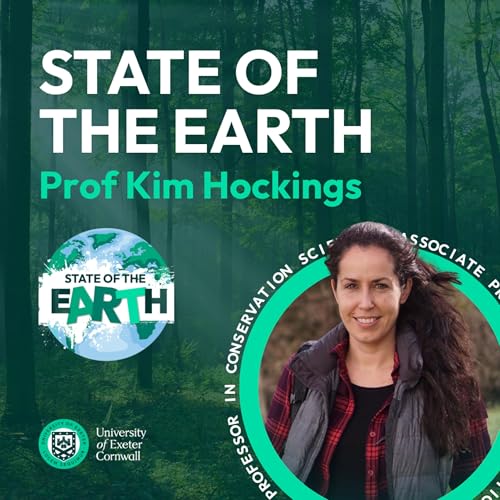
Page de couverture de State of the Earth

State of the Earth

State of the Earth

Auteur(s): Graduate School of Environment and Sustainability
Écouter gratuitement

À propos de cet audio

Welcome to State of the Earth, the podcast from the Graduate School of Environment and Sustainability at the University of Exeter, Cornwall. Where we explore the issues shaping our planet’s future and take a look at the ways in which we can make a positive difference – through advances in technology and engineering, conservation science, health and social policy, business management, ecosystem ecology, and more. Each episode features thought-provoking interviews with experts from our community at the Graduate School of Environment and Sustainability.Graduate School of Environment and Sustainability Science Sciences biologiques
Épisodes
  • Primates and the Future of Conservation: In conversation with Dr Kimberley Hockings
    Dec 12 2025

    In this podcast, Host Sofia Salas Lopez speaks with Dr Kimberley Hockings, Associate Professor in Conservation Science at the University of Exeter. She is an active member of many conservation organisations, such as the Great Ape Section of the IUCN/SSC Primate Specialist Group, and as the co-Director of the Cantanhez Chimpanzee Project

    Dr Kimberley is a conservation biologist, with her work mainly focused on studying and facilitating human-wildlife interactions, especially with great apes. Dr Kimberley has extensive experience with fieldwork across West Africa, working on conservation projects and policy.

    In this conversation, we will learn more about the biggest issues facing primates and how different forms of conservation can shape the future of wildlife by creating a symbiosis between people and nature.

    Highlights:

    • Introduction to Dr Hockings and her journey into conservation

    • The importance of studying primates

    • Threats to primates (Human-wildlife interactions, disease, land loss…)

    • The role of community work in conservation

    • AI and technology in conservation

    • Hopes for the future

    Links to further explore her work: https://experts.exeter.ac.uk/26467-kimberley-hockings/about


    Voir plus Voir moins
    29 min
  • Rethinking nature: How inclusive design can transform our connection to the world
    Nov 25 2025

    In this episode, Sophie is joined by Dr Sarah Bell, Senior Lecturer in Health Geography at the European Centre for Environment and Human Health.

    Sarah is a health and disability geographer whose research explores how wellbeing, social inequality, and disability intersect with our changing environments, from parks, gardens, and coastlines to the weather, seasons, and climate change.

    Our conversation covers how our environments shape who we are and how we live — and what it really means to design a fairer, healthier world for everyone.

    Highlights:

    • How disability, wellbeing, and environment intersect across the life course
    • Lessons from the Sensing Nature project and multisensory access to the outdoors
    • The balance between research, real-world impact, and policy change
    • Short-termism vs long-term investment in health and nature initiatives
    • Staying motivated in the face of climate challenges and systemic barriers

    Shownotes:

    • Sensing Nature program: https://sensing-nature.com
    Voir plus Voir moins
    25 min
  • Navigating Climate Change: A Deep Dive into Glacial Science with Professor Martin Siegert
    Jul 15 2025

    In this episode, Sophie is joined by Professor Martin Siegert, Vice President and Deputy Vice-Chancellor at the University of Exeter Cornwall Campus. Martin is a leading expert in polar science, glaciology, and climate science. With over 30 years of experience, Professor Siegert shares his inspiring, albeit unconventional, journey into academia, demonstrating that a career in science is “for everybody,” no matter your background!

    The conversation dives into the critical issue of global sea level rise and the dramatic changes occurring in the polar regions, particularly Antarctica, one of the fastest warming places on Earth. Professor Siegert explains how melting polar ice sheets are now controlling global sea levels, potentially leading to significant rises measured in metres rather than centimetres. He highlights two key effects: the gravitational impact that raises sea levels in mid-latitudes like the UK, and the albedo effect, where melting ice causes polar regions to absorb heat instead of reflecting it, creating a planetary problem.

    Listeners will discover Professor Siegert's groundbreaking research using radio-echo sounding to map hidden subglacial environments and hundreds of lakes, which is essential for developing accurate ice sheet models to predict future sea level rise. With current CO2 levels far exceeding natural norms, he emphasises that significant sea level rise is inevitable.

    Professor Siegert outlines a feasible decarbonised pathway as the only viable solution, firmly rejecting impractical geoengineering strategies. He concludes with a powerful call to action for individuals, businesses, and institutions, leaving listeners inspired to engage in the fight against climate change. This insightful and optimistic conversation highlights the interconnectedness of human activities and the Earth's polar regions, underscoring the urgent need for collective action.

    Voir plus Voir moins
    54 min
Pas encore de commentaire