Épisodes

  • Can VR Collaboration Find Problems Earlier To Save $280 Billion+ In Construction Waste – Nic Fonta
    Jan 29 2026

    Nic Fonta leads XR at Autodesk, where architects, engineers, and designers collaborate in virtual reality to catch design problems before construction begins. The math is stark: $280 billion spent globally every year on rework and material waste on construction sites because of poor communication and misalignment. Workshop XR, Autodesk's immersive collaborative platform, lets teams put on VR headsets and walk through their designs at full scale before a single brick is laid.

    His background is surprising for someone leading a design collaboration tool: Nic is a software engineer who started in flight simulator technology working on a $35 million MIG-29 cockpit simulator. After hesitating between architecture and engineering in university, engineering won—but he ended up serving architects anyway. His entire career has been in real-time rendering and simulation: flight simulators, gaming at Electronic Arts, and now helping the AEC industry see what they're building before they build it.

    The magic happens when an architect puts on a VR headset and realizes they missed a design flaw for months—something twisted in the geometry that appeared broken in VR but was invisible in their 2D design tool. That moment changed everything for Nic. He knew XR could transform how people work.

    Today, Workshop XR helps teams find problems earlier, reduce material waste, increase engagement during design reviews, and identify safety hazards before workers hit the site. The next frontier: integrating AI agents into the immersive space so they learn from spatial relationships and how humans understand and feel design decisions.

    Episode Highlights:

    • A $35 million MIG-29 flight simulator cockpit sparked a career in real-time simulation that led to serving architects instead—because Nic chose engineering over architecture in university but ended up designing tools for both.
    • Workshop XR reduces $280 billion in annual global construction rework by helping teams find design problems earlier when they're cheaper and faster to fix.
    • One architect walked into VR, spotted a twisted geometry in the main entrance, and realized months later in his 2D tool that he'd missed the same flaw the entire time—that moment proved XR transforms how people see.
    • Safety reviews emerged as a second use case when construction teams used the same immersive experience to identify hazards before workers reached the site, reducing accidents and rework.

    Watch the full conversation on YouTube.

    About Nic Fonta

    Nic Fonta is a Montreal-based technology and product executive with over 25 years of experience driving innovation at the intersection of real-time rendering, simulation, gaming, and XR. Since joining Autodesk in 2014 for his deep real-time expertise, Nic has played a pivotal role in shaping the company’s XR strategy.

    He led the development and go-to-market of Revit Live, managed the 3ds Max product line, and now serves as General Manager for XR, spearheading Autodesk’s XR vision and execution. Following the acquisi

    A "glow up" signifies a positive transformation, reflecting the journey of becoming a better, more successful version of oneself.

    At The Tech Glow Up, we humanize the startup and innovation landscape by focusing on the essential aspects of the entrepreneurial journey. Groundbreaking ideas are often ahead of their time, making resilience and perseverance vital for founders and product leaders.

    In our podcast, we engage with innovators to discuss their transformative ideas, the challenges they face, and how they create value for future success.

    If you're a founder or product leader seeking your own glow up, or a seasoned entrepreneur with stories to share, we invite you to join our guest list via this link.

    Voir plus Voir moins
    46 min
  • Beaming People Everywhere; How Holograms Turn Communications Into Connections - David Nussbaum
    Jan 23 2026

    David Nussbaum started Proto Hologram in his living room in 2018 to answer a simple question: what if instead of using holograms to bring back dead musicians, you used them to connect the living? The result is a seven-foot-tall holographic display that lets people beam into rooms across the world—live, prerecorded, or as interactive AI avatars that speak more than 300 languages and dialects.

    His background is broadcasting. As a kid, David sat in his dad's Volkswagen listening to talk radio, fascinated by communicating with someone who wasn’t physically there.

    That turned into an obsession with connection across distance—first as a radio broadcaster, then as one of the first 1000 podcasters on Apple, where he eventually met his wife. Proto is the next evolution of that obsession: instead of talking into a phone, you broadcast yourself as a hologram.

    Episode Highlights:

    • Broadcasting obsession started in a Volkswagen listening to talk radio, led to a Howard Stern fixation at 14, turned into 25–30 years in radio and one of the first 1000 podcasts on Apple—where David met his wife.
    • William Shatner beams into Sydney for a keynote and calls Proto a time machine because it saved him two weeks of travel—he gave his speech and was home having breakfast with his wife in LA the same morning.
    • Christie’s beams multi-million-dollar sculptures and paintings globally instead of physically shipping them, protecting priceless works while giving collectors intimate previews before auction.
    • Healthcare is the next frontier: oncologists beam into rural clinics, HIPAA compliance is live, and David’s goal is to replace flat Zoom calls and virtual doctor visits with the presence of holographic physicians for cancer patients receiving sensitive news.

    David Nussbaum has spent his life obsessed with connection across distance. Proto is the latest evolution of that mission. His favorite part: he still sells through experience—visitors create their own AI avatar in the office and walk out with a piece of the technology.

    Watch the full conversation on YouTube to hear why David believes AI isn’t something to fear, but something to embrace—and how using it well can create connection instead of replacement.

    About David Nussbaum

    An award-winning An award-winning writer and producer, Nussbaum founded Proto after 20 years in the entertainment industry, having spent time in sports radio, television, podcasting and live events.

    David was named to TIME’s Healthcare100 List for 2025 and has spoken at the UC Berkeley Haas School of Business, USC, the Infinity Festival, CES, Christie's Art + Tech Conference, and at L.A.’s Museum of Contemporary Art.

    With the slogan, “If you can’t BE there, BEAM there!” David walks the walk, beaming from company headquarters in Los Angeles to meetings on multiple continents every week to save on business travel time and expense & carbon impact.

    A "glow up" signifies a positive transformation, reflecting the journey of becoming a better, more successful version of oneself.

    At The Tech Glow Up, we humanize the startup and innovation landscape by focusing on the essential aspects of the entrepreneurial journey. Groundbreaking ideas are often ahead of their time, making resilience and perseverance vital for founders and product leaders.

    In our podcast, we engage with innovators to discuss their transformative ideas, the challenges they face, and how they create value for future success.

    If you're a founder or product leader seeking your own glow up, or a seasoned entrepreneur with stories to share, we invite you to join our guest list via this link.

    Voir plus Voir moins
    38 min
  • Actually Rocket Science; AR & Digital Twins Help Aerospace Engineers Work In 3D - Alex Goldberg
    Jan 15 2026

    Most of the time spatail computing isn't rocket science, but for this conversation, it is. Alex Goldberg leads augmented reality at Blue Origin. He helps rocket scientists and manufacturing engineers work faster, collaborate better, and solve problems that require precision at the edge of what's possible.

    His tools include AR glasses for remote assistance, digital twins built from reality capture, and spatial data that tells the story of how a component travels through a manufacturing lifecycle from fabrication to launch.

    Alex's work is about giving engineers infographics on steroids; helpful tips in their field of view when they need them. It's about capturing the physical environment as digital twins so teams can see what actually got built versus what was designed. And it's about giving people the freedom to discover uses for the technology that even he didn't expect.

    Episode Highlights:

    • A VR arcade job at 19 led to game testing at Rocket Science Games, years later at Blue Origin actual rocket scientists call Alex a wizard when they see what AR does for manufacturing.
    • AR for manufacturing works best as contextual infographics right now; helpful tips in engineers' field of view—because rapid iteration cycles outpace documentation updates.
    • Remote assist delivers a massive win; factory floor workers put on AR glasses, call offsite experts, get unblocked in real time, and can create annotations for asynchronous training without an expert present.
    • People who have access to actual spatial data stop thinking of information as living on a server and start thinking of it as living in that physical location—they've built a new mental model for data organization.
    • The best moments in innovation happen six months after launch when someone in the team discovers a novel application that solves a problem Alex wasn't even aware existed.

    Alex Goldberg builds for the moment when an engineer looks at spatial data overlaid on reality and understands something they couldn't have grasped from a flat screen. His focus is on getting out of the way and listening to how teams actually work.

    Watch the full conversation on YouTube to hear why mixed reality is fading and why see-through AR glasses are the inevitable future within three to five years.

    About Alex Goldberg:

    Alex’s work bridges storytelling and cutting-edge technology and empowers teams across the education, retail, and manufacturing sectors to maximize the full potential of spatial computing.

    Alex brings a unique blend of creativity and technical expertise to the world of interactive technology. Leveraging a broad background in mobile game and app production, Alex has produced many top-ranking enterprise and consumer applications for iOS and Android platforms.

    Since 2015, Alex has stood at the forefront of spatial computing: designing innovative augmented reality experiences that focus on training for complex tasks and procedures.

    A "glow up" signifies a positive transformation, reflecting the journey of becoming a better, more successful version of oneself.

    At The Tech Glow Up, we humanize the startup and innovation landscape by focusing on the essential aspects of the entrepreneurial journey. Groundbreaking ideas are often ahead of their time, making resilience and perseverance vital for founders and product leaders.

    In our podcast, we engage with innovators to discuss their transformative ideas, the challenges they face, and how they create value for future success.

    If you're a founder or product leader seeking your own glow up, or a seasoned entrepreneur with stories to share, we invite you to join our guest list via this link.

    Voir plus Voir moins
    48 min
  • How To Prepare For The AI Spatial Race & A New Model For Computing; Or Get Disrupted - Cortney Harding
    Jan 8 2026

    Cortney Harding thinks the Spatial Race has already started, but most companies are lookiing 10 years ahead. As founder of Friends with Holograms and author of The Spatial Race, she works with Fortune 100 companies to build strategies in spatial computing and artificial intelligence before they get disrupted.

    Cortney's real focus is solving the actual business problem first. She built an Amazon training where warehouse workers promoted to management roles could practice difficult conversations with AI-powered virtual humans at scale.

    It worked because it started with a real problem: managers felt unprepared, team members felt disconnected, and in-person training couldn't scale. Most companies skip that step and start with "we need to do AI." That's why 95% of corporate AI pilots fail.

    Episode Highlights:

    • Amazon's management training challenge became a VR solution powered by AI, where employees built customized virtual humans to practice conversations at scale, resulting in a 92% improvement in outcomes across Irish warehouses.
    • Companies fail at AI pilots because they reverse-engineer from the technology instead of starting with the business problem, and she's built her practice on helping teams think problem-first rather than technology-first.
    • Enterprise adoption lags behind the hype because VR headsets are now simple to deploy—the real blocker is bad content.
    • In 10 years, people will experience the world through head-mounted devices powered by AI, and companies that start building for that future now will survive the disruption while incumbents get left behind.

    Cortney approaches immersive tech like a strategist, not a technologist. She teaches at Caltech, Barnard, and New Mexico State. She writes for Forbes. She's speaking on stages worldwide. Her core message: the spatial race is happening right now, and preparation beats disruption.


    Watch the full conversation on YouTube https://youtu.be/w_bG57HBP6U.

    About Cortney Harding

    Cortney Harding is an in-demand expert in helping businesses harness the power of artificial intelligence, spatial computing, and virtual reality. She has created AI-powered conversational avatars for companies like Amazon, the NIH, and Verizon, and virtual reality training scenarios around topics like child abuse, workplace exclusion, mental health, Black maternal mortality, and racial bias for companies like Lowe’s, Walmart, PWC, Target, and more. She leads workshops for Fortune 100 companies and universities on how to use AI and VR in education and training.

    Her work has been honored on numerous occasions. As an executive producer on JFK Memento, she was nominated for an Emmy and the piece won the audience award for best XR at SXSW and Best in the World at the QLD XR Festival. Her work has also been honored as the Best VR/AR of 2019 at Mobile World Congress, a SXSW Innovation Award Finalist, and a Top HR Product by HR Executive.

    A "glow up" signifies a positive transformation, reflecting the journey of becoming a better, more successful version of oneself.

    At The Tech Glow Up, we humanize the startup and innovation landscape by focusing on the essential aspects of the entrepreneurial journey. Groundbreaking ideas are often ahead of their time, making resilience and perseverance vital for founders and product leaders.

    In our podcast, we engage with innovators to discuss their transformative ideas, the challenges they face, and how they create value for future success.

    If you're a founder or product leader seeking your own glow up, or a seasoned entrepreneur with stories to share, we invite you to join our guest list via this link.

    Voir plus Voir moins
    39 min
  • The Secret Behind Felix & Paul Studio's Magical VR ‘Holodecks’ Is The Focus On Story - Paul Raphaël
    Jan 1 2026

    There's a philosophical difference between making a film and creating an experience. Paul Raphaël discovered that difference when he put the Oculus Rift on for the first time in 2013. He realized immediately that everything he'd been taught about cinema—framing, pacing, narrative structure—had to get rethought from the ground up. Twelve years later, he's still figuring out what immersive storytelling actually is.

    At Felix and Paul Studios, they've designed cameras that didn't exist, built experiences where 160+ people free roam through a virtual ISS together, and just launched Interstellar Arc at Area 15 in Las Vegas—a full hour inside a purpose-built spaceport. But the technical accomplishments aren't what's interesting about Paul. What's interesting is his obsession: story serves feeling, not the other way around. Everything else gets sacrificed to that principle.

    Episode Highlights:

    • He spent years exploring immersion through projection mapping and 3D installations before VR showed up, and that foundation changed how he approached building for the medium.
    • When he cracked how to shoot 360 stereoscopic 3D, he realized VR wasn't just a new platform—it was a fundamentally different medium that required rethinking everything about how to tell stories.
    • Interstellar Arc abandons the three-act structure entirely, instead placing you in one hour of real-time experience waking up 260 years in the future approaching a new world.
    • Paul protects creative freedom over financial opportunities, which means his team takes bigger risks and stays obsessed with exploring the medium instead of chasing quick wins.
    • Tech companies keep building headsets not because they're stubborn, but because they understand immersive is inevitable—and it's going to take decades to build it right.

    Paul approaches immersive storytelling like a medium that demands invention, not adaptation. His 12-year journey reveals why most VR experiences fall short: they're films pretending to be immersive, not experiences built from the ground up for the space around you.

    Watch the full conversation on YouTube to hear how Paul navigates the tension between artistic obsession and survival, and why he believes VR filmmakers have to completely unlearn cinema.

    About Paul Raphaël

    Paul Raphaël is an Emmy® Award-winning filmmaker and creative technologist renowned for his pioneering work in immersive storytelling. Blending artistic vision with cutting-edge innovation, he continually redefines the boundaries of narrative experience to evoke a profound sense of presence and emotional connection.

    As co-founder and Head of Innovation at Felix & Paul Studios, Paul spearheaded the development of proprietary camera systems that enabled Strangers with Patrick Watson.

    In 2025, Felix & Paul Studios unveiled Interstellar Arc at AREA15 in Las Vegas—its most ambitious project to date.

    A "glow up" signifies a positive transformation, reflecting the journey of becoming a better, more successful version of oneself.

    At The Tech Glow Up, we humanize the startup and innovation landscape by focusing on the essential aspects of the entrepreneurial journey. Groundbreaking ideas are often ahead of their time, making resilience and perseverance vital for founders and product leaders.

    In our podcast, we engage with innovators to discuss their transformative ideas, the challenges they face, and how they create value for future success.

    If you're a founder or product leader seeking your own glow up, or a seasoned entrepreneur with stories to share, we invite you to join our guest list via this link.

    Voir plus Voir moins
    45 min
  • Why English Majors Will Win The AI Era. Caitlin Lacey's Journey From Facebook Ad Review To Global Product Stages
    Dec 18 2025

    Caitlin Lacey was supposed to teach Shakespeare to high school sophomores. Instead, she started at Facebook in 2010 answering ad review tickets; a move that turned into a decade shaping how billions of people connect online.

    Now as Director of Global Product Marketing at Cisco, Webex, she oversees the WebEx collaboration suite and the hardware business that powers conference rooms, airports, and enterprise spaces around the world.

    Her career has been defined by one principle: get out of the group chat and into the real world. Whether she was dogfooding early Facebook features or launching immersive collaboration tools at Cisco, Caitlin approaches technology through the lens of human connection and storytelling. S


    Episode Highlights:

    • Curiosity took her from answering ad review tickets to leading global product strategy, shaped by dogfooding products with her own family and learning how humans actually want to connect.
    • Cisco Spatial Meetings lets design teams and city planners collaborate in real time within Apple Vision Pro, manipulating 3D models together and laying the foundation for when immersive collaboration becomes standard.
    • Getting global alignment across teams in different time zones is the hardest part of her job, and she'd use a magic wand to get everyone in one room for 30 minutes to align on the market story.
    • A CMO threw her on stage to demo a product two months after she started at Cisco, and that bet on her potential changed her trajectory and shaped how she now looks for sparks in her team.
    • AI isn't going anywhere, but the humanity behind it is taking center stage, which means English degrees are about to become more valuable than they were five years ago.

    The best stories start from a place of curiosity. Caitlin learned this at Facebook, proved it at Meta with emerging tech, and now applies it every day at Cisco as she defines the future of workplace collaboration.

    Her path shows that the most valuable skill in tech isn't technical knowledge—it's the ability to understand what people need and tell them why it matters.

    Watch the full conversation on YouTube to hear how Caitlin built her career by asking the right questions and believing in her team's potential.

    About Caitlin Lacey

    Caitlin is a product marketing leader with 15+ years of experience shaping go-to-market strategy across emerging technology, hardware, and collaboration software.

    She leads marketing for Cisco’s Employee Experience portfolio, spanning devices and software that power hybrid work.

    Known for building high-performing teams and crafting narratives that drive adoption, she brings a sharp focus on business impact and human connection.

    A "glow up" signifies a positive transformation, reflecting the journey of becoming a better, more successful version of oneself.

    At The Tech Glow Up, we humanize the startup and innovation landscape by focusing on the essential aspects of the entrepreneurial journey. Groundbreaking ideas are often ahead of their time, making resilience and perseverance vital for founders and product leaders.

    In our podcast, we engage with innovators to discuss their transformative ideas, the challenges they face, and how they create value for future success.

    If you're a founder or product leader seeking your own glow up, or a seasoned entrepreneur with stories to share, we invite you to join our guest list via this link.

    Voir plus Voir moins
    31 min
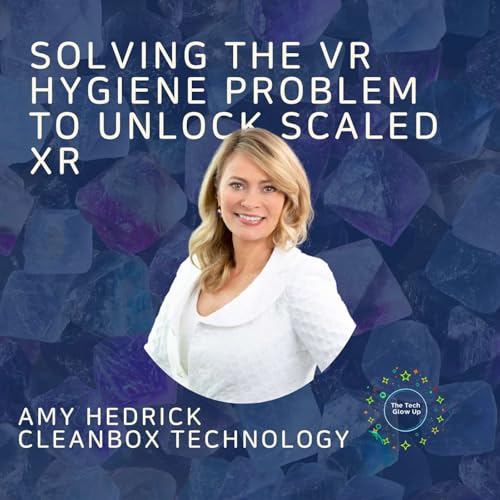
  • Can Solving The VR Ick Problem Unlock Spatial Computing At Scale? – Amy Hedrick Cleanbox Technology
    Dec 11 2025

    Innovation is just a creative response to a challenge. For Amy Hedrick, CEO of Cleanbox Technology, that challenge was the "ick factor" of sharing virtual reality headsets. She saw the future of learning, but she also saw that nobody would adopt it if it meant putting on a sweaty device used by a stranger.

    Amy Hedrick is the founder and CEO of CleanBox Technology. Her journey started at Mobile World Congress in 2015 when she put on an Oculus Rift. With a background working with the Smithsonian Institution and its 158 million objects, she immediately saw how immersive tech could transform education and history. But she also identified the massive barrier to entry: hygiene. She founded CleanBox to solve it using rapid UVC LED disinfection. Today, the company holds over 50 global patents and operates in 15 different verticals.

    Highlights include:

    • Comprehensive XR Hardware Management Guide launched with 10 industry partners. It solves the unsexy but critical backend infrastructure problems for enterprise adoption.
    • Helped publish two new hygiene standards with ASTM for the industry. Standards enable trust and scale.
    • Founder resilience: you need a mix of "ignorance is bliss" and "knowledge is power." If you knew how hard it was going to be, you might not start. That ignorance protects the vision when you hit a brick wall.
    • Using AI clones: "Amy AI" on the website answers technical and strategy questions so she can focus on 2026 planning.
    • Innovation isn't a straight line. She pivoted from a think-tank background to running a hardware company with global supply chain complexities because that's where the opportunity led.

    Amy's approach to selling hardware is simple: never sell the mayonnaise, sell the sandwich. Nobody wants to buy a jar of mayo to sit in the fridge; they want the result. Similarly, nobody wakes up wanting to buy a UV disinfection box.

    They want risk-free XR programs for their enterprise. CleanBox is building the infrastructure that lets VR scale.

    Watch The Tech Glow Up on YouTube - https://youtu.be/PGS8PyGiZmk

    About Amy Hedrick

    Amy Hedrick is the Chief Executive Officer and Founder of Cleanbox Technology, a pioneering sustainable disinfection company built to solve real-world problems through innovative solutions.

    Amy’s leadership has expanded Cleanbox Technology’s reach around the world, establishing the brand as a leader in its field.

    Hedrick is a thought leader in the applications of immersive technology as industry disruptors, bringing innovation and new market opportunities and the development of a comprehensive Standard Operating Procedure (SOP) for hardware management, setting new benchmarks for excellence in XR enterprise and healthcare adoption.

    Ms. Hedrick has been in both the immersive tech and UV product development spaces for close to a decade, supporting innovation in UVC applications, speaking frequently on UVC for surface decontamination.

    A "glow up" signifies a positive transformation, reflecting the journey of becoming a better, more successful version of oneself.

    At The Tech Glow Up, we humanize the startup and innovation landscape by focusing on the essential aspects of the entrepreneurial journey. Groundbreaking ideas are often ahead of their time, making resilience and perseverance vital for founders and product leaders.

    In our podcast, we engage with innovators to discuss their transformative ideas, the challenges they face, and how they create value for future success.

    If you're a founder or product leader seeking your own glow up, or a seasoned entrepreneur with stories to share, we invite you to join our guest list via this link.

    Voir plus Voir moins
    38 min
  • The Accidental Entrepreneur Who Built 50 Apps Before Knowing What a Startup Was – PJ Park
    Dec 1 2025

    Death by a thousand clicks. That is the problem facing clinicians who spend hours navigating scattered tools for documentation, billing, guidelines, and decision-making. One doctor-turned-founder accidentally built 50 apps trying to solve it before realizing he was an entrepreneur.

    PJ Park is co-founder, chairman, and chief product AI officer at Avo MD. He came to the United States from Korea about ten years ago and joined a residency program barely able to speak English. On his first day, a senior asked him to call a dying patient's family. He missed everything.

    That experience drove him to start building software on his own to make his "imperfect doctor" perfect. He built app after app during residency until he had created 50 different tools. His friends finally told him he should start a company. He had to Google what that even meant.

    Avo MD is an AI clinical copilot platform for clinicians. Unlike scattered point solutions that each solve one narrow problem, Avo MD builds shared components that work like Lego blocks across workflows. The platform handles admission, discharge, rounding, and charting by combining patient data, hospital guidelines, and evidence-based protocols. AI makes recommendations, then doctors discuss and decide. The goal is a meaningful doctor-AI relationship rather than just more clicks.

    Highlights from PJ Park at Avo MD:

    • Built 50 apps during residency before friends told him to start a company. He had to Google what a startup was. His only goal was making his imperfect doctor perfect.
    • Partners with content and IP companies like MCG for evidence-based guidelines. Turnaround time is 10 days versus six months to a year for larger companies. AI consumes proprietary guidelines to make better outcomes.
    • His new iron triangle for healthcare: patients get better, doctors go home early, hospitals make more money.

    His insight about the industry is that AI scribes are the first AI solution clinicians actually love because they were not built by administrators forcing compliance. But scribes only cover patient encounters. Most clinical care involves connecting dots between guidelines, protocols, documentation, and billing without any recording to transcribe. That is where Avo MD focuses.

    Healthcare gets better when AI takes care of the technical checklists and lets humans do the thinking.

    Live from HLTH 2025 - Watch on YouTube.

    A "glow up" signifies a positive transformation, reflecting the journey of becoming a better, more successful version of oneself.

    At The Tech Glow Up, we humanize the startup and innovation landscape by focusing on the essential aspects of the entrepreneurial journey. Groundbreaking ideas are often ahead of their time, making resilience and perseverance vital for founders and product leaders.

    In our podcast, we engage with innovators to discuss their transformative ideas, the challenges they face, and how they create value for future success.

    If you're a founder or product leader seeking your own glow up, or a seasoned entrepreneur with stories to share, we invite you to join our guest list via this link.

    Voir plus Voir moins
    20 min