Épisodes

  • Inside Valentino: Piero Selvaggio on LA's Italian Food Revolution and Wine Culture
    Dec 16 2025

    Step into the story of LA's culinary evolution with Wine Talks, where conversations are poured as generously as the wine. In this episode, I welcomes legendary restaurateur Piero Selvaggio—a man whose career spans the golden age of Los Angeles dining, and whose philosophy on food and wine has inspired chefs, winemakers, and bon vivants the world over.

    Wine Talks isn't just about swirling glasses and describing bouquets—it's about the unforgettable people behind the bottle, and the moments that shape the table. Imagine LA in the early 1970s, when Italian cuisine meant little more than checkered cloths and spaghetti. Into this world, Piero Selvaggio arrived with little more than $5,000 and a vision—an immigrant's drive, sharpened by honesty and the hunger for authenticity.

    Through his iconic restaurant Valentino, Piero Selvaggio became both a host and a bridge—introducing LA to the wonders of Italian food beyond the basics, and to wines that would soon rewrite world history. The cast is rich with characters: Jim Barrett of Chateau Montelena, the quiet revolutionary behind the Judgment of Paris; Wolfang Puck and Michael McCarty, friends and culinary disruptors; and a procession of winemakers, chefs, and critics who together transformed LA's dining scene from backwater to beacon.

    But at the heart of the story is Piero Selvaggio's enduring message: passion and curiosity are what make the journey worthwhile. He shares how a well-timed piece of honest criticism set him on a path of discovery, how the bonds between food, wine, and people mean more than accolades, and how restaurants aren't just businesses—they're places of memory, inspiration, and celebration.

    As Paul Kalemkiarian and Piero Selvaggio unfold the tale, you'll hear about earthquakes that shatter cellars but never friendships, about the pursuit of true ingredients, and about the resilience behind the glamour—especially in times of uncertainty. The conversation is a tribute to tradition, innovation, and the spirit that keeps us gathering, toasting, and tasting no matter what.

    Listen to Wine Talks for a seat at the table of LA's great culinary adventure, and find yourself inspired not just to drink, but to savor the story in every glass.

    winepodcast, LArestauranthistory, Italiancuisine, PieroSelvaggio, PaulKalemkiarian, Valentinorestaurant, winecollecting, JudgmentofParis, Californiawines, foodandwinepairing, restaurantbusiness, Michelinguide, chefculture, winedistributors, winelistcuration, pandemicrestaurants, culinaryinnovation, sommelierstories, finedining, wineeducation, neighborhoodrestaurants

    Voir plus Voir moins
    1 h et 26 min
  • Breaking Wine Barriers: Rita Rosa's Journey from Nigeria to Bordeaux
    Dec 9 2025

    Wine Talks has been watching this woman. She is making waves in a part of the wine world that one might not consider in daily converstaion: Nigeria.

    How does one become a Bordeaux specialist in Nigeria? Where does that inspiration come from?

    I have to tell you, having Rita Rosa on Wine Talks was like catching a warm breeze off the Mediterranean—unexpected, lively, and full of stories you want to tuck away for a rainy day with a glass of red. I started our conversation, as I often do, thinking I'd heard most things about the global wine world, but Rita took me right to the heart of Nigeria, weaving its vibrancy into the fabric of Bordeaux's storied cellars.

    Let's be honest: when you hear "African wine market," most folks in the business still think it's in its infancy, maybe a curiosity for big European houses sniffing after emerging markets. But Rita set me straight right from the jump—Nigerians have been drinking wine for quite a while, thank you very much. She explained that Lagos, with its 30 million people and a nightlife that rivals New York, is a place where wine shops mingle with the energy of a city that never sleeps.

    What struck me most was Rita's insistence that wine, at its core, is about what makes your heart beat and your mouth feel alive—forget the technical jargon for a moment, and just savor the connection it brings between people. I've always found wine to be the great equalizer at the table, but Rita has this beautiful ritual, telling her guests—ministers, commissioners, presidents—to leave their titles at the door and just be human, united by the "elixir which brings all of us joy."

    And talk about insight—she moved from banking into wine through a happy twist of fate, marrying into a family that started an actual wine store in Nigeria. She didn't just open the doors; she redefined what a wine shop was in Lagos by bringing Bordeaux's best right to West Africa. Rita didn't mince words about what it felt like to be a black woman in the predominantly male, white-dominated world of wine—walking into tasting rooms in Bordeaux and feeling the eyes on her, questioning her authority and knowledge. And yet, her sense of pride in being Nigerian, in holding space for herself and others like her, was palpable. That same energy she poured into her business, her studies, and later into programs like Bordeaux Mentor Week, aiming to open doors for young hopefuls from emerging wine countries.

    One of my favorite moments was when she shared her disdain for wine pairing rules. Rita throws caution (and orthodoxy) to the wind—she's out there pairing Bordeaux with Nigerian meats and letting guests explore, taste, and challenge all the old conventions. As someone who's never shied from having strong opinions about pairing, I found her approach utterly refreshing. It reminded me of my own tendency to resist being put in a box, especially by tradition-bound French winemakers.

    Throughout our conversation, Rita kept tying things back to connection, humanity, and the healing power of wine—how her own store in Lagos became not just a business, but a sanctuary during grief. I resonated with that, having seen the same in my own shop over the years. In a world where the market is consolidating, distributors are cautious, and cell phones threaten genuine interaction, Rita's approach stands as a glowing reminder that the heart of wine is, and always should be, its power to bring people together.

    So here's to Rita—her infectious energy, her resilience, and her vision for a new, more inclusive wine world. I count myself lucky to have had a front-row seat to her story, and if you ever get a chance to pair Amarone with plantains or taste Bordeaux alongside cassava ravioli, take it. That's the kind of experience that makes Wine Talks more than just a podcast—it's a journey.

    Or watch on YouTube: https://youtu.be/CVimDZmf_4g

    #WineIndustry
    #AfricanWine
    #WomenInWine
    #WineCulture

    Voir plus Voir moins
    57 min
  • Terroir, Technology, and Taste: The Future of Wine in Armenia
    Dec 4 2025

    This might meet with controversy, but I think Adam is correct. growing non-indigenous varietals, whether it be Armenia, Georgia or anywhere else, supports the chances of burgeoning wine regions to get any traction in the world of wine. It is tough out there where brand recognition is a tough battle to win, and consumers are inundated with messaging.

    Adam has taken, not sure I can call it the high road, but "A" road to getting his wines recognized as worthy of your attention. And he has done it by growing what otherwise would be sacreligious varietals.

    In this special episode, I sit down with Adam Kablanian, the visionary founder and owner of Alexandria Winery in Armenia—a man whose life has spanned the worlds of microchip design and ancient terroir, bringing together the precision of Silicon Valley and the heart of Armenian soil.

    Our story begins with Adam Kablanian's ambitious dream: to put Armenia on the world wine map, proving that its volcanic soils and diverse terroirs can produce wines of excellence and distinct character. Raised in physics and forged in the fires of tech entrepreneurship, Adam Kablanian isn't your typical winemaker. He talks about hiring talented minds for his tech companies and learning, through trial and success, that potential is more about people and environment than just experience. This philosophy naturally transitioned when he began examining the land, the grapes, and the possibilities in Armenia—a nation with a deep but interrupted history of winemaking.

    Adam Kablanian shares how he could have chosen the comfort and prestige of Napa, but instead, he was drawn to the challenge and the adventure of Armenia, where land is cheaper, and the story richer. His approach is pragmatic and inspirational; recognizing the headwinds of unfamiliar grape names and unknown regions, he decided to bridge old and new by producing international varietals alongside Armenia's indigenous grapes. His winemaking isn't just about bottles—it's about creating honest wines that echo the terroir, about blending ancient vines with modern techniques, and, most importantly, about making wine accessible.

    From his initial days struggling with unremarkable local wines, to witnessing Armenia's transformation as technology and global culture elevated the nation's palate, Adam Kablanian reflects on the intersection of progress and tradition. He sees his winery not just as a business—"a $10 million investment in belief"—but as a proof point that Armenia, with its elevation, volcanic soils, and unique varieties, can inspire the world.

    This episode invites you behind the curtain—to learn not just about wine, but about vision, persistence, and the courage to marry old roots with new dreams. Whether you're a seasoned oenophile or just wine-curious, the journey of Adam Kablanian will remind you that wine is much more than a drink; it's an expression of humanity, a link between land, culture, and the boldness it takes to create something lasting.

    So pour a glass, settle in, and let this story inspire your next sip and next adventure.

    YouTube: https://youtu.be/bJ9_r7-LYQQ

    #WineTalks
    #ArmenianWine
    #WinePodcast
    #Terroir

    Voir plus Voir moins
    57 min
  • Oregon Wine's Evolution: In the Vineyard with Robert McKinley of Norris Winery
    Dec 2 2025

    Wine is family. True wine, true expression, true passion only comes from the support of the family. Not just your blood relatives, but the family of wine. One who is in the trade and has an earnest appreciation for the value of an honest wine, is welcome all over the world by their fellow brothers and sisters. I have seen if first hand over and over again.

    In this case, Robert McKinly came to Wine Talks through what might be the most authentic, meaning non-commercial, path...through a USC fraternity brother.

    We learned of our mutual involvement in the wine trade when we were both asked to participate in creating a wine dinner for upt 50 guests. And when I tasted the wines they were making out of Williamette Valley, Oregon, I became an instant fan.

    Robert McKinley, the winemaker, is the son of my college brother and he got caught the jist of wine at an early age. Our discussion was fascinating.

    For this episode, I have the pleasure of sitting down with Robert McKinley of Norris Winery—an Oregon vintner whose journey embodies the restless curiosity, grit, and humility that define the Willamette Valley's rise.

    The tale begins like all good wine stories do: with family and a patch of earth no one quite knows how to love yet. Robert McKinley's parents purchased what was then a hazelnut orchard in 2005, right as Ribbon Ridge earned its AVA status. A teenager, Robert spent his formative years amidst newly planted vines, not yet knowing the soil would shape not just Pinot Noir, but his destiny. He recounts, with genuine awe, the slow, collaborative growth of an entire region—neighbors lending a hand, grapes shared and bartered, and a sense that the Willamette was still, in his words, "the wild, wild West" of winemaking.

    What's compelling about Robert McKinley is his philosophy—a conviction that great wine is made in the vineyard, not the cellar. "Our goal is just to guide the fruit through," he says, placing nature, patience, and attentive farming above the artifice of heavy-handed cellar work. Each year brings new weather, new tests, and new opportunities for discovery. Some years, smoke from wildfires changes everything. Some years, unexpected frost demands nimble thinking. The constant, Robert McKinley says, is the discipline and humility to let the land—and the vintage—speak for itself.

    We explore what it means to chase the elusive concept of terroir, to collaborate with neighbors instead of merely competing, and to endure the challenges of a winemaker's life: distribution headaches, shipping woes, and generational change. Robert McKinley shares his love for Riesling—a grape he calls misunderstood and loves to see guests discover in his tasting room. His story isn't one of overnight success, but of dedication, adaptability, and the deep satisfaction of crafting something authentic.

    Come listen, and you'll find echoes of your own passions—the patience required to build something meaningful, the vulnerability of weathering change, and the inspiration to put your own fingerprint on whatever field you call home. Pour a glass, lean in, and join us: this is Wine Talks, a story as much about Oregon's soil as it is about the human spirit taking root.

    YouTube: https://youtu.be/ucETmLVwQyQ

    #WinePodcast
    #WillametteValley
    #OregonWine
    #WinemakerStories

    Voir plus Voir moins
    46 min
  • Reflections on Wine, Family, and Finding Passion in Life's Unlikely Journeys
    Nov 27 2025

    I came into the studio today to get some wine and organize a few things. I also wanted to test the internet connections because yesterday I had two show fall apart from internet issues. It seems they were on the guests side.

    As I started testing, it turns out I had something to say (shocker).

    Absolutely! Here's a warm recap of the episode from my point of view as the narrator:

    In this episode, I took a moment to share both some personal reflections and a few heartwarming stories from the wine world. As Thanksgiving approached, I found myself in the office, grabbing wines for our family gathering, and reminiscing about the journey that brought me here—especially how grateful I am for my father's decision to offer me the Wine of the Month Club before selling it. I never planned on being in the wine business, but looking back, I'm thankful every day for the path it set me on.

    I also spoke about the tight-knit fraternity and sorority within the wine trade, highlighting friendships with people like Veronique Sanders and Alexander Van Beek of Bordeaux's Chateau Giscours. Their support—taking my niece Lisa in as an intern at Château Batailley—perfectly illustrates how the wine world feels like an extended family. Lisa's journey from hesitance to a newfound love of working in the vineyard reminded me that the passion for wine truly begins in the soil.

    The episode was also a chance for me to talk about upcoming podcasts, including my recent interviews with figures like Nick Karavitas—who's been in the wine business for 45 years—and Walter Georis, the musician behind the iconic surf film, The Endless Summer, who now owns a winery. It's always fascinating to see the serendipitous ways people find themselves in the wine industry!

    I reflected on the two very different sides of the wine trade: the premium, terroir-driven wines that express a unique sense of place and time, and the mass-market, consumer-driven labels found in supermarkets. I made it clear that I value both, but I have a special place in my heart for the wines that reflect honest craftsmanship and their natural origins.

    Lastly, I expressed pride in helping my nephew navigate the world of wine as he builds his corporate career, teaching him that understanding wine isn't just about the drink—it's about opening doors and connecting with people around the world.

    All in all, this short episode was my chance to share gratitude, celebrate the connections made through wine, and offer a few human stories along the way. Cheers and Happy Thanksgiving!

    YouTube: https://youtu.be/irTHdpjPATY

    #WinePodcast
    #WineIndustry
    #WineStories
    #WineEducation

    Voir plus Voir moins
    12 min
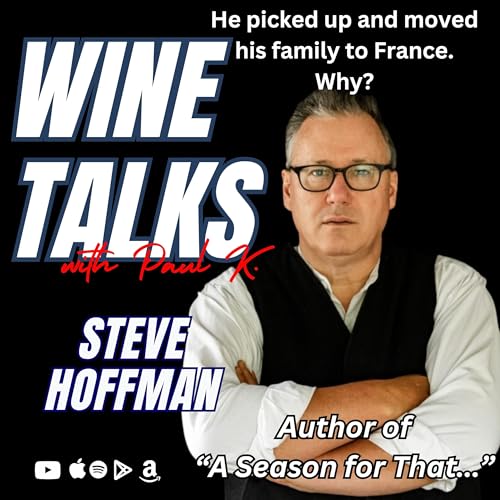
  • How French Village Life Changed the Hoffman Family's View of Food, Wine, and Culture
    Nov 25 2025

    It is a dream for many people to pick up and move to another country. Virtually, no one acts on that dream. Steve Hoffman did.

    And it seems it takes a certain type of partner, a certain type of children and a certain type of risk tolerance.

    What do you do? Throw a dart and a map of France and moce there? The answer to that question and just about any question you might have in regardst o moving your entire family to a foreign country is answered in his book "A Season for That: Lost and Found in the Other Southern France"

    In this episode, I sat down with Steve Hoffman—a truly fascinating guest whose life journey has taken him from tax preparation in Minnesota to writing about food, wine, and the adventures that come when you upend your comfortable life and move your family to rural southern France.

    We kicked things off by talking about Steve Hoffman's unusual career blend: by day he's a seasoned tax preparer (25 years in the game), but his real creative passion lies in writing, especially about food and travel. We dove into his book, "A Season for That," which chronicles his family's adventure as they left behind their predictable Minnesota routine for a small French village—with two kids in tow. That journey was as much about immersing themselves in French culture and language as it was about discovering how to cook the local food and connect with the local winemaking traditions.

    One of the big themes we explored was creativity—how hard it is to switch gears from the structured world of numbers to the freewheeling world of writing. Both of us agreed: creativity is a skill you have to practice, nurture, and work at. We also talked about how the relentless pace of social media and AI-generated content creates burnout for today's creators, and how meaningful writing (and winemaking) always comes from a deep, unique personal perspective.

    We took the listeners through the excitement and challenges of integrating into French village life—the struggles with unfamiliar and often pungent cuisine, and how difficult it was for Steve Hoffman's kids to adjust. We got honest about failed dishes, peculiar local ingredients, and the cultural value of not wasting any part of the food. The conversation was filled with stories about learning from neighbors, the importance of family meals, and how sharing food and wine became a way of connecting across cultures.

    Of course, wine was front and center. We talked about the deep agricultural roots of winemaking in France, the differences between American and European wine culture, and why wine is so much more than just a beverage—it's a time capsule, capturing the character of a particular year and place. We compared the American pursuit of "great vintages" to the French view: that every vintage is valuable if it honestly expresses that year and terroir.

    Lastly, we dove into the mystique of wine pairing—questioning whether there's really a "perfect match" or if the best pairings are simply what fits the moment and mood. Sometimes you open a special bottle and let the food catch up, rather than the other way around!

    This episode was packed with personal anecdotes, deep dives into creativity and culture, and, most importantly, a celebration of wine as a connector between people, places, and memories. Whether you're a wine geek, a foodie, or just looking for inspiration to shake up your routine, you'll find something to savor here. Pull up a glass, and join us for the ride!

    YouTube: https://youtu.be/0MtN3SANKak

    #WineTalksPodcast
    #WineCulture
    #FrenchWine
    #FoodAndWine

    Voir plus Voir moins
    1 h
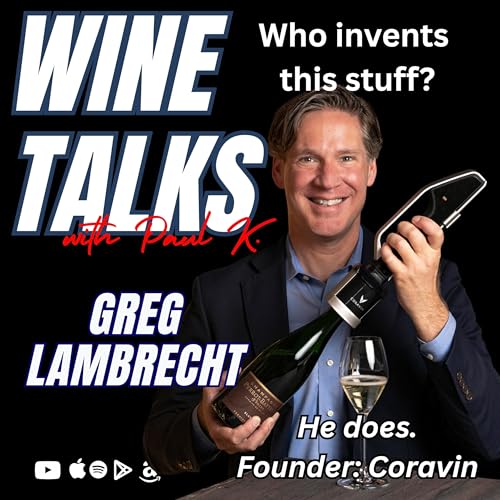
  • Inventing the Coravin: Greg Lambrecht on Transforming Wine Culture and Expanding By-the-Glass Exploration
    Nov 18 2025

    Who invents these things? and what experience do they have that gets them to the point that they can invent these things?

    Entrepreneurs are a crafty bunch. They dream. They test themselves. They switch gears on the fly. So goes the story of Greg Lambrecht, the inventor of the Coravin wine preservation and dispensing system.

    You have to believe the story, though it seems unbelievable, because it is true.

    Imagine a podcast where invention, passion, and the enduring mystique of wine come together—where stories of ingenuity inspire new perspectives on the familiar rituals of sharing a bottle. Welcome to Wine Talks, and in this special episode, we sit down with none other than Greg Lambrecht: medical device inventor, Chairman, and founder of Coravin, the revolutionary wine preservation system that's changed the way we taste and savor the world's finest bottles.

    Our journey begins not in a vineyard, but deep inside the world of plasma physics, where a young Greg Lambrecht first dreamed of fusion reactors before pivoting toward medicine and, ultimately, the creative crossroads that would see him transform both fields. It's the kind of path mapped by an insatiable curiosity, a "ferocity of purpose"—as Greg Lambrecht puts it—that won't let go until a solution is found. Whether protecting healthcare workers with safer needles or opening doors to rare wines without ever pulling a cork, Greg Lambrecht's inventions answer needs no one thought to ask out loud.

    What sets this conversation apart isn't just its recounting of triumphs over glass and grape, but the philosophy animating Greg Lambrecht's work. He believes wine's true essence lies not in luxury, but in experience: its power to bring people together, its infinite variety ripe for exploration, its uncanny knack for weaving memory and flavor into moments we'll never forget. Wine, as he reminds us, is the "most social beverage," a thread running through history that binds strangers and friends alike.

    Threaded throughout the episode is an unyielding optimism: that even as wine faces cycles of challenge—from shifting tastes to industry headwinds—it will endure, because what it offers is elemental and unchanging. Imbued with the joy of discovery and a respect for craftsmanship, this episode doesn't just trace the arc of an inventor's career; it champions a deeper message. Innovation and tradition aren't adversaries, but partners that keep the world of wine vital and surprising for the generations yet to come.

    So pour a glass, settle in, and let this episode remind you that sometimes, the best stories—and the best bottles—are those we share together, with curiosity and an open mind. The future of wine, it turns out, is a journey made one meaningful sip at a time.

    #WineTalksPodcast #GregLambrecht #PaulKalemkiarian #Coravin #WineInnovation #WinePreservation #Entrepreneurship #WineIndustry #WineByTheGlass #WineDiscovery #WineExperience #MedicalDevices #WineCulture #WineTasting #WineTechnology #ChampagnePreservation #WineMemories #Sommelier #WineEducation #WineCommunity

    Voir plus Voir moins
    1 h et 16 min
  • Breaking Traditions: Collaboration, Diversity, and Modern Strategies in the Wine Industry
    Nov 11 2025

    There is alot of speculation, prognositcatiom, miss-information, ridiculous conclusions, and outright bad data about the wine trade right now. Everyone with an opinion is chiming in. And some of these folks have done nothing more than work in a wine shop or behind the scenes at an agency. How does that quote go? "It is much easier to give advice from the veil of cover, than to use it at the point of attack" That is percisely how I feel about much of what is being said.

    Enter Barbara Gorder. She gives advice but has used it at the point of attack. You see, she didn't come from the wine trade to convolute and miss-comprehend the data, she came from main stream marketing; high end stuff; Leo Burnett.

    Barbara Gorder never cared much for the wine itself—at least, not at first. Her fascination started in a Roman-built wine cave, an art history professor and a bottle of Châteauneuf-du-Pape. But what truly pulls Barbara Gorder into wine's gravity isn't just what's in the glass; it's the changing, challenging business behind it. This episode pours listeners an insider's view not just of shifting generational tastes or the specter of "neo-prohibitionists," but the seismic explosion of wineries competing for our (increasingly distracted) attention. You'll discover how direct-to-consumer (DTC) wine marketing—once an afterthought—has grown into a multibillion-dollar necessity, and how Barbara Gorder helped drive this revolution by importing lessons from fields as disparate as luxury beauty and global snack foods. With wit and blunt honesty, she uncorks tales of exclusion—women in marketing meetings, outsiders "not related by blood or marriage"—and explains how diversity and collaboration are quietly rewriting the rules of success. Listen in as Paul Kalemkiarian grills her on why most wineries have only now started talking to their customers (and still don't know their acquisition costs), why the wine industry's language gap drives away curious drinkers, and how the future lies not in doom-and-gloom narratives, but in creative marketing and open doors. This is a rare tasting of industry confessionals, hard marketing truths, and what it really takes to stand out when your competitors have multiplied from 7,500 to over 11,000 in under five years. By the end, you'll have a seat at the table with the most eccentric thinkers in wine, understand why "my wine sells itself" is a myth, and get a glimpse at the future of how—and to whom—wine is going to be sold.

    #wineindustry
    #DTCwine
    #BarbaraGorder
    #PaulKalemkiarian
    #winemarketing
    #winebusiness
    #winerycompetition
    #winesymposium
    #FreetheGrapes
    #directtoconsumer
    #wineclubs
    #winediversity
    #wineexperience
    #wineeducation
    #winesalesstrategies
    #winetech
    #digitalmarketing
    #womeninwine
    #wineconsumertrends
    #winepodcast

    Voir plus Voir moins
    59 min