

This post was originally published on Audible.com.
Note: Text has been lightly edited for clarity and does not match audio exactly.
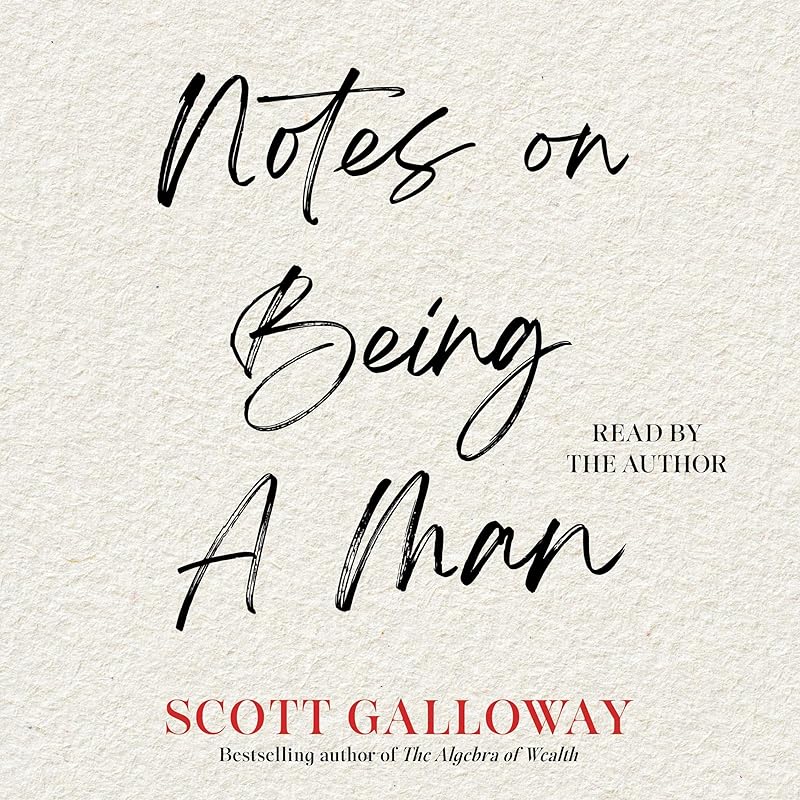
Katie O'Connor: Hi, listeners. I'm Audible Editor Katie O'Connor, and today I'm excited to be speaking with entrepreneur, bestselling author, and co-host of the Pivot podcast Scott Galloway about his new book, Notes on Being a Man. Welcome, Scott.
Scott Galloway: Katie, it's great to be here.
KO: I have called this book part memoir, part battle cry. In Notes on Being a Man, you use your own personal history to underscore the crisis that men and boys are facing today. They have fallen behind. They are isolated and lonely. They are doing worse in school. They are falling behind professionally. How long have you been meditating on this book and why did now feel like the right time to bring it forward?
SG: It's a generous question. The moment I started going down a rabbit hole and looking at the issue was, I don't know if you know who Alex Kearns is. He was a rising sophomore at, I believe, Oklahoma State, and he was trading options on Robinhood. He got an errant message saying that he owed $600,000, and he furiously emailed the company trying to get an answer back, didn't hear back from them, and then in the morning left a note for his family saying he didn't want to burden them and killed himself. I reached out to the family, and I saw a picture of this kid and it just reminded me of my son, and started just doing research around teen suicide. One of the first things I stumbled on was that if you walk into a morgue and there's five people who've died by suicide, four are men.
It just inspired a journey looking at the data around young men, and I came to the conclusion that no group has fallen further faster than young men in America. And then contrast that with what I saw as a remarkable lack of empathy, because men of my generation registered so much unearned privilege and advantage that we were holding young men accountable. If any group was killing themselves at four times the rate of the control group, we'd weigh in with programs, but because of my advantage, there was just a lack of empathy. I went to the Democratic National Convention, a parade of special interest groups highlighting the very real issues they each faced. Not a single mention of young men.
So, it just inspired sort of a journey around data. I relate to young men who are struggling. I didn't have a lot of economic or romantic opportunities when I was a young man, but I feel like America loved me. I applied to UCLA, it had a 74 percent admissions rate. It let in unremarkable kids. Now it's 9 percent. I got a 2.27 GPA out of UCLA, and Berkeley, arguably the finest public school in the nation, let me in to graduate school. That would not happen now. I got assisted lunch, Pell Grants. I was raised by a single mother who lived and died a secretary. My mom had access to family planning. Had we not, we would've been in poverty. I got to come of age in the internet. I just feel like everything that lifted me up as a young man is under attack, and then you couple that with a lack of empathy. It just started this multiyear journey where I became very interested in the issue.
"I just feel like everything that lifted me up as a young man is under attack, and then you couple that with a lack of empathy."
The moment is right. It's better to be lucky than good, but I think the dialogue has just become so much more productive. When I started talking about this four years ago, there was an understandable gag reflex. I was called Andrew Tate with an MBA, because a lot of the discussion around these issues was being led by people who were thinly veiled misogynists. But the dialogue has become so much more productive. You have Governors [Gavin] Newsom and [Wes] Moore talking openly about programs to address the plight of young men and boys. That just would've gone nowhere four or five years ago. And I think the dialogue is sort of being led or supported by mothers who see what's going on with their kids.
So, it started with a young man's tragic suicide. I relate to these young men. The data is overwhelming. And I think society is sort of warming, or not warming but embracing the notion that something's going on here.
KO: Yeah, as you say, the data is overwhelming, and I think it's enough to make anyone spiral. You do share a lot of statistics in the book. For example, nearly one in five men in their 30s still live with their parents. And 15 percent report having close to no friends. The statistic you just mentioned, that men are four times more likely to die by suicide than women. Was there one particular data set that you found the most alarming?
SG: How men aren't attaching to relationships. You mentioned one in four men can't name a best friend. One in seven can't name a single friend. Sixty-three percent of men under the age of 30 are not even trying to date. Forty-five percent of men age 18 to 24 have never asked a woman out in person. One in three men under the age of 30 are in a relationship, or two in three are not. Whereas it's two in three women under the age of 30 are in a relationship. And you think, "Well, that's statistically impossible." It's not, because women are dating older because they want more economically and emotionally viable men. The number of men called NEETs, that is men who [have] neither education, employment, or training has tripled in the last 20 years. These are men, able-bodied men, literally doing nothing.
So, it just feels like we've got this lost generation of young men. I'm not an adolescent psychiatrist. I'm not an endocrinologist. I'm not a gender studies expert. I do know more about technology than your average bear. It's been the primary focus of my research for the last 15 years, is how technology disrupts traditional industry. And what I recognize is I don't think people realize that we've attached our economy—basically 40 percent of the S&P market value now is 10 companies in big tech or AI. They do a lot of things, but I would argue their primary means of creating shareholder value is to divide and polarize us.
They have found the ultimate nutrition for economic value, and that is the immature brain of a young man, who's more prone to nationalist content, extremist content, wants a quick dopa hit. Maybe he's frustrated with his own economics so he's susceptible to gambling or crypto or trading stocks, which is just gambling. Maybe he feels rejected by women because he has fewer venues to try and demonstrate excellence, so he turns to increasingly life-like synthetic porn. I just feel like the most powerful, deepest-pocketed entities in history, big tech, have figured out that you have attached economic value to essentially evolving a new species of asocial, asexual males. It's as if we're planning our own extinction, if you want to talk about capitalism imploding on itself.
I would say the most disturbing thing is when I look at my life, hands down—and if you ask people, and I'll ask you the same thing, I'll put forward the thesis and you tell me if you agree or don't agree: All this AI and podcasts and economic growth, it's all a means. The ends is deep and meaningful relationships. That's the shooting match. That's where you get happiness or a lack thereof. We're mammals. Put an orca in a tank alone, see what happens. The worst thing you can do to a human is solitary confinement. Most prisoners will opt for exceptional danger rather than being sequestered from everyone else. Leave your dog alone without another dog or a human and see what happens.
I just see more and more young men at the hands of big tech being sequestered from what is the key to a meaningful life and happiness, and that is relationships with people off of a screen. So that, to me, big tech attaching our entire economy to the isolation of young people, specifically young men, and finding a profit incentive in it, I don't think people have really made that connection and realize just how mendacious it is.
KO: Yeah, it's becoming more and more prevalent too. The reliance, as you say, is increasing and their worlds are just getting smaller. So, I'm a mom to four young boys. My boys are still little. What are some early decisions parents can make that can help course-correct for some of what you're seeing in young men?
SG: So, I want to be clear, I have no domain expertise in adolescent psychiatry. A lot of times I talk so much about parenting, I get imposter syndrome, because I know I'm a good dad but I'm not sure I'm a great dad. So, I can share my experience, and I have some research around it. Generally speaking, if you were to reverse engineer where a boy comes off the tracks and it indicates real problems as an adult, it's one thing, and that's when the boy loses a male role model through death, divorce, or abandonment. And even just saying that five years ago triggered this notion of “What, women can't raise boys?” No. I was raised by a single immigrant mother who lived and died a secretary, light of my life.
But what's interesting is the research shows that girls in single-parent homes, of which America now has the most anywhere in the world as a percentage of our households, they have similar outcomes as girls in dual-parent homes. Same rates of college attendance, same income. They're a little bit more promiscuous because they're looking for male attention sometimes in the wrong places. But on the big stuff—self-harm, college attendance, future earnings—largely the same. When a boy loses a male role model, at that moment he becomes more likely to be incarcerated than graduate from college. So, the presence of a male role model seems to be especially important for boys.
In terms of parenting, it's the obvious stuff. Just keep them off screens as much as you can. Then there's the basic parenting stuff, chores, engagement, presence with them, all that good stuff. Every time I read a book on parenting, it contradicts the one I read before it. The advice I give to other dads is something I got from Ryan Holiday from The Daily Stoic, and that's garbage time. I bought into this notion of quality time because I was trying to compensate for the fact I wasn't around a lot because I was working so hard and traveling 180 days a year. What I have found is that these moments of connection you have with your boys happen so randomly, so unpredictably, that it's a function of just the amount of gross tonnage of time you spend with them. What I have found, my hack is, I'm an Uber driver, and that is I like to drive them everywhere because I find if I'm not staring at them and there's no expectation of a conversation, occasionally they just start talking about something.
I think making sure that you have men involved in their lives, being present, what I'll call garbage time with them, and God, keep them off screens as long as possible. I actually think, because you have young kids, we're going to have figured it mostly out by then. Took us 30 years of tobacco, 20 years of opiates. It looks like it's taken us about 20 years with smartphones to realize these people are not on our side. The amount of time your kid spends on a screen that's not schoolwork or whatever is probably pretty strongly inversely correlated to their success as adults.
KO: That's always my joke is that I hope social media is entirely passé by the time my kids are old enough to be interested in engaging with it. COVID certainly seemed to exacerbate a lot of this. Another statistic that you share is that nearly 40 percent of bars and pubs have closed since the pandemic. These were places that young men used to meet up and socialize. Again, with what you were just saying, the phone is an incredible agent in men's struggles, really furthering the isolation. Between the two, COVID and handheld devices, do you think one has been more detrimental or perhaps one was the catalyst and the other the accelerator?
SG: Well, first off, it's multidimensional. I mean, it's biological. The gap between a boy's maturity and a girl's maturity seems to be broadening. Girls are menstruating earlier and boys’ testicles are descending later. So, literally the gap in maturity seems to be broadening. We don't know if it's environmental or pesticides. It's economic. We have consistently transferred wealth from young people to old people. Tax policy, mortgage interest rate, capital gains. We transfer $1.2 trillion from young people to old people every year in the form of Social Security. And I'm not suggesting we let seniors be in poverty, but should I be getting Social Security in two years? It just makes no sense.
"Big tech creates these unreasonable expectations and makes young people feel like if you're not hanging out at the Cannes Film Festival and you didn't just make 400 percent on your ETH trade on Coinbase, you're failing."
So, we've taken money out of young people. It's economic. It's sociological. We talked about the lack of empathy for young men. I do think COVID exacerbated or intensified all these things. But I think there's just a bunch of different things attacking it. If I were to pick what is the biggest factor? I think hands down it would be attaching screens and algorithms to profitability, to sequestering young men from their relationships. And six out of seven gambling addicts are young men. Vegas is down 20 percent this year, and we now have Vegas inside of us, or in our phone. And it's also got the highest suicide rate. Because if you became a meth addict, we'd figure it out pretty fast. When you're a gambling addict, you can spend your kid's college fund, mortgage your house, and no one knows. And you decide there's no way out. Six out of seven gambling addicts are young men.
We have a homeless crisis and an opiate crisis, but we really have a male homeless, a male opiate crisis. Three out of four homeless and three out of four opiate addicts are men. So, I would say that COVID really did a number on young people, kids. I mean, I don't think anyone got COVID right. I can't point to a nation and say, “They got it right.” Some people say Sweden. I didn't realize this, that the risk to a young person from isolation from their classmates was much more damaging to their health than the risk of COVID for kids, and also for the teachers who tended to be female and younger.
So, I have no doubt it all contributed. But if I had a magic wand and said what is the one thing, if you just look at the data—rates of self-harm among young girls, rates of depression, obesity, anxiety—the factor that seems to have really accelerated it seems to be around 2012. And that's when social went on mobile.
KO: Again, crossing my fingers for it to become passé. It's very dangerous. Going back a little with what you were saying about kids and how damaging COVID was to them as they were coming into their maturity, post-COVID for parents, at least for me personally, has really made the intersection of parenthood and work even more difficult. Childcare does not look the way that it used to. And kids themselves have COVID-level expectations of their parents' time and attention. For me, as a mom, I so appreciated you saying that there is no balance, just trade-offs. And that you can have it all, just not at the same time. At what point did you come to that realization yourself?
SG: So, I teach a class at NYU, and the last class, the most popular session, I call it The Brand Is You or The Algebra of Happiness. I just go through, "Look, this has nothing to do with marketing. I'm going to take you through a series of observations around what I have found has not worked and has worked in terms of living a life of purpose and meaning." One of the things I do is I survey the class: Where do they expect to be economically in five years? And granted, it's a skewed sample because these are second-year MBAs at NYU. It's a very ambitious group of people. I say, "What are your priorities?" Okay, 70 to 80 percent of them expect to be in the top 1 percent of income-earning households within five years, which is $700,000 a year they expect to be making. And I can see it. The average compensation of an NYU Stern graduate is $220 grand right out of school. So, they think, “Okay, in five years I want to be in the top 1 if not the top 2 percent.” Then we talk about priorities. Towards the top of the list, if not the top, is balance. And I'm like, "Okay, so you want to be thin and eat ice cream 10 times a day?" These two are not compatible.
We all know that person who is handsome, or hot, works out, great relationship with their parents, great parent, rains money on them, donates time to the ASPCA, and has a food blog. Assume you are not that person. Unless you're smart enough to be born rich, the only way you can get to that level of influence and economic security, I have found, is to do pretty much nothing but work for 20 years and just try and manage your fitness and your relationships. By the way, I'm not suggesting that's the right way. That's what I did. It cost me my hair. It cost me my first marriage. And this is what gets pushback. For me, it was worth it. I have a shit-ton of balance in my life right now. I do a ton of amazing things with my boys. I had them later in life. I have an amazing life with my partner. I get to do just a ton of extraordinary things that a capitalist society affords you. That was because, in large part, from the age of 25 to 45, I did pretty much nothing but work. I'm not saying that's the right way. You can move to a lower-cost neighborhood, coach little league, go to church, have a wonderful life. Some people don't live to work, some people work to live. I get it.
But where the inconsistency is, I think young people need to have a sober conversation around their expectations and the requisite trade-offs. You might decide, “I don't need to be a baller. I don't need to go to Saint-Tropez. I don't need a Range Rover. I want to work 40 hours a week, have a good job. Maybe my partner works. We have a good living. We adjust our lifestyle, our expectations.” What I find amongst a lot of young people is a total mismatch of the expectations they believe around economics and influence and the requisite sacrifice. Because 210 times a day, people are vomiting their wealth porn and their faux success, “Oh, I'm just so naturally f---ing gifted that it rains money on me, and I'm going to take pictures of my feet at the Aman Hotel in Venice. And it just happened because I'm so crazy talented.” Anyone who takes a picture of a plane, trust me, they do not own a plane.
Again, big tech creates these unreasonable expectations and makes young people feel like if you're not hanging out at the Cannes Film Festival and you didn't just make 400 percent on your ETH trade on Coinbase, you're failing. There is no balance, there's only trade-offs. You and your partner need to get alignment around what's required and what the reasonable expectations are in a capitalist society. By the way, I'm not saying this is the way the world should be, I'm saying this is the way the world is. But the reason I have a lot of balance now is because I had almost none when I was your age.
KO: Relatedly, another piece of wisdom I found very interesting that you shared, you said, "Don't follow your passion professionally. Find what you're good at and follow your talent." The idea being that rewards will help create a level of passion in what you're doing. How do you think following this advice will change the structure of work and career searches in our individualistic society?
SG: I don't know how it's going to change the workplace. So, at NYU we have two types of luncheon speakers. We get a speaker every day, and it's either billionaires or very talented, thoughtful people. We've decided that once you have three commas behind your net worth, you somehow immediately garner insight into life. Billionaires always end with the worst advice: follow your passion. And the guy telling you to follow your passion made his billions in iron-ore smelting. What I have found is that oftentimes young people mistake their passions for their hobbies. I wanted to be quarterback of the Jets. I was really fortunate that by the time I got to high school and started playing against real athletes, much less UCLA, I realized that was not going to happen.
When you think about the passion fields for a young person, it's usually something along the line of the arts, acting, modeling, sports, opening a restaurant, opening a nightclub. Those industries draw so much human capital that the majority of them don't make a living because they can be underpaid and there's too many people pursuing too few goods. SAG-AFTRA has 180,000 people. That's the union representing actors. These are the most talented people in the world. It's not easy to get your SAG-AFTRA card. It's not like you just apply for it. You have to be in a legitimate creative production. Last year, 83 percent of them didn't qualify for health insurance because they didn't make $23,000. So, I don't want to crush your dreams. What I'd suggest to young people is if they want to be in sports or open their own jewelry or fashion line, that they set up very reasonable benchmarks that say, “Okay, within five years, if I'm not making enough money such that I don't have to call my parents and ask for money, maybe I should think about workshopping another career.”
There's just a lot of data. The less sexy an industry, the greater the return on your human and financial investments. I have a friend who's opening a private members club in Manhattan for artists downtown. I'm like, "I will absolutely join. No way I'm investing." Another friend is starting this SAAS platform to help schedule maintenance for MRI machines. It sounds so boring I want to put a gun in my mouth. Take my money, I will absolutely invest. What I have generally found is the millionaire next door made it by figuring out a way to import those brushes at car washes from China.
I'm renovating a house, I'm living in London, we're putting in marble in our kitchen. I found this guy, Iraqi immigrant, came here desperate, started working for a renovator, got really into marble. He was very honest with me. He’s been in the business 15 years, makes £2 million a year, clears £600,000. This guy's so passionate about marble now because he understands it. It gives him a great life. The accoutrements of being great at anything—the economic stability, the prestige, the validation, the respect of your colleagues—will make you passionate about whatever that thing is. So, passion comes, I find, from artisanship and mastery. And as you get older, you're going to find that you're really passionate about taking care of your kids. You become really passionate about boring things like health insurance. You become passionate about the ability to help your parents. You become passionate about the ability to give some money away to things you feel strongly about. You become passionate about taking amazing vacations and experiences with your family and your partner and your kids.
So, I don't want to crush your dreams, but all the evidence leans one way, and that is if you want to be passionate about something, be great at it. And it is much easier to be in the top 1 percent of tax attorneys than it is to be in the top 1 percent of NBA players. The unemployment rate in the passion industries is 90-plus percent. As an accountant, you just need to be in the top half and you'll make a good living. So, yeah, I think it's follow your talent, not your passion.
KO: You're very vulnerable in this book. You share some high highs, but you're also very honest about your own shortcomings. What has it taken to not only get to this level of self-reflection and understanding of yourself, but also to be willing to share it publicly?
SG: It's a couple things. One, I didn't want to position the book as “check my shit out, here's how you be a man,” you know? Beating my chest. It's more about what I think I've gotten right, and what I know I've gotten wrong, and how I've tried to be a better citizen, better human, better man. A lot of that has come from my shortcomings and a lack of character and learning from it. The way I write is I try to imagine that no one's going to read the book but my kids, my sons in 20 years. I want them to understand me and the world a bit better. I know when I'm writing certain stuff, I'm like, “Oh, my God, I'm going to get so much shit for this and people are going to push back on it. It just sounds not great.” And I'm like, “Well, okay. The people I admire the most are fearless.” I want to be seen as someone, maybe I didn't get it right all the time, but I was fearless and was writing what I was thinking at that moment.
"Billionaires always end with the worst advice: follow your passion. And the guy telling you to follow your passion made his billions in iron-ore smelting."
Also, a huge unlock for me, I talk about this in the book, from the age of 29 to 44, for 15 years, I didn't cry once. I kind of forgot how. I didn't cry when my mother died. Didn't cry when my company went out of business. Didn't cry when I got divorced. I have found that being more emotive and stopping and really wallowing in things that inspire me, that when I moved to be openly emotional, I've just found it's been a great way to slow time down. It informs what's important to me. I have found when I'm in the company of other men and someone's saying something and I get emotional, I'm not exaggerating, I think some of those men look at me and think, “Jesus Christ, I wish I could do that. I'll take a six-pack of that to go. Like, I need that. I need to be sad more. I need to register how upset I am at something or how much I'm inspired by something.”
The reasons why men don't—to be emotive and to cry or to express affection, or to compliment another man, or to talk about how badly you screwed up, or you're worried about money or your marriage isn't going well, or for the first time you're experiencing erectile dysfunction—to sort of communicate those things to people, we've been taught for 3,000 years as men that there's a good chance a stronger man will take your shit, sleep with your wife, and eat your children. You should never communicate that type of weakness. That it could result in harm or death to you and yours.
I think that men need to just objectively evaluate [that] we no longer live in a primitive world, and life goes fast. I can't tell you, you're much younger than me, I mean, the end is just barreling towards me. So, I have a series of hacks to try and slow it down. One of those hacks is, I was at the Royal Academy of Arts and I saw this painting, and it moved me for some reason. I am not into art. Typically, I would've been like, “Oh, that's cool,” and kept moving. Now, I sit in front of it and really try and touch it, feel it, absorb it. Really just trying to be in the moment more and register my emotions and not check back.
When I see something that inspires me or someone does something that I'm impressed by, I'll stop men on the street, or I stopped an older couple just this morning. I said, "You guys just look so f---ing amazing." I didn't use the F-bomb. But that's what I thought. And they just light up, and you feel more confident. I found, in a weird way, that expressing my vulnerability makes me feel more masculine because I think, at the end of the day, it makes you seem more confident.
I find that whenever I open up about my weaknesses where I'm really devastated—I'm a 61-year-old man that still hasn't gotten over the death of his mother. My mom died 20 years ago, and I still can't talk about my mom without getting emotional. I'm not exaggerating when I write about my mom and my struggles with her death and how it paralyzed me for a couple years. I hear from masters of the universe that are considered the ultimate alpha males and they're like, "Yeah, me too.” I send emails to my mother even though I know she's dead. So, it's been a real nice unlock for me and it just makes me happier. I think it makes me more mentally healthy. I find that people, especially other men, are really receptive to it.
KO: I really enjoyed getting to hear about your mom in this book, and particularly for the ways in which you were there for her at the end of her life. You can definitely hear that emotion in your voice as well. You have narrated almost all of your books. Talk to me about that process and experience, and do you find it enjoyable to revisit your work in that way?
SG: It's interesting. It's funny, when I read it, I should do it first and then go back and rewrite it because what you find is sometimes it highlights the flaws in my writing. I'm like, "Oh, this isn't natural." If you can't give it the spoken word, it's not written that well. But what it does is, when you can have inflection and emotion and pauses, and they hear you angry or insecure when you're reading or talking about something, or they hear you emotional, it literally takes the words off the page. The first time I had an actor read my book, I'm like, "No, that's not what I meant. I think this is funny, it's not supposed to be dramatic. This is tongue-in-cheek for me.” Or "You're taking me too seriously when you read it this way" or "No. No. Slow down. This really upset me when this happened to me.”
I have a good voice and I'm good at it, so it comes naturally to me. I can see why some people use actors or voiceovers because they just have a better voice. But it's something I enjoy. It informs my writing, and it gives the listener a chance to say, “He's clearly still struggling with this. He wrote it, but he still hasn't reconciled it.” A lot of times I read my stuff and I'm like, “Wait, I hope it's right, but I'm not sure.” And that can come through when you're reading it over.
So, I really enjoy the narrative part of it, or the audible part of it. Also, people feel closer to you. The written word hits people in a more meaningful way over the long term. I think great written work can make you immortal. No one's going to be watching my YouTube videos when I'm dead. I don't think anyone's going to give a shit about my newsletters or watch my talks. But if you write something really powerful, I do think it can outlive you. But in the present day, the way you connect with people is with your voice. Because one of the wonderful things about podcasting and a voice-driven medium is that people feel very close to you.
I can tell how someone's been introduced to my work based on the way they greet me. If someone comes up and goes, "Prof G," and they high-five me, I know they saw a video. If they write a really long, thoughtful email, I'm like, "Oh, they're responding to something I've written." When someone comes up to me—and this happens to me pretty much every day if I'm outside for longer than an hour—and they start talking to me as if they know me, they don't even introduce themselves, and I have to sometimes sit there and go, "Do I know this person?" Then they'll stop and say, "Oh, I'm sorry. I know more about you. I listen to your podcast."
I had people come up to me and say, "Did Alec hear from UNC?" Because they know my son's applying to UNC and I'm just totally freaked out about the college application process. They don't come up and say, "Oh, hi, I've been listening..." Because you're in their ears physically, because of AirPods, because they're usually listening to you when they're doing the dishes with their husband, or walking their dog, or exercising. You're with them in a private moment. They feel as if they're your friend. That is unique to the audible or the voice medium. It's really lovely, because I'm a bit of a narcissist. I have a big ego. I'm desperate for other people's affirmation. I like it when people come up to me and they're nice to me. I generally find that people think they're your friend and they have real affection for you through this medium.
KO: That was well said. I do think that there is a connection and an intimacy that happens when you are listening to something. I'm curious, what are the books that you are reading or listening to right now?
SG: It's so embarrassing, I don't read a lot of books. I read a lot, but I don't read a lot of books. I like Yuval Noah Harari. I like that stuff. I'm reading Nexus right now. I don't read a lot of books. What I typically do is try and find a book that's outstanding and read it two or three times because I selfishly want to be able to incorporate that into my intellectual work. I'm reading the biographies of Churchill. I've turned into that old guy. I'm fascinated with anything starring Hitler. I read a lot of books on World War II. I read so much during the day that I find it doesn't, I hate to say this, it doesn't really relax me to read. I write more—I probably read a book every three to six months and I write a book every 18 months. So, I just reread a wonderful book, it’s pedestrian, Stephen King, On Writing.
KO: He's good [laughs].
SG: But I'm doing it for selfish reasons. I think that guy is such a genius, and he talks about the craft of writing. Along those lines, next to my bed is Strunk and White, Elements of Style. I think of myself as being educated and I come across as pedantic, and yet someone just highlighted the fact I say the term “anyways” all the time, which is like fingers on a chalkboard for them, and I'm embarrassed. So, I went back to Strunk and White and I'm like, "Okay, I gotta get my grammar act together."
I'm starting to read John Malone's book, which I think is fantastic. I love it when these 90-year-old men start writing. You can tell they're fearless because they're like, "I'm going to be dead soon." Barry Diller's book is really interesting. About the best business book I'd read in a while, it's a little bit older now, but I just read it, was Shoe Dog by Phil Knight. So, my books are more, like, old men finally coming clean who were ballers in the world. And then World War II. I just can't get enough of World War II. I find that stuff fascinating.
KO: Is there anything else that you would like to share with our listeners today?
SG: I feel like I get men. So, this is advice to men, but I hope it's advice to everyone. The biggest unlock of my life the last 30 years has been—if you believe that relationships are the key to happiness, and I have a lot of research that proves that point—the biggest unlock of my life was I had a bit of a tortured relationship with my father. He left us. He wasn't very good to my mom, and I resented him for it. And when I found myself being a better son to him than I thought he was a father to me, I would go dark and not speak to him for six or 12 months. Then about 20, 25 years ago, I said, "All right, I'm going to put all that bullshit aside and I'm going to decide what kind of son do I want to be."
"I found, in a weird way, that expressing my vulnerability makes me feel more masculine because I think, at the end of the day, it makes you seem more confident."
I thought, “I would really like to be a generous, loving son.” And I became that. And we've just had the most wonderful relationship for the last 25 years. He softened as he got older. He passed away six months ago. That pivot in my relationship with my father inspired me to put away the scorecard across all my relationships. That is, I took a very transactional approach to my relationships. If I had a girlfriend and I spent time with her father when he was in town, I expected her to spend time with my mother when she was in town. And if she didn't, I was angry. I was constantly assessing, am I getting as much out of this friendship as I'm giving? That's how I approached every relationship, from kind of a transactional, or if you will, capitalist standpoint. And one of the biggest unlocks in my life has been to put away the scorecard and just ask yourself, “What kind of partner do I want to be?”
I used to think about my kids, “I'm not getting as much back, I don't like being a parent.” And then I realized, well, that's the whole point. The whole point is you're not going to get as much back. That's the opportunity. I've done a ton of research on happiness because I struggle with depression and anger, which won't surprise anyone who listens to my podcast. But one of the keys to happiness, it's not only relationships, but people think, “Well, it's how much people love you.” And what they found is that while people who have a lot of people love them are happier than people who don't, the happiest people are the ones that find permission from other people to love them. And that's just been such an enormous unlock for me.
I'm not a martyr. I don't think I'm ever abused. I'm happy to shed relationships. But I just say, “Okay, who do I want to be in this relationship?” And then I try to hold to that standard. If I add a little bit more value, surplus value, that's the whole point. That's, in my opinion, what it means to be a man, is surplus value. I want to create more tax revenue and jobs than I get. I want to notice people's lives more than they notice mine. I want to give more love to my kids than I will get back. I want to be better to my country. It's been better to me. All those things are really high bars, because I got a lot. But, anyways, one piece of advice, put away the scorecard. It's a huge unlock.
KO: That's good advice for all of us. Thank you. And thank you so much for your time today, Scott, and for this book. I appreciate it.
SG: It's my pleasure, Katie. Thanks. I really enjoyed the conversation.
KO: Listeners, you can get Notes on Being a Man by Scott Galloway right now on Audible.