Épisodes

  • Aristotle, Alexander, and the Logic of the Cosmos
    Dec 27 2025

    How did a philosopher from a small town in northern Greece become the architect of a new intellectual paradigm? This episode explores the "seismic" shift from the transcendent focus of Plato to the immanent realism of Aristotle. We analyse the complex relationship between Aristotle and Alexander the Great, discussing how the student rejected his master’s ethnocentrism to pursue a fusion of Persian and Greek cultures.We also deconstruct the Aristotelian Organon—the tool of logic that separates the "cosmos" of order from the "chaos" of the unintelligible. Finally, we discuss the metaphysics of the "Unmoved Mover" and how Aristotle’s concept of the "Four Causes" was later appropriated to explain the nature of Christ in texts like Colossians and Romans.Key Topics:• The Lyceum and the "Peripatetic" (walking) method.• Taxonomy as the linguistic map of reality.• Potentiality vs. Actuality and the problem of change.• The paradox of the Irresistible Force and the Immovable Object.

    Voir plus Voir moins
    36 min
  • Thomas Aquinas Explained: The 5 Ways, Nature vs. Grace, & The Summa Theologica
    Dec 27 2025

    In this episode, we explore the life and mind of Thomas Aquinas, the "supreme architect" of Western theology who defined the Roman Catholic Church’s intellectual tradition. We uncover the dramatic life of the man nicknamed the "Dumb Ox"—a friar whose family once kidnapped him and held him prisoner for a year to stop him from joining the Dominicans,.Join us as we break down his massive synthesis of faith and reason, designed to resolve the 13th-century crisis caused by the rediscovery of Aristotle,. We examine his famous "Five Ways" (Quinque Viae)—logical arguments arguing that the cosmos proves the existence of a Creator through motion, causality, and design,. Finally, we discuss why Aquinas insisted that "Grace does not destroy nature, but perfects it," and look at how his intellect compares to the Puritan theologian Jonathan Edwards

    Voir plus Voir moins
    41 min
  • Søren Kierkegaard: The Father of Existentialism & The Architecture of Inwardness
    Dec 26 2025

    Are you living as a spectator or an existing individual? In this episode, we explore the intense and challenging philosophy of Søren Kierkegaard, a thinker whose work was born not from academic comfort but from profound internal suffering.We discuss the critical "crossroads" of Kierkegaard's life—his broken engagement to Regine Olsen—and how it influenced his distinction between the aesthetic pursuit of pleasure and the ethical commitment to duty. We delve into his radical concept that "truth is subjectivity," where the passion of the believer matters more than objective facts.Finally, we examine Kierkegaard’s "Attack on Christendom," where he accused the state church of reducing Christianity to empty formalism and "baby baptism" machinery. Join us to understand why this "Danish Gadfly" believed the highest truth is not something to be possessed, but something to be existed.Key Concepts:The Leap of Faith: A decision made with passion that transcends rational proof.• The Teleological Suspension of the Ethical: When duty to God overrides universal moral laws.• Existentialism vs. Marxism: The clash between the irrational individual and the lawful collective

    Voir plus Voir moins
    30 min
  • Augustine of Hippo: The Architect of Western Theology
    Dec 26 2025

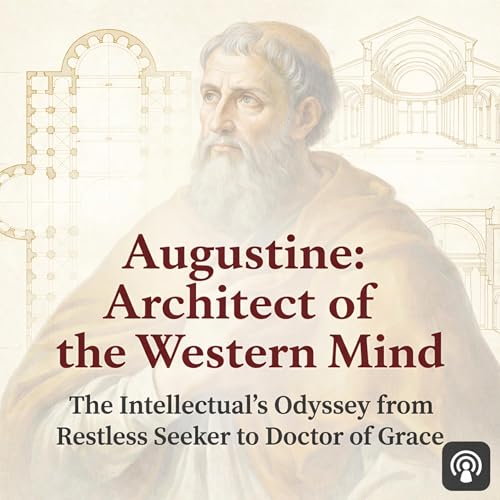
    St. Augustine of Hippo stands as the bridge between classical antiquity and the Christian order, synthesizing Roman rhetoric and Platonic philosophy with the radical claims of the Gospel. But before he was a bishop, he was a young man praying for chastity "but not yet," entangled in the "scientific" allure of Manichaeism.This video examines the intellectual odyssey of the man who defined Western Christianity for over fifteen centuries. We discuss his pivotal encounter with Bishop Ambrose, his battle against the skepticism of the Academics, and the "Divine Illumination" theory that claims all truth is God's truth.We also break down his major theological controversies: the Donatist schism regarding the purity of the church, and the Pelagian debate concerning the necessity of divine grace. Finally, we look at how the sack of Rome in 410 A.D. inspired his philosophy of history in The City of God.In This Video:0:00 - Introduction: The "Architect of Western Theology" born in North Africa.• Origins: Monica’s prayers, a pagan father, and a hedonistic education in Carthage.• The Manichaean Phase: The lure of dualism and the problem of evil.• The Conversion: The garden in Milan and the command to "Take up and read".• Epistemology: Refuting skepticism, the Law of Non-Contradiction, and the "Bent Oar" illustration.• Faith & Reason: Why faith must precede understanding (credo ut intelligam).• Metaphysics: Creation ex nihilo and the rejection of a material cause.• The Problem of Evil: Evil as privatio boni (the absence of good).• Anthropology: The loss of liberty and the bondage of the will (Augustine vs. Pelagius).• Ecclesiology: The corpus permixtum (mixed body) of the Church and valid sacraments.• The Trinity: Memory, Understanding, and Will as the image of God in the mind.• The Two Cities: The City of God vs. The Earthly City.Key Quote: "Late have I loved You, O Beauty ever ancient, ever new."

    Voir plus Voir moins
    39 min
  • The Seed of God: The Metaphysics of the New Birth
    Dec 20 2025

    1 John 3:9 presents one of the most difficult paradoxes in the New Testament: "Whosoever is born of God doth not commit sin; for his seed remaineth in him". If Christians still struggle with sin, how can this verse be true? In this episode, we perform a deep theological and exegetical dive into the concept of the "Seed of God" (sperma theou) to understand the ontological reality of regeneration.

    In this video, we cover:

    🌱 The Exegesis of "Seed": We analyze the Greek word sperma (seed) versus spora (sowing), examining how the Apostle John describes a biological and metaphysical transmission of God’s nature to the believer. We also explore the grammatical significance of the Greek present tense (poiei hamartian) to resolve the tension between "cannot sin" and the reality of human stumbling.

    🧬 The "Chimera" Illustration: We use the modern biological phenomenon of the Chimera—where a host receives new DNA that rewrites their blood system—as a powerful metaphor for how the Divine Nature invades and slowly conquers the old nature.

    🔥 Theological Perspectives: We break down how different traditions interpret the permanence of this Seed:

    • Reformed: The "Indestructible Seed" that guarantees perseverance.

    • Arminian/Wesleyan: The "Conditional Seed" that can be evicted by willful sin.

    • Roman Catholic: The view of Sanctifying Grace and its relationship to mortal sin.

    📜 The Marrow Controversy: We look back at the 18th-century Scottish debate to understand why preaching the "Seed" as a free gift is the only cure for both legalism and antinomianism.

    💡 Pastoral Application: How to distinguish between a "struggling saint" (who has the Seed) and the unconverted. We discuss why the presence of an internal "civil war" against sin is actually the greatest evidence of salvation.

    Chapters: 0:00 - The Paradox of 1 John 3:9 2:15 - What is the "Seed"? (Word, Spirit, or Nature?) 8:30 - The "Chimera" Analogy: Spiritual DNA 12:45 - Can the Seed be lost? (Calvinist vs. Arminian views) 18:20 - The Marrow Controversy & Antinomianism 24:10 - The Three Tests of Life (Moral, Social, Doctrinal)

    #Theology #1John3 #Regeneration #Soteriology #BibleStudy #ReformedTheology #Christianity

    Voir plus Voir moins
    24 min
  • Francis Turretin: 21 Questions on the Authority, Necessity & Purity of Scripture
    Dec 20 2025

    Is the Bible sufficient for salvation? Who has the final say on interpreting theology—the Church or the Scripture itself? In this episode, we unpack Francis Turretin’s rigorous defence of the Doctrine of Scripture from his Institutio Theologiae Elencticae.

    Join us as we explore 21 foundational questions that defined the debate between Reformed theologians and the Roman Catholic Church. We discuss why written revelation was necessary for the church’s survival, the internal evidences of the Bible's divinity, and the crucial distinction between the "ministerial" authority of the church and the "magisterial" authority of God's Word.

    We also cover:

    • The Preservation of the Text: Why Turretin believed the original Hebrew and Greek manuscripts were preserved by God's providence and remain the authentic rule of faith.

    • The Clarity of Scripture: Debunking the idea that the Bible is too obscure for the common believer to read without church permission.

    • The Supreme Judge: Why the Spirit speaking in the Scriptures is the only infallible judge of controversies, rather than popes or councils.

    Whether you are a student of history or seeking to deepen your understanding of why we trust the Bible, this deep dive into 17th-century systematic theology offers timeless insights.


    --------------------------------------------------------------------------------

    Analogy for clarity: To understand Turretin's view on the "Supreme Judge" of controversies (Question 20), imagine a courtroom. The "law" is the supreme standard that decides the case. A "judge" on the bench is merely a minister who must interpret based on that law. Turretin argues that the Bible is the Law (the Supreme Judge), while the Church is merely the minister on the bench who must submit to the Law, rather than claiming to be the Law itself.

    Voir plus Voir moins
    52 min
  • The Handmaiden of Exegesis: What is Reformed Scholasticism?
    Dec 14 2025

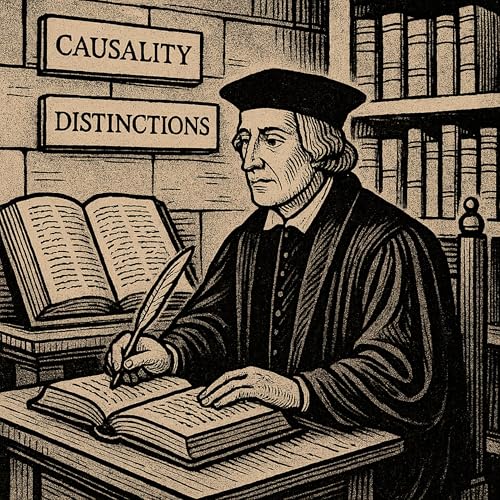
    Did the theologians who followed Luther and Calvin ruin the Reformation with dry logic? Historical consensus has shifted. Far from displacing the Bible, the "Reformed Scholastics" developed a sophisticated method to organize and defend biblical truth. This video breaks down the technical tools of Reformed Orthodoxy—from "Causality" to "Distinctions"—demonstrating how they were used to mine the depths of Scripture and guard against heresy.We cover:The Historiographical Resurrection: Why the "Calvin against the Calvinists" theory has been rejected by scholars like Richard Muller and Willem van Asselt.• The Scholastic Method: Understanding this approach as a pedagogical tool characterized by definition, division, and argumentation,.• From Text to System: How systematic theology was built from the bricks of exegesis and the "common places" (loci communes) of the text,.• Metaphysics in Action: How the "Four Causes" (Efficient, Material, Formal, Final) helped explain the doctrine of Election and the book of Daniel,.• Hard Texts Solved: How distinctions like Voluntas Beneplaciti (Will of Decree) vs. Voluntas Signi (Will of Command) resolved apparent contradictions in Scripture.Timestamps: 0:00 - Introduction: The Myth of "Dead Orthodoxy" 2:15 - What is Scholasticism? Method vs. Content 5:30 - The Role of the "Consectarium" (Logical Consequence) 8:45 - Case Study 1: Causality in Amandus Polanus 12:20 - Case Study 2: Election and the Order of Causes 15:50 - Hermeneutical Distinctions: God's Will & Power, 19:10 - Christology: Did God Bleed? (Acts 20:28) 23:40 - Polemics: John Owen vs. The Socinians 27:00 - Conclusion: The Scaffolding of a CathedralKey Figures Mentioned:John Owen: The exegetical giant who used "demonstrative argumentation" on the book of Hebrews.• Francis Turretin: The systematician who used logic to defend the literal sense of Scripture.• Gisbertus Voetius: The theologian who combined precise distinctions with vital piety to fight Cartesianism

    Voir plus Voir moins
    46 min
  • How Do We Know God? Scripture as the Principium Cognoscendi (Reformed Dogmatics)
    Dec 14 2025

    How can finite, fallen creatures truly know an infinite, holy God? In this video, we dive deep into the "architectonic" structure of Reformed Systematic Theology to explore the doctrine of Scripture as the Principium Cognoscendi (the principle of knowing).Drawing from giants of the tradition like John Calvin, Francis Turretin, Herman Bavinck, and Cornelius Van Til, we examine why the Reformed tradition insists that while God is the foundation of being (principium essendi), Scripture must be the foundation of our knowing.In this episode, we cover:The Metaphysical Gap: The crucial distinction between God’s infinite self-knowledge (Archetypal Theology) and our finite, "creaturely copy" (Ectypal Theology).• Why Nature Isn't Enough: Why General Revelation declares a Creator but cannot save, and how sin has darkened human reason.• Calvin’s "Spectacles": How Scripture acts as the corrective lens necessary to interpret the "Book of Nature" correctly.• Autopistia: The doctrine that Scripture acts as a self-authenticating axiom that does not derive its authority from the Church or human reason.• The Holy Spirit: The role of the Principium Cognoscendi Internum—how the Spirit illuminates the mind to receive the objective truth of the Word.• No "Brute Facts": Why there is no such thing as a neutral fact and how this impacts science and apologetics.CHAPTERS: 0:00 - Introduction: The Necessity of First Principles 01:45 - God's Knowledge vs. Our Knowledge (Archetypal vs. Ectypal) 04:20 - The "Theology of Pilgrims" (Theologia Viatorum) 06:15 - The Insufficiency of General Revelation 08:30 - Scripture as "Spectacles" & Self-Authentication 11:45 - The Internal Principle: The Spirit & Faith 14:30 - Historical Development: Calvin, Turretin, & Bavinck 17:10 - Van Til & The Impossibility of the Contrary 19:00 - Conclusion: Finding "Cognitive Rest"#ReformedTheology #SystematicTheology #SolaScriptura #Bavinck #Turretin #ChristianApologetics #TheologyProper

    Voir plus Voir moins
    30 min