Épisodes

  • A Family's Last Hope Was Velocity Rx
    Dec 30 2025

    Send us a text

    A misread MRI, a rushed surgery recommendation, and a family searching for answers—this story tracks a teenage catcher’s long road from chronic shoulder and back pain to a confident, pain-free throw. We walk through the turning points: why three orthopedists said “no tear” while one pushed the knife, how a second MRI with a trusted reader changed the narrative, and what happened when we stopped chasing symptoms and rebuilt the kinetic chain instead.

    You’ll hear how we used clear video angles and a simple Game Test to reveal the real culprits: poor scapular coordination and a lat caught between shoulder and pelvis duties. From there, the plan got smaller, not bigger—high-rep scapular depression holds, sub-centimeter chair lifts, and isometric work that reconnected brain to body. As control returned, we layered skill with the front-foot-strike, three-tap, and finish drills to restore rhythm, downhill posture, and smooth release. No tall-and-fall shortcuts. No band carnivals. Just repeatable mechanics that put the athlete in charge of every inch of the movement.

    The result? Pain that lingered for days after tournaments disappeared. Command improved. Velocity likely ticked up, but more importantly, the throw felt easy again. The mom now filters every provider with a simple test: do they speak the kinetic chain? If you’re a parent or athlete stuck between conflicting diagnoses and quick fixes, this conversation shows how to demand clarity, measure progress on video, and choose the boring drills that actually change your game.

    If this helped, follow the show, share it with a teammate, and leave a review with the one drill you’re adopting this week. Your feedback helps more families find a smarter path back to play.

    Support the show

    The Velocity Rx podcast mission is to help save one million arms by giving the very best mechanical, health, and arm care information to it's listeners.

    Voir plus Voir moins
    25 min
  • From Pitch Count To OP10: A Smarter Way To Protect Arms
    Dec 7 2025

    Send us a text

    What if the number you trust most to protect pitchers is the one hiding the real risk? We break down OP10—outs per ten pitches—a clear, practical stat that blends results with context by adding errors back into the equation. Instead of worshiping a pitch count, we show how OP10 reveals true efficiency, flags fatigue early, and helps coaches decide when to pull, when to push, and how to plan training with purpose.

    We walk through the simple formula and why it matters at every level, from youth leagues to varsity. Think of a kid burning 41 pitches in the first inning versus another who weathers multiple errors but keeps the pitch load low; OP10 makes the difference obvious. We also revisit Greg Maddux’s surgical efficiency to illustrate what strong OP10 looks like across innings, and why fewer pitches per out is the real currency of healthy, sustainable performance.

    Numbers are only part of the story, so we pair OP10 with quick, coach-friendly checks: range of motion screens, simple strength and sequencing tests, and on-the-mound fatigue cues tied to command and velocity drift. With injury rates rising and position players now joining pitchers in UCL surgeries, waiting for a pitch cap to save the day isn’t a plan. OP10 offers a smarter lens for game management, offseason design, and honest conversations with athletes and parents about workload, mechanics, and recovery.

    If you care about healthier arms, better decisions, and more efficient innings, this is your blueprint for moving beyond pitch count to what truly matters: outs with less stress. Subscribe, share with your staff, and leave a review to help more teams protect their pitchers and win smarter.

    Support the show

    The Velocity Rx podcast mission is to help save one million arms by giving the very best mechanical, health, and arm care information to it's listeners.

    Voir plus Voir moins
    20 min
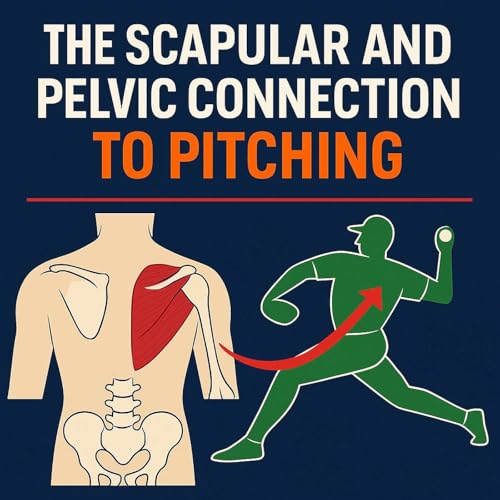
  • The Scapula and Pelvic Connection to Pitching
    Nov 24 2025

    Send us a text

    A pitcher’s arm shouldn’t need a full-body emergency to finish a throw, yet that’s exactly what we uncovered when a minor leaguer reached out about thoracic outlet symptoms, a past elbow fracture, and a velocity drop that got worse as outings wore on. The video told the story: a sharp pelvic pop at release, weight shifting back to the heel, and a short, guarded finish. The surprise was where the problem really started—not in the legs, but in the shoulder, where scapular rhythm had broken down and the upper traps were doing the wrong job at the worst time.

    We walk through the Game Test we use to map neurological sequence and then break down the shoulder coordination screen that revealed the truth. Above horizontal, his upper traps fired hard and early, the shoulder blades stalled and protracted, and the middle and lower traps—the true decelerators—went missing. When the scapula can’t glide down and in, the brachial plexus gets crowded and the arm can’t decelerate, so the nervous system recruits the pelvis to slam on the brakes. That protective pattern may save the joint but it steals velocity, consistency, and health. We dig into why “you can only accelerate what you can decelerate” isn’t a slogan; it’s the organizing rule of high-velocity throwing.

    Then we share the simplest fix most pitchers never try: isometric scapular depression. Supine, arms up, shoulder blades tucked down and toward the spine, five-second holds for high-quality reps. After 100 reps, our athlete threw and felt an immediate difference—clearer path, calmer finish, less stress, better carry. We also dispel a persistent myth that scapular depression causes thoracic outlet signs, and explain why shrug-heavy cues and screen-strained posture feed the exact pattern that closes the outlet and crushes performance. If you coach pitchers, rehab throwers, or fight late-inning velo fade, you’ll learn how to spot the pelvic “brake,” test shoulder rhythm, and activate the right decelerators so the arm can finally move fast without fear.

    If this resonated, subscribe, share with a teammate or coach, and leave a review. Want help fixing your sequence and saving your arm? Visit velocityrx.org and join the mission to help save one million arms.

    Support the show

    The Velocity Rx podcast mission is to help save one million arms by giving the very best mechanical, health, and arm care information to it's listeners.

    Voir plus Voir moins
    16 min
  • From Broken to Bulletproof: The Pattern That Saved a Pitcher’s Career
    Oct 27 2025

    Send us a text

    A high school pitcher was told to rest, stretch, and wait it out—yet every week hurt more than the last. We took a different route: test how he moves under real conditions, then rebuild the pattern from the ground up. What we found was simple and powerful. His upper traps were calling the shots, his lat was stuck in neutral, and his pelvis and scapula were speaking different languages. Once we taught the shoulder blade to depress and the hips to hinge, pain gave way to clean mechanics and confident throws.

    We walk you through the exact tests we used—the shoulder coordination test that exposes trap dominance, the squat screen that reveals pelvic control, and how serratus activation becomes the missing link for overhead athletes. You’ll hear why scapulohumeral rhythm matters for deceleration, how the lat connects shoulder and spine stability, and what changes when the body redistributes work from “always on” neck muscles to true stabilizers like lower traps and lats. The before-and-after details are striking: better thoracic extension, more space at end range, and a squat that preserves spinal curves while generating real force.

    From there, we map the training plan that stuck: high-rep scapular depression with serratus, a catcher squat that grooves hip hinge and lordosis, and a steady ramp of throwing volume to 300 pain-free towel and ball throws a week. Along the way, we tackle the bigger lesson for players and parents—ask why every drill exists, demand a clear cause-and-effect, and measure what matters. If imaging is clean but movement is noisy, the fix is in the pattern. Subscribe for more case studies, share this with a pitcher who needs a roadmap back to the mound, and leave a review with your biggest takeaway so we can keep saving arms together.

    Support the show

    The Velocity Rx podcast mission is to help save one million arms by giving the very best mechanical, health, and arm care information to it's listeners.

    Voir plus Voir moins
    24 min
  • UCL INJURY: The Non-Surgical Road Back
    Oct 20 2025

    Send us a text

    A frayed ligament doesn’t have to end a pitching career. We share a raw, real case study of a high school senior with a partial UCL tear who skipped injections, rebuilt his foundation, and came back throwing harder—with less pain. The story isn’t about a miracle drill; it’s about finally honoring how the shoulder blade and arm are supposed to move together and how that single truth can protect an elbow under stress.

    We start with an unexpected pivot: free throws. Hundreds of smooth shots helped restore full elbow extension, improve blood flow, and calm the brain’s protective reflex that turns a recovering arm into a guarded “lobster claw.” From there, we zoom in on scapular humeral rhythm—the backbone of safe, powerful overhead motion. When the upper trap dominates and the shoulder shrugs, the body loses clean deceleration, the ball leaves the glove too early, and the arm is forced to “throw uphill,” pushing unnecessary load straight to the UCL.

    Through side-by-side video and clear cues, we walk through how delaying hand break until foot strike, training scapular depression and retraction, and focusing on downhill acceleration transformed mechanics without chasing gimmicks. You’ll hear the simple tests that exposed the root cause, how deceleration capacity sets the ceiling for safe velocity, and why “build proximal to distal” is more than a slogan—it’s the roadmap to durable performance. The proof is in the outcomes: a safer arm path, better finish, cleaner layback, and a mound return with more velocity than before the injury.

    If you coach pitchers, parent a throwing athlete, or want to bulletproof your own elbow, this deep dive will sharpen your eye and your plan. Subscribe, share with a teammate who needs it, and leave a review with the worst cue you’ve ever heard—we might break it down on a future show.

    Support the show

    The Velocity Rx podcast mission is to help save one million arms by giving the very best mechanical, health, and arm care information to it's listeners.

    Voir plus Voir moins
    19 min
  • The Dangers of Layback: Why Pitchers Get Hurt, ft. Jason Colleran
    Oct 8 2025

    Send us a text

    Stop stretching the shoulder to a place it can’t control. We dig into the myth of “layback” and explain why forcing passive end range is a fast track to labrum wear, elbow pain, and shortened careers—especially for growing athletes. With inventor and coach Jason Colleran of Kinetic Arm, we unpack what actually builds safe velocity: thoracic extension, scapular depression, and pec extensibility that create a stable power position, plus foot and hip mechanics that unlock rotation without requiring the shoulder to bear the brunt of the load.

    We break down the difference between range of motion and available joint position, why timing and center of mass matter more than still photos, and how a simple change, such as externally rotating the back foot, can open “layback” from below rather than yanking from above. Jason shares how constraint-based training and the Kinetic Arm sleeve provide proprioceptive feedback, limit harmful passive extremes, and support post-op throwers rebuilding horizontal abduction and external rotation. We also focus on the scapulohumeral rhythm, avoiding upper trap dominance, and offloading stressed tissues, such as the supraspinatus, by improving the first degrees of abduction and upward rotation.

    Along the way, we call out the training culture that confuses volume with intention and protocols with precision. Maxing in passive ranges, cookie-cutter rehab, and viral cues that ignore structure all drive the injury epidemic. The fix is simple, not easy: assess daily, define a clear goal for each drill, align lines of force with anatomy, and teach athletes to own mid-range positions before they chase speed. When the chain is set—foot to hip to trunk to scapula—the arm stops compensating and velocity becomes a byproduct of efficiency, not a gamble with connective tissue.

    If you care about throwing harder and longer without sacrificing your shoulder or elbow, this one’s for you. Subscribe, share with a coach or parent who needs it, and leave a review with the biggest myth you want us to tackle next.

    Support the show

    The Velocity Rx podcast mission is to help save one million arms by giving the very best mechanical, health, and arm care information to it's listeners.

    Voir plus Voir moins
    43 min
  • Rebuilding a Pitcher's Arm: A 15-Year-Old's Journey Back from Elbow Injury
    Aug 2 2025

    Send us a text

    Ever wondered why so many young pitchers are suffering devastating elbow injuries? Dr. Kevin McGovern pulls back the curtain on the rehabilitation process with a fascinating real-time coaching session featuring 15-year-old Aiden, who's battling back from multiple elbow injuries.

    The episode reveals a revolutionary approach to arm care that challenges conventional wisdom. Rather than extended rest periods, we witness the power of daily throwing practice—with either baseballs or towels—combined with unconventional methods like basketball shooting to maintain elbow extension. Dr. McGovern methodically breaks down what he calls the "Tommy John formula"—three critical mechanical flaws destroying young pitchers' arms: drifting forward too early, dragging the back leg, and improper glove-hand technique.

    Through Aiden's transformation, viewers gain practical insights into proper mechanics that not only prevent injury but enhance performance. By maintaining weight back longer and releasing closer to home plate, pitchers create what baseball insiders call a "heavy ball" effect—making an 80mph fastball feel like 95mph to hitters. This case study provides a sobering reality check for parents and coaches: mechanical flaws aren't just performance issues; they're ticking time bombs for young arms. The rehabilitation timeline presented offers a realistic perspective on recovery, debunking quick-fix solutions and emphasizing patient, consistent work on mechanics.

    What's happening in youth baseball today? Overcoaching and poor mechanics are creating an epidemic of arm injuries. Watch this episode to understand the warning signs, learn proper rehabilitation protocols, and discover how daily work on sound mechanics can save your young pitcher's arm—and perhaps their baseball future. Visit velocityrx.org to learn more about preventing Tommy John injuries and keeping young arms healthy through proper mechanics.

    Support the show

    The Velocity Rx podcast mission is to help save one million arms by giving the very best mechanical, health, and arm care information to it's listeners.

    Voir plus Voir moins
    17 min
  • Why Modern Baseball Pitchers Can't Stay Healthy: A Deep Dive with Chris O'Leary
    Jul 17 2025

    Send us a text

    The alarming rate of arm injuries in baseball isn't just bad luck—it's the predictable outcome of fundamentally flawed mechanical approaches dominating the sport today. In this eye-opening conversation, Chris O'Leary returns to explain why modern pitchers can't stay healthy and what can be done about it.

    O'Leary presents compelling visual evidence of what he calls "Flat Arm Syndrome"—a timing problem where the pitching arm is parallel to the ground (not up) when the body begins rotating, creating devastating stress on the elbow and shoulder. Through detailed comparisons of classic pitchers like early-career Verlander, Nolan Ryan, and Tom Seaver with today's injured stars, he demonstrates how modern mechanics have fundamentally changed for the worse.

    The discussion doesn't just identify problems but explains their origins. The "Inverted W," "Tommy John twist," and other mechanical shortcuts promoted by velocity programs are systematically breaking down pitchers at all levels. Perhaps most troubling is how these flawed mechanics are being taught to young athletes as the path to success, creating a pipeline of arm injuries waiting to happen.

    What makes this conversation particularly powerful is O'Leary's predictive track record. He's correctly identified injury risks in numerous pitchers before they broke down, including Sandy Alcantara and Spencer Schwellenbach. These aren't coincidences but the result of understanding how mechanical flaws inevitably lead to physical breakdown.

    The solution isn't complicated training protocols or exotic conditioning—it's about returning to fundamental athletic movements that work with the body's natural biomechanics rather than against them. As O'Leary puts it, "There's no free lunch" in developing velocity; sustainable speed must be built through patience and sound mechanics rather than shortcuts.

    Ready to understand baseball's injury epidemic and protect the arms of the next generation? Listen now and discover why the difference between healthy and injured pitchers often comes down to just a few critical mechanical distinctions that anyone can learn to identify.

    Support the show

    The Velocity Rx podcast mission is to help save one million arms by giving the very best mechanical, health, and arm care information to it's listeners.

    Voir plus Voir moins
    56 min
adbl_web_global_use_to_activate_DT_webcro_1694_expandible_banner_T1