Épisodes

  • Jyoti Bansal on the Builder's Playbook for Repeatable Success
    Jan 14 2026

    Jyoti Bansal, Founder & CEO of Harness, Traceable, and Unusual Ventures, joins host Mudassar Malik to discuss the ideas and lessons that have shaped each of his companies. He begins with the transition from engineer to founder, describing how a “burning passion” to solve a specific engineering challenge pushed him toward building a product, and ultimately a business. Jyoti also shares the investor question that led him to quit his job and commit to AppDynamics, along with the early rejections that forced him to refine his pitch and validate the problem.

    From there, he explains why product excellence is only half of the equation, and why matching that with a strong go-to-market is essential. Jyoti outlines how both AppDynamics and Harness expanded: first by winning a single, focused use case, then by adding new capabilities once the foundation was proven. This leads into his view that platforms work only when every module is best-of-breed, and why customers won’t accept integrated but mediocre tools.

    Jyoti and Mudassar then dig into Harness’s “startup within a startup” model. Each module operates like an internal venture with its own product leader as “startup CEO,” responsible for product quality, revenue, and customer success. Jyoti explains why Harness avoids bundling, how internal startups are funded, which signals guide new investments, and how small teams, increasingly AI-enabled, allow for faster experimentation at lower cost.

    He closes with the lessons he carried forward from earlier startups, including building impressive technology without business justification, hitting growth limits when the addressable market stays narrow, and watching strong products struggle under high sales costs. His final advice: solve a problem you care about, make sure the market cares as well, and focus relentlessly on delivering solutions that work for customers.

    Jyoti digs into topics like:
    - The investor question that changed everything
    - Product greatness vs. go-to-market reality
    - Turning one use case into a platform
    - A startup-within-a-startup operating model
    - Why small teams build faster (especially with AI)


    Visit mobilelive.ca/podcast to learn more about each guest and read key insights for every episode.

    Voir plus Voir moins
    25 min
  • Mohammad Yousaf on the First 90 Days of Transformation
    Oct 9 2025

    Mohammad Yousaf, Chief of Operations and Technology at National Mortgage Insurance Corporation, joins host Mudassar Malik to discuss how trust, alignment, and disciplined technology choices drive lasting transformation in financial services.

    Mohammad traces his path from telecom engineering into banking and mortgage finance, explaining why he moved from building technology to shaping business strategy. He highlights how lessons from team sports shaped his leadership style, where trust and alignment aren’t just cultural values but the foundation for effective execution.

    The conversation turns to transformation in operations and technology. Mohammad cautions against chasing trends and stresses the importance of the first 90 days, identifying the right processes to change, involving underwriters and processors early, and co-creating solutions. He shares a practical example of a middleware upgrade that unlocked revenue growth once reframed around speed and customer impact, showing how technology decisions gain traction when tied directly to business outcomes.

    Closing the discussion, Mohammad outlines how leaders can build cultures that adapt quickly while managing legacy resistance, and why AI adoption must stay anchored in transparency and borrower-first principles. Throughout the episode, he offers a clear, grounded guide to balancing innovation with responsibility.

    Mohammad also explores:

    • Trust and alignment in execution
    • Defining transformation beyond buzzwords
    • The first 90 days of change
    • Turning middleware upgrades into revenue
    • Why AI must stay borrower-first


    Visit mobilelive.ca/podcast to learn more about each guest and read key insights for every episode.

    Voir plus Voir moins
    36 min
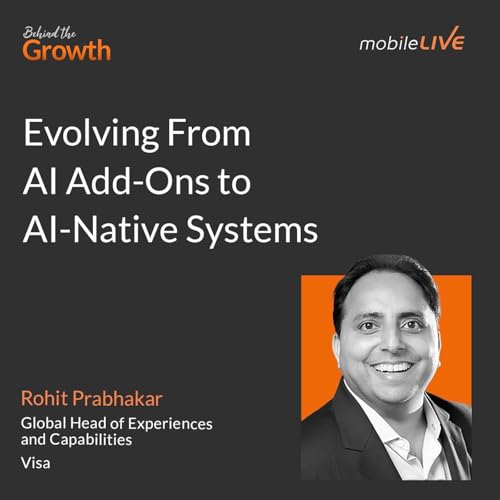
  • Rohit Prabhakar on Evolving From AI Add-Ons to AI-Native Systems
    Sep 18 2025

    Rohit Prabhakar, Global Head of Experiences & Capabilities at Visa, joins Mudassar Malik on Behind the Growth to explore how leaders can move from AI add-ons to AI-native marketing ecosystems that deliver hyper-personalized experiences at scale. With a career spanning technology, product, and marketing, Rohit grounds the discussion in two priorities: customer obsession and business enablement.

    He outlines a two-track AI adoption model: use AI as a partner to incrementally improve existing systems, while also reimagining processes from the ground up to remove legacy constraints. At the core is unified, high-quality data, breaking down silos so machine learning and large language models can work with accuracy and relevance.

    Rohit pinpoints content creation as the long-standing blocker to personalization at scale and explains why recent advances in generative AI make on-demand, context-specific assets achievable. He distills three essential building blocks for AI-native systems: connected data, robust machine learning, and LLMs.

    The conversation closes on leadership and change management. Rohit shares how small, empowered teams can drive transformation, why human oversight must remain in the loop with AI, and what marketing leaders should prioritise as expectations, speed, and productivity demands rapidly increase.

    Rohit dives into themes like:
    - Building AI-native marketing ecosystems
    - Overcoming personalization’s content bottleneck
    - Unifying customer data for scale
    - Structuring change through small wins
    - Keeping humans in the AI loop


    Visit mobilelive.ca/podcast to learn more about each guest and read key insights for every episode.

    Voir plus Voir moins
    32 min
  • Valerie McMurtry on Corporate Partnerships Creating Social Value
    Sep 4 2025

    Valerie McMurtry, President & CEO of Children’s Aid Foundation of Canada, joins Mudassar Malik on Behind the Growth to discuss how purpose-driven leadership, data, and partnerships are reshaping outcomes for children and youth in care. Drawing from her experience leading Canada’s largest charity in this space, Valerie explains how aligning mission, strategy, and innovation drives measurable change.

    The conversation begins with Valerie’s career journey from corporate marketing to the nonprofit sector. She shares how her upbringing shaped her focus on solving complex social issues and why she pursued work with deeper purpose. This background informs her leadership approach today, where she prioritizes long-term outcomes over short-term wins.

    Valerie then outlines the foundation’s mission: improving education, employment, mental health, and stability for young people who have experienced abuse, neglect, and abandonment. She explains why these priorities matter, the scale of the challenge in Canada, and how data guides funding decisions. She also discusses redefining success based on youth feedback, broadening it beyond traditional metrics to reflect individual progress.

    Finally, she highlights how the foundation has evolved from traditional philanthropy to testing new service models through social innovation and venture funding. Using examples like the TELUS Mobility for Good program, Valerie demonstrates how corporate partnerships can go beyond sponsorship to deliver real impact. She closes by urging business leaders to integrate social responsibility into their strategies, not as a side effort, but as a way to build stronger organizations and communities.

    Valerie dives into topics like:
    - Leaving corporate to find purpose
    - The hidden scale of child welfare
    - Why success metrics needed rewriting
    - Taking risks with social innovation
    - Building partnerships that actually work


    Visit mobilelive.ca/podcast to learn more about each guest and read key insights for every episode.

    Voir plus Voir moins
    39 min
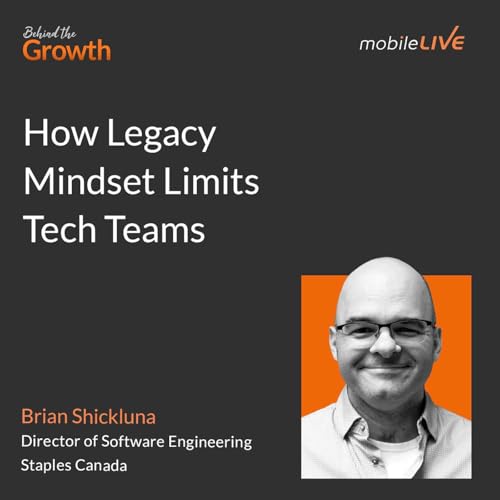
  • Brian Shickluna on How Legacy Mindset Limits Tech Teams
    Aug 14 2025

    Brian Shickluna, Director of Software Engineering at Staples Canada, joins Mudassar Malik on Behind the Growth to unpack the leadership principles and organizational design strategies that have shaped his career. Drawing on experience from startups to large enterprises, Brian shares what it really takes to build and scale high-performing engineering teams.

    The conversation begins with Brian’s reflections on his career path and how working across industries taught him the value of seeing beyond technical expertise. He explains why leaders need a breadth of perspective to guide teams effectively, especially as they move from hands-on roles to broader organizational influence.

    Further diving deep into the concept of “legacy mindset,” Brian explores why outdated thinking and overcomplicated processes often hold organizations back more than their tech stacks. He challenges common assumptions about transformation and describes how simplifying workflows and clarifying roles can unlock speed and agility at scale.

    Finally, Brian shares his approach to fostering a culture of experimentation, empowering teams to take ownership of their ideas, and avoiding the traps of micromanagement. He closes with practical insights on servant leadership, psychological safety, and why senior executives should prioritize structure and mindset as the foundation for sustainable growth.

    Brian unpacks topics like:
    - The silent risks of structural debt
    - Designing orgs that outlast people
    - Breaking out of micromanagement
    - Protecting engineers from alert fatigue
    - When structure beats great ideas


    Visit mobilelive.ca/podcast to learn more about each guest and read key insights for every episode.

    Voir plus Voir moins
    28 min
  • Naresh Babu on When Legacy Cores Become Black Boxes
    Jul 30 2025

    Naresh Babu, AI Technology Leader and Digital Transformation Specialist at mobileLIVE, joins Mudassar Malik to unpack the tough decisions behind core banking modernization. Together, they explore how leaders can balance customer demands, operational resilience, and the rising costs of legacy systems.

    Naresh shares how his early career as a COBOL developer shaped his understanding of resilience and why banks today must rethink their technology stacks to stay competitive. He highlights the primary drivers for modernization, including talent shortages, escalating OPEX, and shifting customer expectations, and contrasts how traditional and digital-first banks experience these pressures differently.

    The discussion dives into the pros and cons of incremental upgrades versus full system replacements, with Naresh offering practical frameworks for assessing risk tolerance and aligning modernization strategies with organizational workflows. He also warns against relying on satellite systems that create blind spots and long-term technical debt.

    Finally, Naresh examines how AI and cloud technologies are reshaping modernization efforts and why governance, KPI design, and a “customer downtime zero” mindset are critical for success.

    Naresh dives into topics like:
    - Rethinking customer expectations in banking
    - The true costs of legacy systems
    - When incremental upgrades backfire
    - AI tools in modernization strategies
    - The trap of satellite architectures

    Visit mobilelive.ca/podcast to learn more about each guest and read key insights for every episode.


    Visit mobilelive.ca/podcast to learn more about each guest and read key insights for every episode.

    Voir plus Voir moins
    29 min
  • Zahid Salman on Scaling Enterprise Innovation with Purpose
    Jul 16 2025

    Zahid Salman, President and CEO at GreenShield, joins Imran Mian on Behind the Growth to unpack the strategy behind building Canada’s first payer-provider platform, and how a nonprofit model is enabling innovation at enterprise scale.

    Zahid opens with the personal experiences that shaped his purpose-driven approach to leadership and shares how he moved from a traditional actuarial career into healthcare transformation. He breaks down GreenShield’s initial hypothesis: that Canadians would benefit from a single organization delivering both insurance and care. He further sheds light into how they moved early, acquiring eight companies in 18 months to accelerate the shift from coverage to service delivery during the pandemic.

    He also discusses the internal and external complexities of that pivot, from winning the trust of plan members and advisors to unifying employees behind a new mission. Zahid also shares how GreenShield Ventures helps the organization look beyond its near-term roadmap, building IP and capabilities around where the market is heading, not just where it is today.

    Throughout the conversation, Zahid reflects on how identity shapes leadership, why DEI remains central to GreenShield’s strategy, and what it takes to drive real impact in underserved communities. He closes with insights on AI's potential in proactive care, the growing role of private sector in delivering public healthcare, and the discipline required to scale without losing sight of purpose.

    Zahid also explores:
    - Diversifying with success
    - Betting on a model before demand
    - Gaining trust as a healthcare insurer
    - Scaling impact without chasing profit
    - The role of tech in unlocking M&A value


    Visit mobilelive.ca/podcast to learn more about each guest and read key insights for every episode.

    Voir plus Voir moins
    25 min
  • Janet Sherlock on Simplifying Org Complexities for Better Results
    Jul 3 2025

    Janet Sherlock, Founder & CEO at Org.Works, joins Mudassar Malik on Behind the Growth to challenge how most companies approach transformation, org design, AI strategy, and why their structures are often built to fail. Drawing from her executive experience and doctoral research, Janet breaks down what she calls “the hidden architecture” that shapes performance across every level of an enterprise.

    The conversation starts with a critique of role bloat at the top, like Chief Digital Officer, Chief Innovation Officer, Chief AI Officer, and how overlapping mandates erode clarity and accountability. Janet outlines how these roles are often a symptom of structural misalignment, not a solution to it. Introducing the Org.Works philosophy, “less but better,” she explains why simplicity, not complexity, is what drives resilience and execution.

    From there, the episode moves into the three most common org design pitfalls, using real-world examples like Unilever’s model shift and omnichannel challenges in retail and banking. Janet shares the telltale signs of structural dysfunction—misaligned KPIs, constant pre-meetings, unclear decision ownership—and why fixing these isn’t just about new titles or reorgs but about rethinking how teams are built to collaborate.

    The second half of the conversation dives into AI: not tools or talent, but structure. Janet introduces her CFD model: Center of Enablement, Federated AI and Modeling, Democratized Data. She elaborates on why governance, flexibility, and accountability matter more than hype.

    Finally, she breaks down how boards are shifting from AI education to execution, and why CEOs must stop chasing ROI and start investing in long-term capabilities.

    Janet explores topics like:
    - When org design creates friction
    - Why bloated C-suite roles backfire
    - The hidden cost of transformation layers
    - How structure drives AI performance
    - What boards now ask about AI


    Visit mobilelive.ca/podcast to learn more about each guest and read key insights for every episode.

    Voir plus Voir moins
    32 min
adbl_web_global_use_to_activate_DT_webcro_1694_expandible_banner_T1