Épisodes

  • Manufacturing Leaders: From "Positional" Authority to "Influential" Power w/ Amos Balongo
    Jan 21 2026
    Episode SummaryIn this episode of Thoughts on Selling, Lee Levitt sits down with Amos Balongo—a leadership expert joining us from Hawaii who is in the business of "manufacturing leaders." We dig into a critical failure point in most organizations: the gap between Strategy and Communication. Amos argues that many leaders rely on "Positional Leadership" (people follow you because they have to), which yields the bare minimum effort. The goal is to shift to "Influential Leadership," where collaboration drives results. We also explore the Three Pillars of Transformation (Motivate, Inspire, Transform), why simplicity mobilizes teams better than complexity, and how to apply Situational Leadership to ensure you aren't sending 5:00 AM texts to the wrong people. Memorable Quotes:"The bigger you're thinking, the smaller your problems." — Amos Balongo "Motivation is an outside job; Inspiration is an inside job." "Complexity impresses, but simplicity mobilizes. If your team can't understand the plan, they can't act on it." Three Actionable Takeaways for Leaders:Audit Your Leadership Style: Are you Positional or Influential? Positional leaders issue directives ("I told you to do this"). Influential leaders invite participation. If you find yourself saying, "Didn't I tell you to do this?" too often, you are relying on position, not influence. The "Motivate-Inspire-Transform" Framework: Don't stop at motivation. Amos explains the progression: Motivate (get them interested), Inspire (evoke internal drive), and Transform (give them actionable steps to multiply results). Leaving them just "inspired" without a plan is a wasted opportunity. Be Bold, Brief, & Strategic: If you struggle to get executive buy-in for your ideas (or if people keep stealing them!), change your delivery. Executives are time-poor. Cut the stories and focus on being bold, brief, and strategic to land your message. Key Topics & Timestamps:(00:00) – Introduction: Manufacturing Leaders in Hawaii. (06:30) – Positional vs. Influential: Why authority doesn't equal leadership. (11:00) – Simplicity vs. Complexity: Why complex plans fail to mobilize. (13:30) – The 3 Pillars: Motivate (External) vs. Inspire (Internal). (20:00) – Growth Mindset: Why "Goal-Oriented" thinking limits potential. (26:00) – Situational Leadership: Tailoring your communication style (and medium) to the person. (43:30) – Stolen Ideas: How to handle it when someone else takes credit for your work. About Our Guest:Amos Balongo is a leadership expert, speaker, and author of A Voice Empowered. He helps executives and organizations bridge the gap between "strategy" and "action" by manufacturing leaders who are exceptional communicators. Amos is also the host of the Journeys of Inspiration podcast. About the Host:Lee Levitt is a seasoned sales performance consultant, sales coach and the Principal of The Acelera Group.With decades of experience in Sales, Sales Leadership, Sales Enablement, Revenue Operations, and Sales Performance Management, Lee helps emerging and enterprise organizations build disciplined, replicable sales operating systems.He is the voice behind the Thoughts on Selling™ brand, covering the intersection of deal mechanics and the "Inner Game" of selling.Resources & Links:The Book: Transforming Your Life by Amos Balongo. The Podcast: Journeys of Inspiration. Connect with Amos: Visit AmosBalongo.com. Subscribe: Get the Thoughts on Selling newsletter at thoughtsonselling.com.Keywords:Leadership Communication, Situational Leadership, Amos Balongo, Organizational Strategy, Positional Authority, Growth Mindset, Employee Engagement, Executive Presence, Sales Leadership, Team Motivation.
    Voir plus Voir moins
    36 min
  • Escape the Sales Treadmill!
    Jan 13 2026

    I recently sat down with Pete Smith, a sales veteran and the founder of SpotLogic, to talk about a problem we are all feeling: The Treadmill.

    Sales organizations are cranking up the speed, flooding reps with tools that demand data entry rather than providing data insight. Pete shares his journey from the old-school days of NCR’s "Sugar Camp" (where they taught you how to dress) to building a tool simply because he needed a way to survive the cognitive load of modern selling.

    We discuss why 84% of enterprise deals die in the first meeting, why "winging it" has become a survival mechanism for overbooked reps, and how to earn the right to sit on the same side of the table as your buyer.

    Key Highlights & Takeaways:

    • The Origin Story: Pete didn't set out to build a startup. He built SpotLogic for himself because he felt he needed a "force multiplier" to handle complex deals. When he realized it made him twice as effective, his friends forced him to turn it into a company.

    • The "Insider" Threshold: There is a moment in every deal where the buyer decides you are no longer an outsider pitching a product, but an insider helping them solve a problem. If you don't cross that threshold, you are just "column fodder."

    • Discovery is Not a Phase: We agreed that treating discovery as a checkbox in the sales process is a death sentence. Discovery is a state of mind that starts before the first call and continues long after the contract is signed.

    • The "Pajama" Problem: We laughed about the shift from the suit-and-tie culture of NCR to the "socks are the new tie" reality of Zoom sales -- and the time Sun Microsystems had to remind reps not to film internal enablement videos in their PJs!

    • The Goldman Sachs Lesson: Pete shares a brutal story about losing a deal not because the product wasn't better (it was), but because the organizational risk of switching infrastructure was too high. It’s a masterclass in understanding the buyer's ecosystem, not just their pain points.

    Memorable Quotes:

    • "Customers buy from the reps who understand them best."Pete Smith

    • "Discovery is the most important part of the job in complex sales... No, it IS the job."Pete Smith

    • "I've got three critical meetings today. I prepared three hours for one of them. And I'm going to have to wing the other two."Pete Smith (quoting his son on the reality of modern sales)

    Call to Action:

    • Stop Winging It: Check out how SpotLogic helps reps reduce cognitive load and prep for meetings in minutes.

    • Connect with Pete: Reach out to Pete at pete@spotlogic.com.

    • Subscribe: If you enjoyed this deep dive into the psychology of buying, hit subscribe on Thoughts on Selling so you never miss an episode!

    Voir plus Voir moins
    39 min
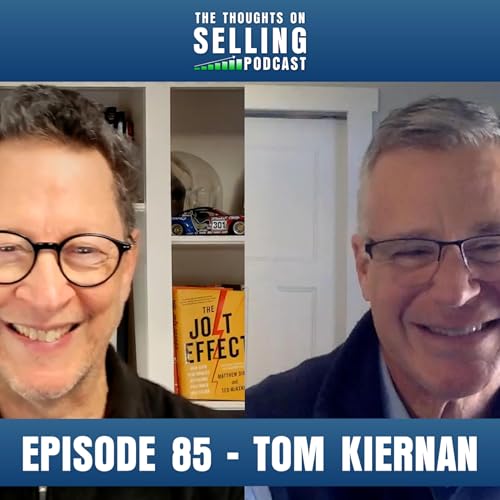
  • Training versus Enabling: The Reticular Activator, The "T-Word" and Lumpy Bones with Tom Kiernan
    Jan 7 2026

    For this episode of Thoughts on Selling, I sit down with my good friend and fellow sales enablement veteran, Tom Kiernan. Tom is a runner, a dad, and a practitioner who cut his teeth at powerhouses like American Power Conversion (APC) and Schneider Electric.

    We dive deep into the real difference between "training" (the forbidden T-word) and true enablement. Tom explains why the "Reticular Activating System" is the secret weapon for cutting through the noise in a prospect's brain, and we debate why sales organizations are so bad at the one thing that makes professional athletes great: Practice.

    We also touch on a topic close to Tom’s heart—his unique "Books as a Service" non-profit, Lumpy Bones, which helps kids (and adults) deal with difficult topics like cancer through humor and adventure.

    Key Findings & Takeaways:

    • The "T-Word" vs. Process: Tom argues that training is just an event, while enablement is a process. He shares lessons from the "Toyota Way" and how rigorous process management at APC set the stage for global success.

    • The Reticular Activating System (RAS): Ever hear your name over a loudspeaker in a crowded airport? That’s your RAS. Tom explains how "Other Centered Selling" triggers this same mechanism in buyers, stopping them in their tracks because you are talking about them, not your product.

    • The Purpose of Selling is Buying: We discuss why the goal isn't to sell, but to help the customer buy. When you shift your motive, you shift your results.

    • The Practice Deficit: Professionals practice; amateurs just play the game. We look at the stark contrast between how NFL teams or Broadway casts prepare versus how little practice happens in corporate sales.

    • Motive is Transparent: As Tom says, if you are only in it for the commission, it’s written on a "yellow sticky note on your forehead." Customers can smell commission breath a mile away.

    • Lumpy Bones: Tom shares his passion project, Lumpy Bones—a "Books as a Service" 501(c)(3) that gets inspiring children's books into classrooms for free through corporate sponsorship.

    Memorable Quotes:

    • "Motive is transparent. It's written right up on that yellow sticky that [is] slapped up onto your forehead."Tom Kiernan

    • "The best swing is the one that I didn't think about... I practiced to get there, but I just hit the ball."Tom Kiernan

    • "If you don't have a defined process, there's nothing to practice."Lee Levitt

    The Bottom Line:Sales enablement isn't just about teaching reps about new products; it's about building capabilities. Whether it's triggering a buyer's attention or building a coaching culture that actually coaches, success comes down to being "other centered."

    Call to Action:

    • Check out Tom's Book Series: Visit LumpyBones.com to see how Tom is bringing humor and life lessons to kids.

    • Connect with Tom: Find Tom Kiernan on LinkedIn.

    • Subscribe: If you enjoyed this conversation, hit subscribe on Thoughts on Selling so you never miss an episode!

    Voir plus Voir moins
    35 min
  • From Journalist to "Accidental Manager": Why New Leaders Fail (and How to Fix It) with Ben Perreau
    Dec 31 2025

    In this episode of Thoughts on Selling, I sit down with Ben Perreau, a recovering music journalist turned entrepreneur and leadership expert. Ben joins me from Los Angeles to discuss a problem that plagues almost every growing company: the "Accidental Manager."

    We explore Ben’s fascinating journey from the BBC newsroom to consulting for Fortune 50 C-suite executives, and why the transition from superstar Individual Contributor to Team Leader is the most dangerous leap in a career. We geek out on photography as a metaphor for leadership, discuss why we are all just "emotional meat sacks" trying to be professional, and dive into how his new company, Parafoil, is using AI-driven "listening circles" to help new managers survive their first year.

    Key Findings & Takeaways:

    • The "Man in the Arena": Ben shares how Theodore Roosevelt’s famous speech defined his transition from observing the world as a journalist to shaping it as an entrepreneur.

    • The Accidental Manager Crisis: A staggering 82% of early-career managers consider themselves "accidental"—thrust into leadership because they were good at their technical job, not because they were trained to lead.

    • Leadership vs. Photography: We discuss the difference between staying in "Auto Mode" versus mastering "Manual Mode." Great leaders, like great photographers, need to know the technicals but ultimately succeed through composition and vision.

    • The "Emotional Meat Sack" Reality: We try to breed emotion out of work, but we are emotional creatures. Ben argues that suppressing this leads to burnout and failure; effective leadership requires integrating your emotional self with your professional self.

    • Listening Circles: Ben highlights his new platform, Parafoil, which uses "Listening Circles" to create safe, high-trust environments where managers can practice feedback and difficult conversations without fear of judgment.

    Memorable Quotes:

    • "I think Ben Perreau... is a complex mix of dualities in search of trying to find the one version of myself in amongst all of that."Ben Perreau

    • "Never doubt that a small committed group of people can change the world. In fact, it's all it ever has."Ben Perreau (quoting Margaret Mead)

    • "There's a reason why 82% of early career managers consider themselves accidental managers. And there's a reason why a third of their teams leave within a year."Ben Perreau

    • "We've almost constructed... our own landscape to help us find our own way out of the sort of emotional meat sacks that we all are... but actually it's the counter narratives."Ben Perreau

    The Bottom Line:

    We often promote our best salespeople, engineers, or marketers into management and then abandon them. Ben’s work with Parafoil reminds us that leadership is a craft that must be practiced, not just a title that is bestowed. If you want to stop the churn of "accidental managers," you have to provide a safe space for them to fail, learn, and grow.

    Call to Action:

    • Stop the Churn: Are you an "accidental manager" or leading a team of them? Check out how Parafoil is changing the game.

    • Connect with Ben: Visit Parafoil.co or find Ben Perreau on LinkedIn.

    • Subscribe: Enjoyed this deep dive on leadership? Hit subscribe on Thoughts on Selling so you never miss a conversation.

    Voir plus Voir moins
    42 min
  • Scaling with Intelligence rather than Headcount, with Amos Bar-Jospeh
    Dec 23 2025

    In this episode of Thoughts on Selling, I sit down with Amos Bar-Jospeh, a third-time entrepreneur connecting from Tel Aviv. Amos describes himself as an "anti-capitalist capitalist" -- someone who has rejected the old "growth at all costs" unicorn playbook in favor of a new model: the Autonomous Business.

    We dive deep into why the "raise a shit ton of money and hire 40 people before revenue" model is broken. Instead, Amos is building Swann, a company designed to scale with intelligence rather than headcount. We explore the concept of Human-AI collaboration (not replacement), why sales is a zero-sum game of attention and budget , and why the future of software isn't about "record and report," but about adaptive systems that wear the shape of your workflow.

    Key Findings & Takeaways:

    • The "Unicorn Playbook" is Dead: The era of raising massive capital before finding product-market-fit is over. Amos advocates for scaling companies by discovering the "100x version" of each employee through AI augmentation rather than just adding bodies.

    • Sales is a Zero-Sum Game: Attention and budget are finite. If everyone uses the same AI SDRs to spam the same buyers, no one wins. Success comes from being different, not just better, which requires human creativity.

    • Zone of Genius: The goal of AI isn't to replace the human but to automate everything outside their "zone of genius" so they can focus on high-value interactions.

    • The New Software Paradigm: We are moving from static software (like traditional CRMs) to adaptive software that learns your specific habits and feedback loops. It’s not about "more features" -- it’s about software that re-tailors itself to you every single day.

    • System Interactions to Zero: For 20 years, CRMs promised to help us sell but became reporting burdens. The future is reducing system interactions to zero so sellers can spend 100% of their time on buyer interactions.

    Memorable Quotes:

    • "I’m an anti-capitalist capitalist... I’ve realized... that playbook [growth at all costs] is not for me."Amos Bar-Jospeh

    • "It's a business that is designed to scale with intelligence, not with headcount."Amos Bar-Jospeh

    • "The future belongs to organizations that... turn each person on the team into their 100X version of themselves."Amos Bar-Jospeh

    • "We need to understand... not the AI replacing the AE, it's the AI taking the review process of that AE specifically, formalizing it and repeating it."Amos Bar-Jospeh

    The Bottom Line:We are entering an era where "software" as we know it -- static tools we have to feed data into -- is becoming obsolete. The new winners will be organizations that master Human-AI Collaboration, creating feedback loops that allow AI to handle the mundane while humans drive the strategy.

    Call to Action:

    • Audit Your Stack: Are your tools "recording and reporting" or are they actually adapting to your workflow? It might be time to demand more from your software.

    • Join the Movement: Subscribe to Amos’s newsletter, The Big Shift, to follow the journey of building an autonomous business.

    • Experiment: Try out Amos’s digital clone, "Autonomous," in the ChatGPT store to ask your own questions.

    • Connect: Find Amos Bar-Jospeh on LinkedIn (he has over 30k followers for a reason!)

    Voir plus Voir moins
    38 min
  • Beyond the Chatbot: How Agentic AI is revolutionizing Sales with Garth Fasano
    Dec 16 2025

    For this episode of Thoughts on Selling, Garth Fasano joins me to discuss the massive shift happening in inside sales.

    Garth Fasano is an ETA (Entrepreneurship Through Acquisition) entrepreneur and leader of a high-growth startup focused on autonomous sales.

    From sailing mishaps in Long Island Sound to the complexities of call center Erlang models, We discuss the evolution of the "inside sales" role and explore how "Agentic AI" is moving beyond simple decision trees to becoming the top-performing sales agent—one that is fully caffeinated and ready to sell 24/7.


    Key Findings & Takeaways:

    • The "Best Day" Every Day: The biggest advantage of Agentic AI isn't just automation; it's consistency. Customers want the best agent on their best day, not an agent who is 175 calls deep at 5:00 PM.

    • Small Business is Leading the Charge: Unlike enterprises bogged down by legacy CRM integrations, small businesses are adopting autonomous sales faster. They need to capture leads instantly (e.g., a 3 AM water damage call) without the owner having to answer the phone while working a job.

    • Visibility as a Service: Autonomous agents don't just sell; they provide "visibility as a service." Instead of a business owner guessing why sales are down, the AI can proactively report, "Conversion is down 10% because of price objections."

    • The End of "Typing While Talking": Traditional inside sales requires reps to juggle rapport building while furiously typing data into a CRM. Agentic AI removes this friction, capturing data instantly and allowing for better customer interaction.

    • Bot-to-Bot Commerce: The future is already here. We are seeing "agentic to agentic" conversations, such as Google's AI calling businesses to check pricing and availability on behalf of consumers.

    Memorable Quotes:

    • "They want them at their 9am fully caffeinated self ready to rock and roll, not their 5pm, 175 calls deep... self." — Garth Fasano

    • "A sales call that's scripted... That's not how sales work. That's not how people buy." — Garth Fasano

    • "Google knows how you search... Open AI knows what you're using this information for... we're going to start to know why customers are buying." — Garth Fasano

    Connect with Garth:

    • LinkedIn: Garth Fasano

    • X (Twitter): @GarthFasano


    Voir plus Voir moins
    38 min
  • The Future of Sales is Looking Bright: Meet NISC Finalist and Super Star Nina Iannuzzi!
    Dec 9 2025

    What do selling gum in the 5th grade and playing defense in hockey have in common with enterprise sales? According to Nina Iannuzzi, everything.

    In this episode, I sit down with Nina, a sophomore at the Isenberg School of Management (UMass Amherst) and a top-5 finalist at the recent National Intercollegiate Sales Competition (NISC). We relive the chaos of "speed selling" in a gym filled with 1,000 suits, discuss how to handle a curveball question from a CFO, and laugh about the moment I rudely interrupted her final sales pitch with a fake phone call.

    Nina brings an infectious energy that proves the future of sales is in very good hands. Whether you are a student, a sales leader, or just someone who appreciates the hustle, you will love her take on why "sucking it up" is the only way to win.

    Key Highlights & Takeaways:

    • The Slime Economy: Nina’s sales career didn’t start at UMass; it started in 5th grade selling slime and gum to classmates.

    • Defense Wins Championships: As a hockey player for 16 years (Left D!), Nina treats walking into a sales room like a puck drop: you know your job, now go execute.

    • The "Scope" Stumble: Nina shares a vulnerable moment where a buyer kept asking about "scope," a term she wasn't fully sure how to handle in the moment. Her retrospective advice? Don't fake it—ask a clarifying question immediately.

    • The Plot Twist: I threw a wrench in her final round by bursting in with a "phone call." Nina stayed so locked in she almost kicked me out of the room before realizing the "emergency" was just a timer on my iPhone!

    • The Contract Slide: Nina admits her main goal wasn't just to chat—she literally slid a physical contract across the table at the 4-minute mark. Always be closing!

    • Suck It Up, Buttercup: Her coach’s advice for sports and sales: if a lace breaks or a deal stalls, you don't call an Uber. You fix it and keep running.

    Memorable Quotes:

    • "I’m a very big talker. I’m competitive... I started my first business in like fifth grade, just selling like slime and gum." — Nina Iannuzzi

    • "You get in that room and... you sit down and you're like, I am SpotLogic... I almost wanted to act like we were friends." — Nina Iannuzzi

    • "Suck it up buttercup or move on to bigger and better things." — Nina Iannuzzi

    Closing Thought:If you think the next generation of sales talent is "soft," you haven’t met Nina. Her "suck it up, buttercup" attitude is a wake-up call for seasoned professionals who might have gotten a little too comfortable. Nina proved that you don't need 20 years of experience to have sales instincts—you just need the courage to slide the contract across the table.

    Next Steps:

    • Challenge Yourself: Take a page out of Nina's playbook this week. Be bold, ask the clarifying question, and don't let a "fake phone call" derail your pitch.

    • Get Involved: Want to see this talent in action? Look into judging or sponsoring a collegiate competition like NISC.

    • Connect: Follow Nina Iannuzzi on LinkedIn to follow her journey from UMass to the C-Suite.


    Voir plus Voir moins
    45 min
  • The Invisible Manager: Coaching, Scaling & Making Yourself Obsolete w/ Sean Gannon
    Dec 5 2025
    Episode SummaryIn this episode of Thoughts on Selling, Lee Levitt sits down with Sean Gannon, founder of GTMPPL (GTM People), to answer the "unanswerable" question: Who is Sean Gannon?We dive into a refreshing (and controversial) take on Sales Leadership: why the best managers strive to make themselves obsolete. If your team can't function without you, you aren't leading—you're hovering. From the trenches of EdTech to the nuances of Sandler Training, Sean shares candid stories about the transition from "spreadsheet inspection" to true coaching. We also share a hilarious cautionary tale about what happens when a salesperson sticks to the script even after the customer has said "yes."Memorable Quotes:"I view my role as a sales manager to make myself obsolete. I should be relatively invisible." — Sean Gannon"Your job is to sell the meeting... not to sell the company, not to sell the solution." — Sean Gannon"The best sales enablement... you don't know what's being done to you. You don't know what's being done for you." — Lee Levitt3 Actionable Takeaways for Leaders:The "Obsolete" Standard: Your goal is to build a team so competent they don't need you to close the deal. If you are constantly swooping in to save the quarter, you are failing at scale.Stop "Spreadsheet Inspection": Sean shares how shifting his focus from inspecting metrics to coaching behaviors increased his team's retention from 18 months to 36 months. Stop asking "What's the number?" and start asking "How can I help you get there?"Read the Room (The Sandler Trap): We discuss a painful example of a rep who kept running the "Sandler Pain Funnel" even after the buyer said they were ready to sign. Lesson: When you get the "Yes," stop selling and start contracting.Key Topics & Timestamps:(00:00) – Introduction: Who is Sean Gannon?(05:15) – The "Obsolete" Manager: Why the best leaders strive to become invisible.(12:30) – Sales vs. Marketing: Dismantling the "throw it over the wall" lead mentality.(19:45) – Coaching vs. Inspection: How to double your team's tenure through mentorship.(27:00) – The "Script" Horror Story: Why you must stop the process when the customer says "Yes."(34:10) – Everyone Sells: Why CSMs, SDRs, and even internal staff need sales skills.(41:00) – Authenticity Wins: Why "I don't know" is a powerful trust-builder.About Our Guest:Sean Gannon is the Founder of GTMPPL (GTM People), a community and consultancy focused on the people side of Go-To-Market strategy. With a deep background in EdTech sales and leadership, Sean is an advocate for human-centric management. He specializes in helping organizations move from rigid "command and control" structures to coaching cultures that drive long-term revenue and retention.About the Host:Lee Levitt is the Principal of The Acelera Group and a seasoned sales consultant. With decades of experience in Sales Enablement, RevOps, and Performance Management, Lee helps enterprise organizations build disciplined, replicable sales operating systems.He is the voice behind the Thoughts on Selling™ brand.Related Episodes:Ep [Prev]: The Accidental Manager Crisis w/ Ben Perreau: More on the transition from rep to leader.Ep [Prev]: Why Sales Training Fails w/ Tom Kiernan: The difference between "events" and "process."Resources & Links:Build Your Revenue Engine: Visit GTMPPL.com.Connect with the Guest: Find Sean Gannon on LinkedIn for his latest industry observations.Subscribe: Get the newsletter at thoughtsonselling.com.Keywords:Sales Leadership, Sales Management, GTM Strategy, GTMPPL, Sandler Training, Sales Coaching, Employee Retention, RevOps, Sales vs Marketing, Go-to-Market, EdTech Sales, B2B Sales Strategy, Deal mechanics, Sales Psychology
    Voir plus Voir moins
    38 min