Épisodes

  • Roman Itskovich on What Businesses Get Wrong About Cyber Risk
    Apr 22 2026

    Roman Itskovich, Co-founder & CRO at At-Bay, joins Mudassar Malik on Behind the Growth to unpack how cyber risk has evolved into a primary business risk—and why traditional approaches to managing it are no longer sufficient. Roman traces his path from military and fintech into cyber, highlighting how increasing reliance on technology has shifted risk from the periphery to the core of enterprise operations.

    He explains why cyber risk behaves differently from other forms of risk. Unlike static business risks, technology environments are constantly changing, and so is the level of exposure. That shift requires a fundamentally different approach—one that goes deeper than surface-level indicators like industry or revenue, and instead focuses on understanding the underlying technology stack in detail.

    Roman introduces At-Bay’s “insure-sec” model, which combines insurance with active security. Rather than simply underwriting risk based on limited inputs, this model continuously evaluates and improves a company’s security posture. He breaks down the two principles behind this approach: the need for technical visibility to assess risk accurately, and the ability to actively intervene to reduce that risk over time.

    The conversation highlights how this model changes the role of insurance—from a static transfer of risk to a more dynamic system that informs better decisions. For enterprise leaders, it reframes how to think about cyber risk, not just as something to mitigate, but as something that can be measured, managed, and priced with greater precision.

    Roman covers topics like:
    - Cyber risk as business risk
    - Technology stack risk visibility
    - Insurance and security convergence
    - Dynamic vs static risk models
    - Underwriting beyond surface metrics


    Visit mobilelive.ca/podcast to learn more about each guest and read key insights for every episode.

    Voir plus Voir moins
    26 min
  • Ben Volkwyn on Why Dashboards Alone Don’t Drive Decisions
    Apr 8 2026

    Ben Volkwyn, Senior Vice President of Data, Analytics & Research at Triumph, joins Mudassar Malik on Behind the Growth to discuss what it actually takes to turn data from a reporting function into a real driver of business decisions. Rather than focusing on dashboards or tooling, Ben explains why the real shift happens when organizations connect data directly to operational workflows and the decisions people make every day.

    The conversation begins with an unexpected lens: endurance sports. Ben shares how principles like pacing, consistency, and long-term discipline shape how he approaches leadership and building data teams. Just as athletic performance comes from sustained effort rather than one intense session, he argues that building an effective data function is a long game driven by repeatable habits, clear priorities, and steady trust with stakeholders.

    From there, Ben reflects on lessons learned working across industries and markets. Early in his career, he assumed that dashboards would naturally lead to better decisions. Over time, he discovered that what actually drives decisions is trust, speed, and whether insights are tied to someone’s real work. More data doesn’t automatically create clarity either; in many cases, fewer signals tied to a clear decision can be more valuable than large volumes of reporting.

    Ben also explains how leaders can move their organizations beyond the “data equals reporting” mindset. Instead of building more dashboards, he recommends focusing on one critical operational decision and redesigning it around data. When data becomes part of the decision itself—not just a report about what already happened—it starts to compound value across the business.

    Ben explores topics like:
    - Consistency over intensity in leadership
    - Why dashboards don’t drive decisions
    - Data embedded in operational workflows
    - When less data improves insight
    - Turning reporting into decision engines


    Visit mobilelive.ca/podcast to learn more about each guest and read key insights for every episode.

    Voir plus Voir moins
    21 min
  • Mike Bruno on Overcoming Change Management Friction
    Mar 25 2026

    Mike Bruno, AVP of Digital at Co-operators, joins Imran Mian on Behind the Growth to unpack what digital transformation really looks like inside a large, regulated financial services organization and why it’s far more than launching a new platform or redesigning a website. Mike explains how enterprise transformation is layered, closely governed at the executive level, and ultimately anchored to one outcome: improving the client experience through coordinated, enterprise-wide change.

    Early in the conversation, Mike digs into one of the most persistent friction points in transformation efforts: change management. Drawing on experience across multiple organizations, he explains why resistance is often rooted not in unwillingness, but in uncertainty, loss of control, and unclear communication. He outlines practical approaches leaders can take, like repetition, tailored messaging, and direct one-on-one conversations, to help teams adapt without burning trust or momentum.

    Mike then shares a concrete example from a CMS implementation that nearly stalled when legacy applications surfaced unexpected dependencies. Rather than forcing a one-size-fits-all solution, his team slowed down, brought stakeholders together, and made pragmatic trade-offs, sunsetting some applications, creating temporary fixes for others, and preserving trust across the enterprise while keeping the project on track.

    Mike also shares his views on digital hygiene, prioritization, and leadership under uncertainty. He breaks down why clear communication, disciplined execution, and knowing how much effort is “enough” are foundational to staying aligned in complex environments. Throughout the discussion, Mike emphasizes practical decision-making over theory, offering grounded lessons for leaders navigating legacy platforms, constrained budgets, and constant change.

    Mike dives into topics like:
    - Enterprise change beyond platforms
    - Change management as transformation friction
    - Hidden legacy system dependencies
    - Digital hygiene in execution
    - Prioritization under constant change


    Visit mobilelive.ca/podcast to learn more about each guest and read key insights for every episode.

    Voir plus Voir moins
    32 min
  • Saeed Shamsi on Sovereign AI Data Centers in Canada
    Mar 11 2026

    Saeed Shamsi, Director of Engineering and AI Factory Lead at TELUS, joins Mudassar Malik on Behind the Growth to break down what it takes to build enterprise AI infrastructure that can ship fast, compliant, and within Canada’s regulatory boundaries. He opens by grounding the conversation in TELUS’s evolution beyond telecom, and why its expansion into data-driven businesses made sovereign AI a practical necessity, not a future bet.

    Saeed explains why TELUS refers to its infrastructure as an “AI factory,” describing it as a system that turns power, cooling, and compute into usable intelligence at scale. He walks through how TELUS retrofitted existing Canadian data centres with GPU clusters designed to support model training, fine-tuning, inferencing, and modern AI applications without forcing customers into a single model, stack, or hyperscaler dependency.

    The discussion then shifts to the problem facing Canadian enterprises: the gap between Canada’s AI talent and its lack of domestic compute. Saeed outlines why data residency, jurisdictional control, and regulatory compliance are critical for sectors like healthcare and financial services. He also explains how TELUS is addressing these constraints while giving startups and enterprises room to move, iterate, and retain their IP.

    To close, Saeed gets specific about architecture and execution, from adopting NVIDIA’s reference designs to validating performance through global benchmarks. He looks ahead to scaling sustainable, sovereign AI infrastructure so Canadian organizations can compete globally without exporting their data, decisions, or innovation.

    Saeed unpacks topics including:
    - Sovereign AI infrastructure in Canada
    - AI factories and GPU compute
    - Data residency and regulation
    - Enterprise AI performance benchmarks
    - Sustainable, renewable-powered data centres


    Visit mobilelive.ca/podcast to learn more about each guest and read key insights for every episode.

    Voir plus Voir moins
    31 min
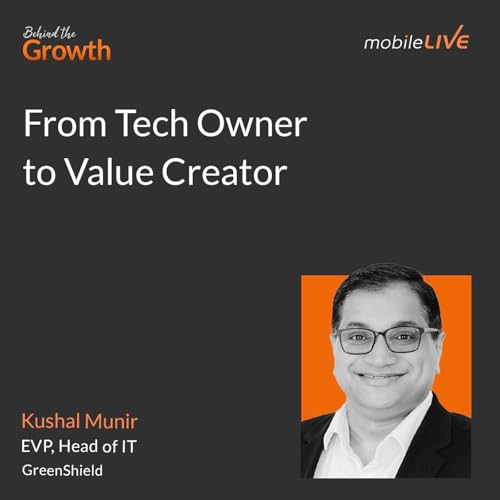
  • Kushal Munir on Evolving From Tech Owner to Value Creator
    Feb 27 2026

    Kushal Munir, Executive Vice President and Head of IT at Green Shield, joins Imran Mian on Behind the Growth to unpack what it really takes to turn emerging technology, especially generative AI, into measurable business value inside complex, regulated organizations. The conversation traces Kushal’s career from early startup and IBM roles into enterprise leadership, and how shifting from purely technical execution to outcome-driven leadership reshaped the way he approaches technology, teams, and decision-making.

    Kushal walks through a real-world GenAI use case at Green Shield focused on improving member care. Rather than centering on models or tools, he explains why success came from defining business outcomes early, embedding governance and safety upfront, and integrating AI directly into existing workflows. He emphasizes that GenAI only scales when business partners are involved from day one and when solutions are designed to fit how people already work, not as standalone experiments.

    The discussion then moves into the harder parts of AI adoption: managing hype, setting realistic expectations, and navigating risk in healthcare and insurance. Kushal shares how a fast but disciplined crawl-walk-run approach, paired with early investment in an AI Centre of Excellence, helped build trust across the organization. He also explains why involving legal, privacy, security, and compliance teams as co-designers, not late-stage approvers, creates the conditions for responsible innovation without slowing momentum.

    Closing out the episode, Kushal reflects on leadership lessons shaped by past technology bets, including early cloud adoption, and shares how he cuts through AI noise today. His focus remains consistent: clarity over complexity, alignment over speed for its own sake, and anchoring every technology decision to real business value for customers and employees alike.

    Kushal breaks down:
    - Why AI expectations break teams
    - When governance speeds execution
    - Making GenAI work in practice
    - Customer experience over internal hype
    - Why clarity drives momentum


    Visit mobilelive.ca/podcast to learn more about each guest and read key insights for every episode.

    Voir plus Voir moins
    20 min
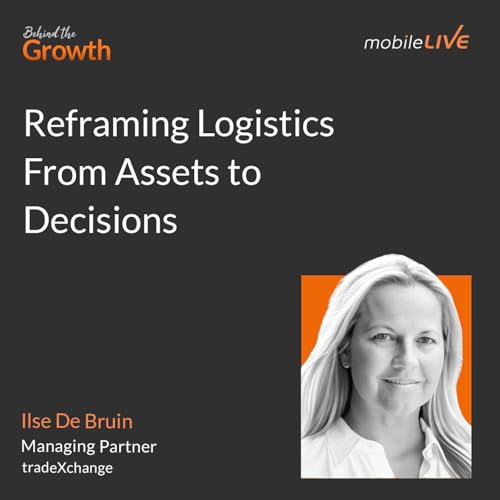
  • Ilse De Bruin on Reframing Logistics From Assets to Decisions
    Feb 11 2026

    Ilse De Bruin, Managing Partner at Trade Exchange, joins host Mudassar Malik on Behind the Growth to break down how logistics and supply chain leaders are navigating a world where volatility is no longer episodic, but constant. Drawing from real operating environments, Ilse explains why today’s disruptions, like tariffs, trade policy shifts, and capacity constraints, are forcing enterprises to rethink how decisions get made, not just how systems are built.

    The conversation reframes logistics from asset orchestration to decision orchestration. Ilse explains why owning infrastructure matters less than the ability to interpret signals, simulate trade-offs, and act quickly under pressure. She makes a clear distinction between digitization and intelligence, outlining why visibility alone doesn’t move the needle unless systems can surface impact, prioritize action, and support judgment in real time.

    At the ground level, Ilse gets practical about where customer experience breaks down. She describes how unclear ownership, fragmented handoffs, and slow exception handling force customers to chase answers. Offering a solution, she details how leading organizations reduce friction by standardizing decision thresholds, aligning teams around shared context, and embedding decision support directly into daily workflows. An example of airline disruption management shows what consequence-aware operations look like when done well.

    The episode closes with a grounded take on AI as Ilse cuts through the hype around full autonomy to explain where AI is actually creating value today, and why context, interoperability, and human judgment still matter. For enterprise leaders, Ilse offers a clear-eyed look at how to modernize complex operations without losing control, trust, or accountability.

    Ilse also shares her views on:
    - Why volatility in supply chain never settles
    - Owning assets is no longer the advantage
    - How digitization quietly fails
    - Why customers chase clarity
    - The limits of AI autonomy


    Visit mobilelive.ca/podcast to learn more about each guest and read key insights for every episode.

    Voir plus Voir moins
    37 min
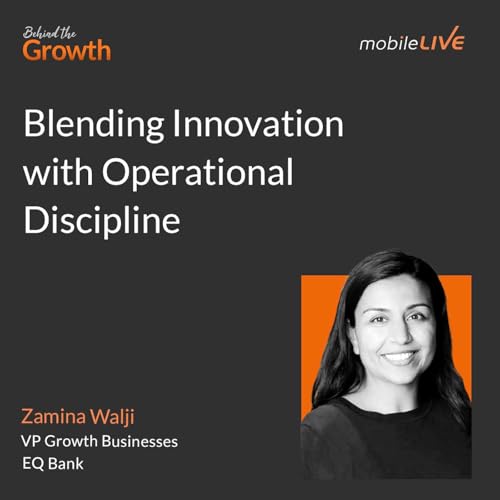
  • Zamina Walji on Blending Innovation with Operational Discipline
    Jan 28 2026

    Zamina Walji, VP Growth Businesses at EQ Bank, joins host Imran Mian on Behind the Growth to talk about how she builds scalable systems, accountable teams, and a culture of innovation inside one of Canada’s most forward-thinking digital banks.

    Drawing from her experience across consulting, retail, and financial services, Zamina explains how customer obsession remains her constant growth driver. She describes the balance between structure and speed, how accountability, process, and standardization enable agility rather than slow it down, and why involving risk and compliance early helps teams move faster with confidence.

    The conversation dives into how EQ Bank uses AI as a practical growth lever, applying it to customer experience, underwriting, marketing, and compliance. Zamina shares her focus on next-phase innovation—AI-powered lead generation and automation that scale responsibly without losing sight of human judgment and customer value.

    She also talks about leadership and culture: hiring people who thrive in both startup and enterprise environments, setting bold goals that unlock creativity, and maintaining clarity in decision-making. Her approach for navigating transformations offers a grounded view of how to blend innovation with operational discipline, and how to keep customer experience at the centre of it all.

    Zamina also explores:
    - When risk and compliance drive growth
    - Accountability as a path to scale
    - Where AI delivers true business value
    - Building teams for speed and depth
    - Focus as a leadership advantage


    Visit mobilelive.ca/podcast to learn more about each guest and read key insights for every episode.

    Voir plus Voir moins
    24 min
  • Jyoti Bansal on the Builder's Playbook for Repeatable Success
    Jan 14 2026

    Jyoti Bansal, Founder & CEO of Harness, Traceable, and Unusual Ventures, joins host Mudassar Malik to discuss the ideas and lessons that have shaped each of his companies. He begins with the transition from engineer to founder, describing how a “burning passion” to solve a specific engineering challenge pushed him toward building a product, and ultimately a business. Jyoti also shares the investor question that led him to quit his job and commit to AppDynamics, along with the early rejections that forced him to refine his pitch and validate the problem.

    From there, he explains why product excellence is only half of the equation, and why matching that with a strong go-to-market is essential. Jyoti outlines how both AppDynamics and Harness expanded: first by winning a single, focused use case, then by adding new capabilities once the foundation was proven. This leads into his view that platforms work only when every module is best-of-breed, and why customers won’t accept integrated but mediocre tools.

    Jyoti and Mudassar then dig into Harness’s “startup within a startup” model. Each module operates like an internal venture with its own product leader as “startup CEO,” responsible for product quality, revenue, and customer success. Jyoti explains why Harness avoids bundling, how internal startups are funded, which signals guide new investments, and how small teams, increasingly AI-enabled, allow for faster experimentation at lower cost.

    He closes with the lessons he carried forward from earlier startups, including building impressive technology without business justification, hitting growth limits when the addressable market stays narrow, and watching strong products struggle under high sales costs. His final advice: solve a problem you care about, make sure the market cares as well, and focus relentlessly on delivering solutions that work for customers.

    Jyoti digs into topics like:
    - The investor question that changed everything
    - Product greatness vs. go-to-market reality
    - Turning one use case into a platform
    - A startup-within-a-startup operating model
    - Why small teams build faster (especially with AI)


    Visit mobilelive.ca/podcast to learn more about each guest and read key insights for every episode.

    Voir plus Voir moins
    25 min